Arthurian Mythology List


Welcome to the Mythopouch list of Arthurian mythology entries! We also delve into the early history of Britain, Wales, and the Celtic and medieval traditions that shaped the Arthurian world. From kings, queens, knights and mages to castles, quests, monsters, artefacts, weapons, enchanted objects, creatures and more, this collection will continue to grow over time. Mythopouch provides real-world background and mythological information drawn from early chronicles, Welsh tales and medieval romances such as: the Welsh Triads, Culhwch and Olwen, the Historia Brittonum, the Annales Cambriae, Geoffrey of Monmouth, Chrétien de Troyes, the Lancelot-Grail or Vulgate Cycle, Sir Gawain and the Green Knight, and Thomas Malory’s Le Morte d’Arthur. Arthurian legend carries powerful ideas about courage, honour, loyalty, temptation, sacrifice, prophecy, betrayal and the dream of a better kingdom - messages passed from storyteller to storyteller for centuries, many of which still speak to modern life. Our unique imagery is meant to capture the imagination and ignite the Arthurian spark within us all. Our “token mark” coin symbol assigned to each record is a visual representation of the entity, for use in Mythopouch learning modules and games.
"Nothing is given, everything is earned" at Mythopouch!
Learn - Earn - Play
Arthurian Entity Quick Index
Our current list of ancient British mythology (Arthurian) and ancient history entities are here -
which are growing day by day!
Search by using the:
-
"Search Mythology Records" function to browse all mythology records and blog pages;
-
Browse the visual cards with overviews by clicking "Go to Visual A-Z";
-
Or just browse and click the A-Z entries below....
Arthurian Entity Card Index
See more entries

Aethlem
Aethlem is the wind-swift hound of Arthurian legend, one of the enchanted dogs whose speed was said to match a gust of wind and whose hunting prowess was always triumphant. It is the hound that Culhwch needed to hunt Twrch Trwyth, the Irish king transformed by God into a venom-bristled boar as punishment for his sins. It is the dog that ran beside Aned, its fellow hound, across the length of Britain from Ireland to Wales to Cornwall, never tiring in the greatest boar hunt ever recorded in Welsh story. It is the beast that vanished into the western sea alongside the boar it pursued, chasing Twrch Trwyth into the waves until neither hound nor boar nor hunting companion was ever seen again. And it is the reminder that in the oldest Arthurian tales, even the dogs were wonders, creatures of supernatural speed and unending determination, whose names were spoken with the same reverence as the heroes they ran beside.

Agravain (Sir)
Sir Agravain is the knight who spoke the truth that destroyed the Round Table, the second son of King Lot of Orkney and the nephew of King Arthur, whose hatred of Lancelot armed him with the one weapon no sword could parry. He is the brother of Gawain, Gaheris and Gareth, and the half-brother of Mordred, born into the blood-feud of the Orkneys, who rode with his brothers to the slaying of King Pellinore and stood in the press when Sir Lamorak fell. He is the whisperer at the king's ear, who named openly what all Camelot suspected and none would say: that the queen loved the greatest knight in the world. He is the leader of the twelve knights who surrounded the queen's chamber in the night and cried traitor at the door, and who died there by Lancelot's own hand, the first blood of the ending. And he is the most uncomfortable figure of the legend's last act, the villain who was right, whose malice proved more destructive than the sin it exposed.

Alier (Count)
Count Alier is the marauding knight whose campaign of plunder against Lady Noroison became the first test of a restored Yvain, the mad knight returned to sanity by a magic ointment and a lady's mercy. He is the lord who led knights and foot soldiers in a war of burning and laying waste, who struck at a castle's defences while its people armed themselves in haste, and who found himself outmatched by a single warrior whose heart had been broken and whose mind had wandered the wilderness like a beast. He is the false wounded who feigned injury to escape the battlefield, only to be caught at the foot of his own high hill fort with no one left to lend him aid. He is the captive who surrendered his helmet, his shield, and his naked sword, who swore by his faith to live in peace and restore every loss he had caused. And he is the reminder that in Arthurian romance, even the villain who burns a lady's lands may become, by the end of a single afternoon, a penitent who rebuilds what he has destroyed.

Ambrosius
Ambrosius is the hinge on which the Arthurian age turns, the last of the Romans and the first hope of the Britons, a man so real that the earliest source knows him and so legendary that no two sources agree on who he was. He is the Ambrosius Aurelianus of Gildas, the gentleman of the purple whose parents were slain in the Saxon storm, under whom the broken Britons found their courage again and began the long fight-back that ended at Mount Badon. He is King Aurelius Ambrosius of Geoffrey of Monmouth, the brother of Uther Pendragon, who burned the usurper Vortigern in his tower, broke Hengist at Maisbeli, set Merlin to raise Stonehenge as the monument of the murdered, and died by poison at Winchester. He is Emrys Wledig in the Welsh tradition. The fatherless boy of the Historia Brittonum, brought to Vortigern to be sacrificed beneath a falling tower, who revealed the red and white dragons fighting in the pool at Dinas Emrys, is a separate figure later fused with him: that boy is the child Emrys who becomes Merlin, not the war-leader Gildas named. And he is the shadowy Roman who may stand behind the very figure of Arthur himself.

Aned
Aned is the breath-swift hound of Arthurian legend, the companion whose name may carry the echo of the Welsh word for breath or life itself, and who ran as one half of a matched pair across the greatest boar hunt in Welsh story. It is the dog that Ysbaddaden the Giant demanded alongside Aethlem, its fellow hound, to track Twrch Trwyth, the Irish king turned into a venom-bristled boar by divine wrath. It is the beast that crossed from Ireland to Wales to Cornwall without faltering, keeping pace with Aethlem through gorse and mountain and river mist, two hounds moving as a single breath. It is the hunter that vanished into the western sea when the chase finally ended, swallowed by the same waves that took the boar and its fellow hound, never to be seen by mortal eyes again. And it is the reminder that in the oldest Arthurian world, even the unnamed shadows of legend had their moment of glory, and that the companion who runs beside the hero is sometimes as vital as the hero himself.

Anna
Anna is the sister of King Arthur, the only daughter of Uther Pendragon and Igraine, and the mother of the two nephews who would shape the fate of Britain more than any other kin of the king. She is the girl whose birth was foretold by Merlin when a dragon-shaped comet split in the sky, promising that her descendants would hold the kingship of Britain in succession. She is the princess given in marriage to King Lot of Lothian, the northern warlord who would become both Arthur's ally and his enemy. She is the mother of Gawain, the greatest knight of the early Round Table, and of Mordred, the son who would rise in rebellion and deal Arthur his mortal wound. She is the woman who, in one Latin romance, loved Lot in secret before their wedding and sent her firstborn son away in a casket with a royal ring and a parchment proving his lineage. And she is the figure who vanished from the later legends almost entirely, her name and her story swallowed by the enchantress Morgause, so that most modern readers have never heard of the sister who stood beside Arthur at the beginning of everything.
Arawn
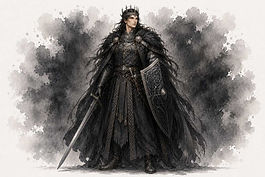
Arawn is the king of Annwn, the Welsh Otherworld, the lord who rules the realm beyond the mortal world where time moves differently and the dead do not age. He is the hunter whose white hounds with red ears, the Cwn Annwn, run through the autumn skies chasing souls and stags alike. He is the king who traded bodies with Pwyll, prince of Dyfed, for a year and a day, trusting a mortal man to defeat the rival who had oppressed him for ages. He is the lord whose wife was approached by Pwyll in Arawn's own form, yet Pwyll refused her, and Arawn rewarded that honour with undying friendship rather than wrath. He is the ruler of a paradise, not a hell, a land of eternal youth and feasting that was later darkened by Christian scribes who could not imagine an afterlife without punishment. And he is the king whose memory survives in a single Welsh saying: long is the day, and long is the night, and long is the waiting of Arawn, a proverb that speaks of patience beyond mortal measure and a reign that outlasts empires.

Arthur (King)
King Arthur is the central figure of the Matter of Britain, a legendary monarch who, according to medieval chronicles and romances, united the British people against Saxon invaders and established a golden age of chivalry. The earliest references to Arthur appear in Welsh poetry, notably the Y Gododdin (c. 600 CE) and the Historia Brittonum (c. 829 CE) by Nennius, where he is described as a military leader rather than a king. Geoffrey of Monmouth's Historia Regum Britanniae (c. 1136) provides the first comprehensive biography, establishing many of the elements that would define Arthur's legend for centuries.
Arthur's significance extends beyond the historical question of whether a real person lies behind the legend. He embodies the ideal of rightful kingship, the dream of national unity, and the moral aspirations of the chivalric code. The stories of his birth, his sword Excalibur, the Knights of the Round Table, and his final battle at Camlann form one of the most enduring narrative cycles in Western literature.

Astolat
Astolat is the castle and city near Camelot where the most famous tragedy of unrequited love in Arthurian legend unfolded, the home of Sir Bernard and his daughter Elaine, the Fair Maid of Astolat, who died for love of Sir Lancelot and floated down the river to Camelot in a white barge with a lily in her hand. It is the place where Lancelot stayed before a great tournament, where he accepted a maiden's red sleeve upon his helmet, and where he was nursed back to health from wounds that should have killed him. It is the castle whose daughter's devotion was so absolute that she refused all food and drink after Lancelot rejected her, pining to death in ten days and leaving a letter that accused no one but confessed everything. It is the town that gave Tennyson his "Lady of Shalott," the island tower and the curse and the mirror, though the poet moved the scene to a more remote and mysterious setting. And it is the Arthurian location that Thomas Malory identified with Guildford in Surrey, a real English town that still stands beside the River Wey, a place where the boundary between history and legend has always been as thin as the water's surface.

Avalon
Avalon is the enchanted island at the edge of the Arthurian world, the Isle of Apples where Excalibur was forged and where King Arthur was carried, mortally wounded, after the last battle at Camlann. It is the island ruled by Morgen, the great enchantress and healer, and her eight sisters, where orchards bear fruit without sowing, where no plough is needed and no winter comes, and where the people live a hundred years and more. It is the destination of the black barge with the weeping queens that came out of the mist to take the dying king from the shore, and the bower where Morgan le Fay promised to heal his wounds if he would stay with her for long ages. It is the island that the monks of Glastonbury claimed to prove in 1191, when they dug up a hollowed oak and a leaden cross naming Arthur in the isle of Avalon. And it is the last hope of the Arthurian legend, the place where the once and future king sleeps or heals, waiting for the day of Britain's greatest need.

Balan
Balan is the brother of Balin le Savage, the knight who bore two swords and dealt the Dolorous Stroke, and he is the other half of the most tragic fratricide in Arthurian legend. He is the knight who found his brother weeping by the bodies of Lanceor and Colombe, who rode with him to capture King Rience and to victory at the battle of Terrabil, and who was called by King Arthur one of the two most marvellous knights in the world. He is the warrior who killed a cursed knight on an island bridge and was trapped in his place, condemned to challenge every traveller who passed. He is the man who looked at his opponent's two swords and thought he knew his brother, but the strange shield convinced him otherwise, and so he fought his own flesh and blood to the death. He is the brother who died first, crawling on his hands and knees to remove his brother's helm, and who was buried in a single tomb with the man he had loved most. And he is the reminder that in Arthurian story, even the best knights can be destroyed by a borrowed shield and a moment's doubt.

Balin
Balin is the Knight with the Two Swords, the ill-fated hero of Arthurian legend whose every good intention ended in catastrophe, from the beheading of the Lady of the Lake to the Dolorous Stroke that laid waste to a kingdom and doomed the Grail quest before it began. He is the Northumberland knight who spent six months in Arthur's prison for killing a cousin of the king, who drew a cursed sword from its scabbard when no other knight at court could move it, and who ignored the damsel's warning that the blade would cause him to slay the man he loved most in the world. He is the warrior who delivered the most terrible blow in Arthurian romance, striking King Pellam with the Spear of Longinus in self-defence and bringing the castle down around them both, turning the fertile land of Listenois into the Wasteland that would fester until Galahad came to heal it. He is the brother who fought his own twin, Sir Balan, to the death without recognising him, the two men killing each other in mutual combat because one wore unfamiliar armour and the other had traded his shield. And he is the knight whom Merlin declared would have been Arthur's best and bravest had he lived, a man of peerless prowess cursed by a sword he refused to surrender.