Egyptian Mythology List


Welcome to the Mythopouch list of Ancient Egyptian mythology entries! We also delve into the ancient history of Egypt, the Nile Valley and the wider world shaped by its gods, temples, tombs and pharaohs. From gods, goddesses, queens, pharaohs and sacred animals to monsters, symbols, artefacts, creatures, places, funerary objects and more - this collection will only grow over time. Mythopouch provides real-world information extracted from original source material and ancient records such as the Pyramid Texts, Coffin Texts, Book of the Dead, temple and tomb inscriptions, the Rosetta Stone, the Memphis Decree, the Metternich Stele, and classical accounts such as Plutarch's writings on Isis and Osiris. Ancient Egyptian words, symbols and stories carried powerful messages about life, death, truth, balance, magic, kingship, resurrection and the journey into the afterlife - many of which still resonate deeply in modern times. Our unique imagery is meant to capture the imagination and ignite the magic mythology spark within us all. Our "token mark" coin symbol that is assigned to each record is a visual representation of the entity, for use in Mythopouch learning modules and games.
"Nothing is given, everything is earned" at Mythopouch!
Learn - Earn - Play
Egypt Entity Card Index
See more entries

Abtu
Abtu is the sacred fish that swims before the solar barque of Ra, the sun god, acting as the eternal lookout who alerts the divine crew to danger before it strikes. It is the golden voice that screams warnings across the dark waters of the underworld, giving the gods time to ready their spears against the serpent Apep, the demon of chaos who attacks the sun boat each night. It is the namesake of Abydos, the most sacred city of the dead, where Osiris, the god of the dead and resurrection, and the earliest pharaohs of Egypt were laid to rest. It is the fish into which the goddess Isis transformed herself, becoming Abtu, Great Fish of the Abyss, to work her magic in the depths. It is the creature whose very name meant "west" to the ancient Egyptians, the direction where the sun dies each evening and enters the realm of the dead. And it is the fish that ordinary Egyptians once used in medical recipes and protective spells, a creature both sacred and practical, bridging the gap between the gods and daily life.

Akhekh
The akhekh is a rare and obscure winged hybrid creature of Egyptian mythology, whose name derives from the Egyptian word kkw, meaning "darkness." Unlike the more commonly depicted composite beasts of the Egyptian pantheon, the akhekh appears only sporadically in artistic and textual sources, leaving much about its nature and significance uncertain. Its very etymology signals an intimate connection with the nocturnal and liminal - the realm of shadows where solar order gives way to chaotic potential.
Depicted as a quadrupedal creature with bird's wings, the akhekh is most consistently associated with the god Set and his domains: darkness, the western desert, chaos, and water. It appears to have functioned either as an ally of Set or as an incarnation of the god himself, serving as a symbol of pharaonic military might during the New Kingdom.
Akhenaten
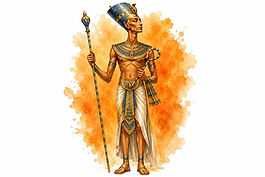
Akhenaten is the heretic pharaoh who threw out a thousand years of Egyptian religion and staked his throne on a single god, the Aten, the blazing sun disk whose rays end in tiny hands. He is the king born Amenhotep IV who erased his own name, closed the temples of Amun, the hidden king of the gods whose priests had grown richer than the crown, and had the old god's name chiselled off monuments across the land. He is the husband of Nefertiti, the queen whose painted bust is the most famous face of ancient Egypt, and the father of Tutankhamun, the boy king whose golden tomb outshines every other royal grave on earth. He is the builder of Akhetaten, a shining new capital raised on empty desert at Amarna and abandoned to the sand within a generation, and the poet of the Great Hymn to the Aten, one of the oldest religious poems in existence. He is the pharaoh who was erased from his own history, his image hacked from temple walls, his sanctuaries pulled down stone by stone, his memory cursed as the criminal of Akhetaten. And he is the man some call the world's first monotheist, a visionary three thousand years ahead of his time, whose one-god experiment died with him and has haunted the imagination of the world ever since.

Ammit
Ammit is the Devourer of the Dead, the monstrous beast who crouched beside the scales of judgement waiting to eat the hearts of the damned. She is the most terrifying creature in the Egyptian underworld, a hybrid of the three deadliest animals of the Nile world: the head of a crocodile, the forebody of a lion, and the hindquarters of a hippopotamus. She is the enforcer of the second death, the annihilation that swallowed a soul so completely that it ceased ever to have existed. She is the silent watcher in the most famous scene in Egyptian art, the weighing of the heart from the Book of Going Forth by Day, the collection of spells that guided the dead through the underworld. She is the demon no Egyptian ever worshipped, with no temple, no cult, and no offerings, for she was not a goddess to be loved but a fate to be escaped. And she is the purest image of conscience ever created: the monster that only the guilty heart could feed.

Amun-Ra
Amun is the Hidden One, the god of wind and mystery who rose from obscurity to become King of the Gods and the supreme deity of Egypt's golden age. He is Amun-Ra, the fusion of the hidden Theban lord with Ra, the ancient sun god, a union that placed him above every other god in the empire's greatest era. He is the owner of Karnak, the largest temple complex ever built, whose Great Hypostyle Hall holds one hundred and thirty-four stone columns like a petrified forest. He is the oracle who chose pharaohs from the crowd, the divine father that Hatshepsut, the woman who ruled as king, claimed in stone, and the power whose High Priests grew so rich they ruled Egypt outright, provoking one heretic king to try to erase his name forever. He is the ram-headed god of Nubia who sent the Kushite kings marching north to conquer Egypt in his name. And he is Zeus Ammon of the Greeks, the desert oracle who greeted Alexander the Great as a son, whose curling horns live on in every ammonite fossil and in the very word ammonia.

Anat
Anat was not a fish. The identification of "Anat" as a "sacred fish" in some modern creature lists is a confusion, likely arising from conflation with other deities or from corrupted source compilation. Anat was in fact a major Canaanite war goddess who was adopted into Egyptian religion during the Second Intermediate Period (Hyksos era) and rose to particular prominence in the New Kingdom, especially under Ramesses II. Her true nature is well documented: she was a fierce, independent goddess of warfare, hunting, and - paradoxically - fertility and sexuality.
Originating in the Ugaritic pantheon of Late Bronze Age Syria (c. 1450-1200 BCE), Anat appears extensively in cuneiform texts as the sister and devoted ally of Baal, the storm god. In these texts she is depicted as a terrifying warrior - slaughtering enemies, wading through blood, and even defeating Mot, the god of death. When her cult transferred to Egypt, she retained these martial attributes while being syncretised with Egyptian deities including Set and Min.

Androsphinx
The androsphinx is the Egyptian sphinx with a human head - the form that most people envision when they hear the word "sphinx." The term itself is a modern scholarly designation derived from Greek anēr/andros ("man"), distinguishing this type from the criosphinx (ram-headed) and hieracosphinx (hawk-headed) variants. Every major human-headed sphinx in Egypt represents a pharaoh, making the androsphinx essentially a royal portrait in leonine form.
The most celebrated example is the Great Sphinx of Giza, believed to depict Pharaoh Khafre of the Fourth Dynasty (c. 2558-2532 BCE). With its human head bearing the royal nemes headdress atop a massive lion's body, the Giza androsphinx exemplifies the fusion of human wisdom and divine kingship with animal strength and protective power that defines the type.
Ankh
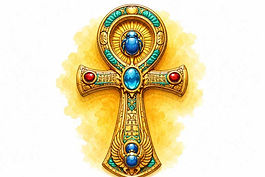
The ankh (anx, 𓋹) is simultaneously a hieroglyphic sign, a divine attribute, a protective amulet, and one of the most enduring symbols ever created by human civilization. As a hieroglyph, it simply means "life" - but in Egyptian theology, it represented far more than biological existence. The ankh embodied the totality of life force, including the promise of eternal life in the afterworld. Gods were believed to possess ankhu (life-force) that they could transmit to mortals, and the ankh was the physical manifestation of that divine transmission.
The symbol appears on virtually every category of Egyptian artifact: temple reliefs, tomb paintings, royal regalia, jewelry, seals, pottery, and papyri. When a deity holds the ankh to a pharaoh's lips or nostrils in Egyptian art, this represents the "breath of life" - the divine vivification that sustains and renews. The ankh is one of humanity's oldest continuously recognized symbols, predating the Christian cross by millennia, and it remains one of the most widely recognized symbols from any ancient civilization today.

Anubis
Anubis is one of the most ancient and visually distinctive gods of the Egyptian pantheon, depicted as a man with the head of a black jackal (or, in recent zoological understanding, the African golden wolf) or as a full jackal recumbent upon a shrine-shaped pedestal. His Egyptian name, Anpu or Inpw, may derive from a root meaning "to decay" or "to putrefy," linking him to the very process of bodily decomposition that mummification was designed to arrest. For millennia, Anubis stood as the paramount guardian at the boundary between life and death - the original psychopomp who escorted souls through the perilous transition into the afterlife. Before the rise of the Osiris cult during the late Old Kingdom (c. 2400-2200 BCE), Anubis was himself the chief god of the dead, retaining this primacy even in the earliest royal tombs of the First Dynasty.
Anubis's black coloration holds profound symbolic meaning in Egyptian thought. Rather than representing evil or malevolence, black signified the fertile black silt deposited by the Nile's annual inundation - a substance of renewal, regeneration, and transformation. It also alluded to the dark resins used in the embalming process, making Anubis a figure not of death's finality but of death as a transformative threshold. His role expanded across Egyptian history from sole lord of the dead to an essential collaborator in the Osirian drama: the divine embalmer who performed the first mummification, the impartial technician who operated the scales of judgement, and the compassionate guide who led justified souls into the presence of Osiris.
Apep
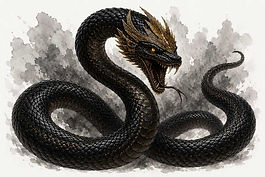
Apep is the serpent of chaos who attacks the sun boat of Ra every night, the eternal enemy who seeks to swallow the sun and plunge the world into darkness forever. It is the demon that lurks in the waters of Nun, the primordial ocean that surrounds the world, waiting for the moment when the sun god descends into the underworld at sunset. It is the creature against whom the Egyptians carved protective spells on every tomb and temple wall, the monster whose name was cursed in rituals designed to bind and destroy it. It is the serpent that Set, the red-haired god of storms and the wasteland, fought beside the barque of Ra with his iron spear, and that Horus, the falcon god who won the throne of Egypt from his uncle's grip, struck with his divine weapons. It is the embodiment of isfet, the force of disorder that threatened to unravel maat, the sacred balance that kept the cosmos alive. And it is the eternal adversary, the proof that creation is not a single event but a daily battle that must be won again every night.

Apshait
The apshait is a malevolent creature of Egyptian funerary theology, appearing in Spell 36 of the Book of the Dead as a flesh-eating beetle or insect that threatens to consume the body of the deceased in the afterlife. Its Egyptian name, transliterated ꜥpšꜣyt, incorporates hieroglyphic determinatives depicting a beetle or insect, underscoring its identity as an entomological threat to postmortem preservation.
In Egyptian belief, the integrity of the physical body was essential for eternal survival. The deceased needed their body to be preserved in order for the ba (soul) and ka (life force) to reunite and achieve resurrection in the Field of Reeds. The apshait represented a direct attack on this necessity - a force of corruption and decay that could destroy the physical vessel upon which immortality depended.

Bastet
Bastet is among the most beloved and widely venerated goddesses of the Egyptian pantheon, celebrated as the divine protector of the home, the guardian of women and children, and the patron of fertility, music, dance, and joy. Her most distinctive attribute - the feline head of a domestic cat - represents one of the most fascinating transformations in Egyptian religious history. Originally, Bastet was a fierce lioness-headed warrior goddess known simply as Bast, a solar deity associated with the destructive power of the sun god Ra and the vengeful Eye of Ra. Over the course of millennia, particularly during the Twenty-second Dynasty (c. 945-715 BCE), she underwent a remarkable evolution: from savage lioness to graceful domestic cat, reflecting profound shifts in Egyptian society, warfare, and domestic life. This transformation gave her a dual nature that made her uniquely accessible - both a gentle nurturer and, when provoked, a formidable protector.
The city of Bubastis in the Nile Delta served as the epicenter of Bastet's cult, and her annual festival there was renowned throughout the ancient Mediterranean world. Herodotus, the Greek historian who visited Egypt in the 5th century BCE, described the Bastet festival as one of the most lavish celebrations in Egypt, attracting hundreds of thousands of pilgrims who traveled by river barge, playing music, dancing, and drinking wine in joyful abandon. The very name "Bubastis" derives from the Egyptian Per-Bast - "House of Bastet" - underscoring the goddess's identity as a divine guardian of the household and all that it contained. Yet Bastet's protective sphere extended far beyond the physical walls of a house; she safeguarded the secrets of women, presided over childbirth and fertility, and warded off evil spirits and contagious diseases.