Details
Region
Arthurian
Regional Information Additional (if applicable)

British
Category
Person
Historicity (actuality or factual truth of persons, events, and claims)
Legendary
Gender
Male
Time Period
5th-6th centuries CE (mythic period); literary tradition c. 1469-1485 CE
Symbol
Shield gate
Tags
arthurian, black-knight, percard, hero, gareth, beaumains, lynette, castle-dangerous, round-table
Introduction - Overview
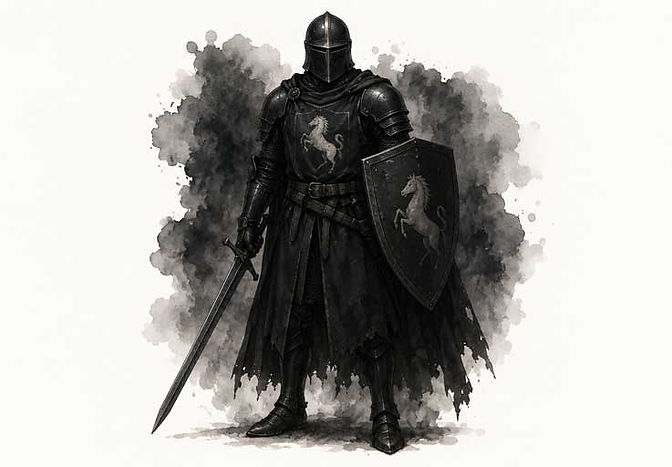
The Black Knight, Sir Percard, is the first of four brothers encountered by Sir Gareth of Orkney while Gareth travels under the name Beaumains with Dame Lynette towards Castle Dangerous. Percard waits at a black lawn marked by a black hawthorn, a black banner, a black shield, a long black spear, a black horse and a black stone, while he himself is armed completely in black.
Believing Beaumains to be no more than a kitchen servant, Percard intends to unhorse him and claim his horse and armour. Gareth declares that he is a gentleman of higher lineage than Percard and insists that he will pass. Their encounter becomes a deadly fight: Percard’s spear breaks, Gareth drives his own spear through Percard’s body, and the Black Knight continues fighting with his sword before collapsing and dying.
Gareth then takes Percard’s black armour and horse. This causes Percard’s brother Pertolepe to mistake the approaching rider for him, beginning Gareth’s successive encounters with Pertolepe the Green Knight, Perimones the Red Knight—later commonly distinguished as the Puce Knight—and Persant of Inde, the Blue Knight.
Gallery
Main Article - Who or What was...
Percard
Sir Percard appears in Thomas Malory’s Le Morte d’Arthur during the adventure commonly known as the Tale of Sir Gareth. Gareth has already revealed his identity to Sir Lancelot and been knighted by him, but he continues to travel publicly under the name Beaumains, the mocking name Sir Kay gave him when he first arrived at Arthur’s court. Kay then placed him in the royal kitchen, where he remained for twelve months before claiming the adventure.
Gareth is accompanying Dame Lynette, who has travelled to Arthur’s court seeking a champion to rescue her sister, Dame Lionesse, from the siege of Castle Dangerous. Lynette does not yet know Gareth’s true identity and continues to dismiss him as a kitchen servant despite the victories he has already won during their journey.
Near evening, Gareth and Lynette reach a black lawn. Malory fills the setting with the colour black: a black hawthorn bears a black banner and shield, while nearby stand a long black spear, a black horse covered with silk and a black stone. Beside them sits a knight entirely armed in black harness. He is initially called the Knight of the Black Lawn and is later identified as Sir Percard.
Lynette tells Percard that Beaumains is merely a kitchen knave who has attached himself to her against her wishes. Percard nevertheless observes that the young man looks strong and likely to be of good birth. He declares that he will knock Beaumains down, take his horse and armour, and separate him from the lady without otherwise harming him.
Gareth refuses to surrender either Lynette or his equipment. He tells Percard that he is a gentleman by birth and of higher lineage than the Black Knight, although he still refuses to reveal his true name. The two knights then charge one another with their spears.
Percard’s spear breaks during the collision, while Gareth’s spear passes through both sides of the Black Knight’s body and also breaks, leaving part of the shaft lodged in him. Despite this terrible wound, Percard draws his sword and continues fighting. He strikes Gareth with powerful blows and wounds him severely, but after approximately an hour and a half Percard falls from his horse in a swoon and dies.
Gareth sees that Percard is well armed and mounted, so he removes his own equipment and puts on the Black Knight’s armour. He also takes Percard’s shield and horse before continuing after Lynette. Lynette still refuses to give Gareth proper credit, claiming that Percard’s death occurred through misfortune rather than through Gareth’s skill.
The black armour immediately affects the next encounter. When a knight dressed entirely in green sees Gareth approaching, he initially believes that the rider is his brother Percard. Lynette then reveals that Beaumains has killed the Black Knight. The Green Knight identifies the dead man as Sir Percard and challenges Gareth to avenge him.
Percard’s surviving brothers are Sir Pertolepe the Green Knight, Sir Perimones the Red Knight—commonly distinguished in later summaries as the Puce Knight—and Sir Persant of Inde, whose colour is described as Inde and is generally represented as blue or indigo. Gareth defeats all three, but unlike Percard, each yields and is spared.
When the surviving brothers later appear at King Arthur’s court, Percard’s death is treated as a genuine loss. Pertolepe explains that Gareth killed him honourably in a direct encounter with a spear. Arthur and several of his knights call Percard’s death a great pity, and Malory states that all four brothers had been well known at Arthur’s court as noble knights, although they had long been at war with members of the Round Table.
Percard is therefore not simply an anonymous obstacle. He is the first of the four brothers encountered by Gareth, the only brother who dies during the sequence, and the knight whose black armour visually connects the succeeding battles. His death provokes Pertolepe’s demand for vengeance and begins the chain through which the surviving brothers are defeated, reconciled with Gareth and eventually brought into Arthur’s fellowship.
Summary
Sir Percard is the Black Knight of the Black Lawn and the first of four brothers encountered by Sir Gareth during his journey with Dame Lynette. Surrounded by black arms, banners and equipment, he underestimates the young knight known as Beaumains and attempts to take his horse and armour.
Percard is mortally wounded in their fight but continues battling for approximately an hour and a half before dying. Gareth takes his black armour and horse, causing Pertolepe the Green Knight to mistake him for his fallen brother. Percard’s death begins Gareth’s encounters with the remaining three brothers and becomes an important early test in Gareth’s rise from the mocked kitchen servant Beaumains to one of Arthur’s recognised knights.
Now enter the Mythopouch World!
You’ve discovered:
Percard
From Myth to Game
Join to access FREE real-world mythology "Learn Quests" and "Courses". Sign up to the newsletter for new releases, game updates, insider news, and more as Mythopouch brings real mythology to life. EARN the right to purchase an offline board game by completing FREE modules.


It's FREE to join as a MEMBER!
Not ready to join? Get the newsletter instead below


Looking for others?
Click into the field below to search, or click the icon to go to full page search function!

Looking for Mythology Insights?


Click below to view our mythology blog article insights, where we delve into the current Mythopouch Tier regions, and what we think you should know!
Sources & Retellings
Explore the original mythological Source texts (most from over 75 years ago, some as translated, possibly with mature content) and Mythopouch's source Retellings (a modern retelling also suitable for 15+) connected to this mythological entity. We are growing this resource and will link these in the future; for now, check the References below, then find the Sources or Retellings on those pages!


References
Validation References:
- Thomas Malory, Le Morte d'Arthur, Book VII, Chapters VI-VII, c. 1469-1470 (printed 1485) - primary source; the Knight of the Black Launds, the duel with Beaumains, and Percard's death
- Vulgate Lancelot, 1215-1230 - the colour-coded knight motif and the tradition of knightly guardians on the road
- Post-Vulgate Suite du Merlin, 1230-1240 - the Fair Unknown tradition and the testing of the disguised knight
- Loomis, Roger Sherman, The Development of Arthurian Romance (Hutchinson, 1963) - scholarly analysis of the colour-coded knight motif in Arthurian romance
- Loomis, Roger Sherman, Arthurian Tradition and Chretien de Troyes (Columbia University Press, 1949) - scholarly examination of the guardian knight archetype
- Benson, Larry D., Malory's Morte Darthur (Harvard University Press, 1976) - scholarly analysis of Book 7 and the character of the Black Knight
- R.S. Loomis, "Malory's Beaumains" in PMLA, Vol. 54, No. 3 (1939) - scholarly examination of the adversaries in the Fair Unknown tale
- The New Arthurian Encyclopedia, ed. Norris J. Lacy et al. (Routledge, 2013) - entry on the Black Knight and the colour-coded knights in Malory
Cultural Context Notice
Mythology developed across different cultures, periods and traditions, and there is rarely one universally accepted version of a story. Mythopouch approaches these traditions with respect while remaining faithful to the complexity of the surviving material. Retellings and educational content may interpret or adapt historical sources, but are not presented as definitive accounts of any culture, religion or belief system.