Greek Mythology List


Welcome to the Mythopouch list of Greek mythology entries! We also delve into the ancient history of Greece and the surrounding areas. From heroes to goddesses, places. monsters, artifacts, weapons, creatures and more - which will only grow over time. Mythopouch provides real-world information extracted from the original source material such as that from: Homer, Hesiod, Apollodorus, Ovid, Pausanias, Pindar, Aeschylus, Sophocles, Euripides, Hyginus, Diodorus Siculus and Apollonius of Rhodes. Words and stories carry powerful messages that were passed down from one generation to the next, many of which are still very applicable to modern times. Our unique imagery is meant to capture the imagination and ignite the magic mythology spark within us all. Our "token mark" coin symbol that is assigned to each record is a visual representation of the entity, for use in Mythopouch learning modules and games.
Learn - Earn - Play
Greek Entity Card Index
See more entries
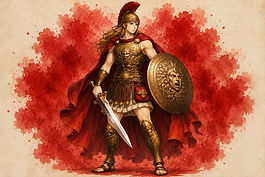
Achilles
Achilles is the greatest Greek warrior of the Trojan War, the hero whose rage shapes the entire course of the ten-year siege of Troy. He is the son of the mortal king Peleus and the sea-goddess Thetis, a demigod whose mother tried to make him immortal by dipping him in the River Styx, leaving only his heel vulnerable. He is the champion who withdrew from battle in a fit of wounded pride, allowing the Trojans to push the Greeks back to their ships and burn them on the shore. He is the avenger who returned to the fight after his beloved companion Patroclus was killed by the Trojan prince Hector, cutting down Hector in single combat and dragging his body behind his chariot. And he is the tragic hero who died young, shot by Paris with an arrow guided by the god Apollo to his single weak spot, his heel, a death that made his name synonymous with a fatal vulnerability forever after.

Acoetes
Acoetes is the helmsman who alone recognised Dionysus when his crew of Tyrrhenian pirates captured the god, the only man spared when the others were transformed into dolphins. He is the sailor whose decades on the wine-dark sea had taught him to read the weather of the divine in a stranger's eyes. He is the voice of warning that the pirates ignored, the old man who begged his captain to release the dark-eyed youth before it was too late. He is the witness who lived to tell the tale, first to Pentheus, the king of Thebes who denied the god's divinity, and then to every generation that followed. He is the priest who served Dionysus after the miracle, the mortal who passed from the deck of a pirate ship to the service of ecstasy. And he is the proof that recognition is its own salvation, the man who saw a god where others saw only ransom. Every warning unheeded, every old sailor's intuition that saves a ship, and every conversion born of terror carries the shadow of Acoetes.

Actaeon
Actaeon is the hunter who saw Artemis, the virgin goddess of the hunt, bathing naked in a forest spring and was punished so terribly his own hounds tore him apart. He is the son of Autonoë, one of the four daughters of Cadmus, the Phoenician prince who slew the dragon of Ares, the god of war, and sowed its teeth to create the first warriors of the land. He is the grandson of the dragon-slaying king who brought the alphabet to Greece, and the pupil of the centaur Chiron, the immortal creature who was half-man and half-horse and who trained the greatest heroes of Greece. He is the master of a legendary pack of hunting dogs whose names were recorded by the Roman mythographer Hyginus, fifty hounds bred for speed and ferocity. He is the victim whose death became a warning to every mortal who gazed upon the secrets of the gods, a tale told in tragedy, painted on pottery, and carved into stone across Greece. And he is the man transformed into a stag by a splash of divine water, his human voice lost, his mind trapped inside the body of the beast his dogs were bred to kill.

Actaeon's Hounds
Actaeon's Hounds are the pack of dogs who tore their own master limb from limb after the goddess Artemis transformed him into a stag, the most terrible case of canine betrayal in all of Greek mythology. They are the fifty hounds bred and trained by the centaur Chiron, the wisest of all creatures, who also tutored the hero Achilles, the greatest warrior of the Trojan War. They are the dogs named individually by the Roman poet Ovid in a catalogue of thirty-six names, from Melampus the keen-scented Spartan to Ichnobates the swift Cretan tracker, each name describing a breed, a colour, or a hunting trait. They are the hounds driven to madness by Artemis, the virgin goddess of the hunt, or by Lyssa, the personification of rabies, so that they no longer recognised the voice of the man who had fed them. They are the pack that devoured Actaeon on Mount Cithaeron while he groaned in a stag's body, his human mind trapped inside, unable to call his own name. And they are the mourning dogs who wandered the hills howling for their lost master after the deed was done, a pack forever stained by the blood of the hunter they had loved.

Aegeus
Aegeus is the king of Athens whose name gave the Aegean Sea its title, the father who threw himself from a cliff in despair when he believed his son had died in the Labyrinth of Crete. He is the son of Pandion, the king of Athens who was driven from his throne by the sons of Metion, and the ruler who reclaimed the city and established his line. He is the childless monarch who travelled to Delphi, the sacred oracle of Apollo, the god of prophecy, and received a cryptic warning that he would die without an heir unless he loosened the wine-skin's foot only when he reached home. He is the man who visited Troezen and fathered Theseus, the hero who would slay the Minotaur, hiding his sword and sandals beneath a great stone for his son to claim. He is the king who took Medea, the sorceress of Colchis, into his court after she fled Corinth, only to watch her try to poison his son. And he is the tragic figure who stood on the clifftop at Cape Sounion and saw black sails on the horizon, leaping to his death and giving the waters below a name that would last forever.

Aegis
The Aegis is the storm-shield of the gods, the most fearsome object carried on any battlefield of myth, a fringed goat-skin that raises tempests when it is shaken and routs whole armies with terror. It is the hide of Amalthea, the she-goat who suckled the infant Zeus in his hidden cave on Crete, taken up by the grateful god as both armour and emblem when he came of age. It is the sign of Zeus the Storm-Bringer, whose very title aigiochos, the Aegis-Bearer, made the object part of his name, fringed with a hundred golden tassels, each one worth a hundred oxen, ageless and undying. It is the shield of Apollo, who shook it over the Greek ships at Troy until their hearts forgot how to fight. And it is the breastplate of Athena, who set upon it the severed head of the Gorgon Medusa, the face that turns living flesh to stone, a gift from the hero Perseus, and wore it on every statue, every coin and every temple that ever bore her image. To stand under the aegis was to stand under the protection of heaven itself, and three thousand years later we still say it.

Agamemnon
Agamemnon stands as one of the most consequential and tragic figures in Greek mythology. As king of Mycenae and commander-in-chief of the Greek forces during the Trojan War, he is both mighty warlord and doomed scion of a cursed house. His story weaves through the Iliad and Odyssey of Homer, dominates the Oresteia trilogy of Aeschylus, and reverberates through the tragedies of Sophocles and Euripides. Agamemnon embodies the destructive interplay of honour, power, and inherited guilt that defines the legendary House of Atreus.

Ajax the Greater
In the catalogue of Greek heroes who sailed to Troy, one name stands apart not for divine parentage or prophetic destiny, but for sheer physical magnitude - the kind of magnitude that makes other warriors seem like boys beside a man. His name is Aías, Ajax, and the very sound of it may carry the residue of grief: the ancients heard in it the cry aiai ("alas, woe"), and one myth claims an eagle - aietós - circled his mother's house before his birth, foretelling the strength that would make him second only to Achilles. But the name's true etymology remains stubbornly opaque. The Linear B tablets have not yet yielded his name, though his father Telamon appears in Mycenaean records, and the double-l structure of the Latinized form (Ajax) - which the Romans borrowed from the epic variant Aíax - may preserve a pre-Greek substrate, a borrowed name that the Greeks later folk-etymologized into their vocabulary of lamentation. Born to Telamon, king of Salamis, and Periboea (or Eriboea, depending on the source), Ajax carried no divine blood in his veins - his grandfather was Aeacus, a mortal king deified after death, and his great-grandfather was Zeus. What made him great was not semidivine ancestry but absolute physical supremacy: he was the herkos Achaiōn, the bulwark behind which the entire Greek army could shelter, the only hero who fought without divine assistance and never needed it. His mythological function is to embody the limits of mortal excellence - the hero who is the best a human can be without being a god, and who is destroyed precisely because that excellence is not enough in a world where gods favor the clever over the strong.
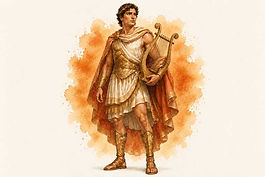
Amphion
Amphion is the king of Thebes who built the walls of his city with the music of his lyre, charming the stones into place while his twin brother Zethus wrestled them into position by strength. He is the son of Zeus, the king of the gods who ruled from Olympus, and Antiope, the princess of Thebes who was seduced by the god in the disguise of a satyr. He is the musician whose art was so powerful that the very rocks obeyed his song, and whose city became one of the greatest in Greece because of his gift. He is the husband of Niobe, the daughter of Tantalus, the king who was condemned to eternal hunger in Tartarus, the deepest pit of the Underworld, and the father of the fourteen Niobids whose slaughter by Apollo and Artemis destroyed his house. He is the king who threw himself upon his sword or was struck by a thunderbolt when he saw his children dead, a man who built a city with music and lost it to grief. And he is the founder whose walls stood for centuries, the proof that art could accomplish what force alone could not. Every wall built by song, every city founded on harmony, and every father who dies of a broken heart carries his shadow.

Androgeus
Androgeus is the prince of Crete whose death in Athens set in motion the most terrible tribute in Greek myth, the sacrifice of fourteen young people to the Minotaur every nine years. He is the son of King Minos, the lawgiver whose judgements were so just that he became a judge of the dead, and Pasiphae, the sorceress queen cursed by Poseidon, the god of the sea and earthquakes, to bear the Minotaur. He is the athlete who travelled to Athens and won every contest at the Panathenaic games, the festival held in honour of Athena, the goddess of wisdom and craft who was patron of the city, only to be killed by jealousy or by a monster sent by a fearful king. He is the brother of Ariadne, the princess who gave Theseus the thread that led him through the Labyrinth, and Phaedra, who would later marry the same hero and die by her own hand. His death made him the catalyst for the entire Minotaur saga, the single life whose loss condemned a generation of Athenian youths to the jaws of a beast. And he is the prince whose murder turned a kingdom's pride into a kingdom's curse, a story that begins with victory and ends with vengeance.

Aphrodite
Aphrodite is the Olympian goddess of love, beauty, and desire, the most beautiful of all the gods and the one whose power can bend the will of mortals and immortals alike. She was born from the sea foam that gathered around the severed genitals of the sky-god Uranus, cast into the ocean by his son the Titan Cronus, and rose from the waves at Cyprus as a fully grown woman of breathtaking beauty. She is the goddess whose bribe of the most beautiful mortal woman, Helen, to the Trojan prince Paris set in motion the ten-year Trojan War that destroyed a city and shaped the course of Greek legend. She is the wife of Hephaestus, the lame smith-god, and the lover of Ares, the god of war, whose adulterous affair was exposed when Hephaestus trapped them in an invisible net and called all the gods to witness their shame. And she is the mother of Aeneas, the Trojan prince whose descendants would one day found Rome, a legacy that carried her influence from the Greek world into the heart of the Roman Empire.

Apollo
Apollo is the Olympian god of light, music, prophecy, archery, and healing, the most beautiful and complex of all the gods, a figure who embodies both creative harmony and sudden destruction. He was born on the floating island of Delos after his mother Leto wandered the earth for nine days, pursued by the jealous goddess Hera who forbade any land to shelter her. He is the god who slew the monstrous Python at Delphi, a serpent that had terrorized the earth, and claimed the site as his own oracle, the most famous in the ancient world. He is the musician whose lyre charmed the gods and whose musical contest with the satyr Marsyas ended in the satyr's flaying. He is the archer whose arrows brought plague upon the Greek camp at Troy and who guided the arrow that killed Achilles. And he is the god of unrequited love, the eternally beautiful youth who pursued the nymph Daphne until she was transformed into a laurel tree, a symbol of victory and poetic achievement that has crowned the brows of poets and conquerors for three thousand years.