Arthurian
Balan
Name in Non-English, or Alternative Name/s
Balaan (Old French), Balan le Savage (English)
Also known as, and/or Titles and Roles
The Red Knight of the Island, the Brother of Balin, the Cursed Champion, the Knight Who Died First, the Companion of the Two Swords
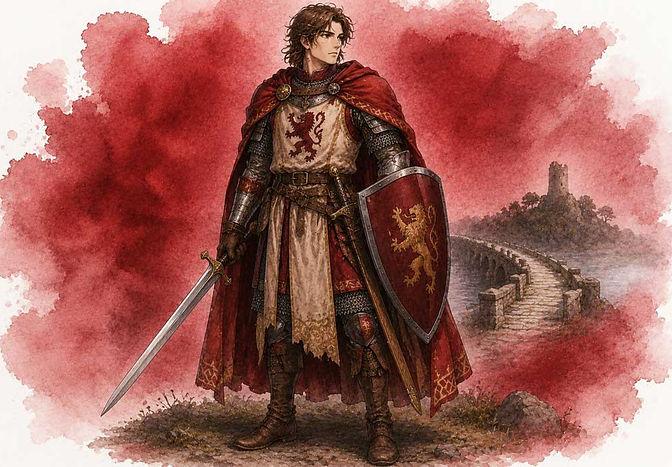
Mythopouch artistic interpretation
Details
Region
Arthurian
Regional Information Additional (if applicable)

British / Celtic
Category
Person
Historicity (actuality or factual truth of persons, events, and claims)
Legendary
Gender
Male
Time Period
5th-6th centuries CE (mythic period); literary tradition c. 1230-1485 CE
Symbol
The red armour, the borrowed shield, the island bridge, the shared tomb
Tags
arthurian, balan, person, balin, dolorous-stroke, fratricide, morte-darthur, post-vulgate, island-castle
Introduction - Overview
Balan is the brother of Balin le Savage, the knight who bore two swords and dealt the Dolorous Stroke, and he is the other half of the most tragic fratricide in Arthurian legend. He is the knight who found his brother weeping by the bodies of Lanceor and Colombe, who rode with him to capture King Rience and to victory at the battle of Terrabil, and who was called by King Arthur one of the two most marvellous knights in the world. He is the warrior who killed a cursed knight on an island bridge and was trapped in his place, condemned to challenge every traveller who passed. He is the man who looked at his opponent's two swords and thought he knew his brother, but the strange shield convinced him otherwise, and so he fought his own flesh and blood to the death. He is the brother who died first, crawling on his hands and knees to remove his brother's helm, and who was buried in a single tomb with the man he had loved most. And he is the reminder that in Arthurian story, even the best knights can be destroyed by a borrowed shield and a moment's doubt.
Gallery
Main Article - Who or What was...
Balan
Balan first appears in Thomas Malory's Le Morte d'Arthur, composed around 1469-1470, in the section Malory calls the Booke of Balyne le Saveage. Malory drew the tale from the Post-Vulgate Suite du Merlin, a French prose romance of the mid-thirteenth century, though the brothers' story is older than either text, rooted in the Celtic tradition of doomed twins. In Malory's telling, Balan is the brother of Balin, a poor knight from Northumberland imprisoned for killing one of King Arthur's cousins.
Balan found his brother on the road outside Camelot, not long after Balin had been banished for beheading the Lady of the Lake. Balin had just killed Sir Lanceor of Ireland in a joust, and Lanceor's lady Colombe had taken her own life upon his body. Balin stood weeping in the forest when Balan rode up, and the two brothers removed their helms and kissed each other. When King Mark of Cornwall happened by and asked their names, Balan answered for his brother, pointing to the two swords at Balin's side and saying that he might be called the Knight with the Two Swords.
The brothers set out to win back Arthur's favour by capturing King Rience of North Wales, who had made war upon Britain and demanded the beards of eleven conquered kings. With Merlin's guidance they ambushed Rience, slew forty of his men, and delivered the captured king to Camelot. Arthur marvelled at their prowess and called them the best knights he had ever seen. They fought again at the battle of Terrabil against the rebel kings Nero and Lot, where their strokes were so wonderful that men said they came from heaven or from hell. Merlin prophesied that Balan would depart and never return to Arthur's court.
Balan rode off alone and came to an island castle guarded by a bridge. There he encountered a fierce knight in red armour who challenged all who passed. Balan slew the knight, but in doing so he fell under the same curse: he was now condemned to remain on the island as its champion, challenging every traveller who sought to cross. He could not leave, could not send word to his brother, could only wait in red armour for the next knight to come.
That knight was Balin. After the Dolorous Stroke that laid waste to three kingdoms, Balin came to the same castle and was told he must joust the guardian before he could pass. A knight offered him a larger shield to replace his own, which bore the device of the Two Swords, and Balin accepted. He crossed to the island, where a damsel warned him that he had put himself in great danger. From the castle rode a knight in red armour. Balan looked at the two swords and thought he knew the man, but the strange shield deceived him. They couched their spears and rode together with such force that both horses went down. They fought on foot for hours, wounding each other grievously, until the ground was red with their blood. At last Balan withdrew and lay down. Balin asked his name, and when Balan answered, Balin fell backward in a swoon. Balan crawled to his brother and removed his helm, but the face was so scarred that he did not know it until Balin woke and spoke. They wept together, cursed the castle's ill customs, and asked the lady to bury them in one tomb. Balan died first, and Balin followed at midnight. The lady buried them richly, writing Balan's name upon the stone, for she did not know his brother's. In the morning Merlin came and added Balin's name in letters of gold.
Summary
Balan endures as the brother who died first, the knight trapped by a curse and destroyed by a borrowed shield. From the reunion in the forest to the capture of Rience, from the red armour of the island to the shared tomb where Merlin wrote their names in gold, his story is the story of a man who fought at his brother's side and then died by his hand. He is the reminder that the greatest tragedy in Arthurian legend is not the fall of Camelot but the moment when two brothers look at each other across a battlefield and do not know what they see.
Now enter the Mythopouch World!
You’ve discovered:
Balan
From Myth to Game
Join to access FREE real-world mythology "Learn Quests" and "Courses". Sign up to the newsletter for new releases, game updates, insider news, and more as Mythopouch brings real mythology to life. EARN the right to purchase an offline board game by completing FREE modules.


It's FREE to join as a MEMBER!
Not ready to join? Get the newsletter instead below


Looking for others?
Click into the field below to search, or click the icon to go to full page search function!

Looking for Mythology Insights?


Click below to view our mythology blog article insights, where we delve into the current Mythopouch Tier regions, and what we think you should know!
Sources & Retellings
Explore the original mythological Source texts (most from over 75 years ago, some as translated, possibly with mature content) and Mythopouch's source Retellings (a modern retelling also suitable for 15+) connected to this mythological entity. We are growing this resource and will link these in the future; for now, check the References below, then find the Sources or Retellings on those pages!


References
Validation References:
- Thomas Malory, Le Morte d'Arthur, Book II (The Booke of Balyne le Saveage), c. 1469-1470 - primary source; the complete story of Balan and Balin, their reunion, the capture of Rience, the island combat, and their shared tomb
- Post-Vulgate Suite du Merlin (Huth Merlin), c. 1230-1240 - primary source; the earliest version of the Balin and Balan story, preserved in British Library Add MS 38117 and Cambridge University Library MS Add. 7071
- Norris, R., "Malory's Use of the Balin Story in the Morte Darthur," in Arthurian Literature (JSTOR, 1999) - scholarly analysis of Malory's adaptation of the Post-Vulgate material and the brothers' tragic arc
- Loomis, Roger Sherman, The Development of Arthurian Romance (Hutchinson, 1963) - scholarly analysis of the Balin-Balan story's origins and its place in the Arthurian tradition
- Tennyson, Alfred Lord, "Balin and Balan," in Idylls of the King, 1885 - primary source; the Victorian poetic retelling of the brothers' tragedy
- Vinaver, Eugene (ed.), The Works of Sir Thomas Malory (Oxford University Press, 1947; 3rd ed. 1990) - scholarly edition with textual notes on the Booke of Balyne le Saveage
- Bogdanow, Fanni, The Romance of the Grail: A Study of the Structure and Genesis of a Thirteenth-Century Arthurian Prose Romance (Manchester University Press, 1966) - scholarly analysis of the Post-Vulgate Suite du Merlin and its narrative techniques
- Lacy, Norris J. (ed.), Lancelot-Grail: The Old French Arthurian Vulgate and Post-Vulgate in Translation (Garland Publishing, 1993-1996) - scholarly translation of the Post-Vulgate cycle with notes on the Balin episode
Cultural Context Notice
Mythology developed across different cultures, periods and traditions, and there is rarely one universally accepted version of a story. Mythopouch approaches these traditions with respect while remaining faithful to the complexity of the surviving material. Retellings and educational content may interpret or adapt historical sources, but are not presented as definitive accounts of any culture, religion or belief system.