Arthurian
Each Uisge
Name in Non-English, or Alternative Name/s
Each-uisge (Scottish Gaelic), Each-uisce (Irish Gaelic)
Also known as, and/or Titles and Roles
The Water Horse, Aughisky, Cabyll-ushtey, the Loch Horse, the Man-Eater of the Highlands, the Jelly Beast

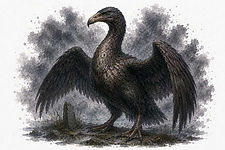
Mythopouch artistic interpretation
Details
Region
Arthurian
Regional Information Additional (if applicable)

Celtic/Scottish
Category
Creature/Monster/Animal
Historicity (actuality or factual truth of persons, events, and claims)
Mythological
Gender
N/A
Time Period
Medieval folklore (collected c. 19th century CE); mythic setting timeless
Symbol
Horse from water
Tags
celtic, each-uisge, water-horse, scottish, monster, kelpie, highlands, shape-shifter, loch
Introduction - Overview
The Each Uisge is the most feared water spirit in Scottish folklore, a shape-shifting monster that haunts the sea lochs and freshwater lochs of the Highlands and Islands, luring riders to a death so terrible that only their livers survive to tell the tale. It is the creature that appears as a beautiful horse with an unnaturally fine coat and rich harness, mingling with mortal herds until some unsuspecting soul climbs upon its back, at which point its skin becomes adhesive and the horse gallops to the deepest part of the loch to drown and devour its prey. It is the handsome stranger who approaches young women on the shore, betrayed only by the sand and water-weeds tangled in his hair or the hooves that replace his feet when he thinks no one is looking. It is the monster that killed nine children at a single stroke in Argyll, leaving only one boy who cut off his own finger to escape, and the beast that the blacksmith of Raasay slew with red-hot hooks after it took his daughter. And it is the creature that dissolves by sunrise into a soft greyish jelly, leaving no corpse to prove it ever existed, the eternal reminder that the most beautiful things in the Highlands are often the most deadly.
Gallery
Main Article - Who or What was...
Each Uisge
The Each Uisge takes its name from the Scottish Gaelic each uisge, literally "water horse," and it has been distinguished since medieval times from the kelpie, the river-dwelling water spirit that is its cousin but not its equal. While the kelpie inhabits streams and rivers, the Each Uisge claims the sea, the sea lochs, and the deep freshwater lochs of the West Highlands and Islands, and it is widely regarded by folklorists as the fiercest and most dangerous of all the water horses. It is a shape-shifter of extraordinary power, able to appear as a fine horse or pony, a huge bird similar to the boobrie, or a handsome young man, and in every form its purpose is the same: to lure human beings to the water and destroy them. In its human shape it is almost indistinguishable from a mortal man, save for the sand, mud, and strands of water-weed that cling to its hair, and in some tales it retains its hooves even when the rest of it looks human, a detail that has linked it in Scottish Christian tradition to the devil himself.
The most chilling tale of the Each Uisge comes from Argyll, near a loch in Sunart, where nine children one day found a beautiful black horse grazing by the shore. The horse was docile and magnificent, its tack finer than anything the children had seen, and one by one they climbed upon its back. As each child mounted, the horse's back stretched and lengthened to accommodate them all, a magical expansion designed to trap as many victims as possible. The youngest child, the last to approach, touched the horse only with one finger, and the moment he did so his finger stuck fast to the creature's hide as though glued by sorcery. He tried to pull away but could not, and in a moment of terrible clarity he drew his pocket-knife and cut off his own finger to free himself. The horse, now bearing eight children, galloped into the loch and plunged to the depths. The next morning, eight small livers were found floating on the surface of the water, all that remained of the children after the Each Uisge had torn them apart and devoured every other part of their bodies.
In another famous account, recorded in the Hebrides, the Each Uisge took a blacksmith's daughter from the Isle of Raasay, dragging her into the loch and drowning her. The blacksmith and his son swore revenge. They built a forge by the water's edge and fashioned a set of enormous iron hooks, heating them in the fire until they glowed red. They then roasted a sheep over a fire and waited. At last a great mist rose from the loch and the Each Uisge emerged, seizing the roasted meat in its jaws. The blacksmith and his son leaped forward and rammed the red-hot hooks deep into the creature's flesh. After a brief and terrible struggle the monster was dead. But when the blacksmith returned at sunrise to claim his victory, he found not the carcass of a great horse but a soft greyish jelly dissolving into the earth, the star-jelly that water spirits leave behind when they are slain on land, as if the creature had never been flesh and bone at all.
On the Isle of Lewis, in the Outer Hebrides, the Each Uisge proved that it could take human form to bypass even the sacred laws of Highland hospitality. Two cousins, known as Fair Mary and Dark Mary, were staying in a remote shieling, a stone hut used for summer grazing, when a weary woman arrived at their door asking for shelter. The girls, following the ancient code of cairdeas, the Highland tradition of friendship and hospitality to strangers, offered her their bed. In the night Dark Mary woke to a warm trickling sensation and discovered her cousin dead beside her, her heart torn out. The "woman" had vanished, but as Dark Mary looked out the door she saw a large horse trotting away into the dawn mist. The Each Uisge had not needed to lure its victims to the water; it had come ashore, disguised itself as a helpless traveller, and entered their home to kill.
The belief in the Each Uisge was so potent in the Highlands that it persisted into the modern era. In 1870, in the Sleat district of the Isle of Skye, reports of a beast waylaying travellers near Loch nan Dubhrachan became so frequent that the local community organised a massive dragging operation with nets, and when the net snagged on something powerful beneath the surface the men dropped the ropes and fled in terror. The folklorist John Gregorson Campbell, writing at the turn of the twentieth century, recorded dozens of Each Uisge traditions from across the Highlands, and Katharine Briggs, the great English folklorist, called it "perhaps the fiercest and most dangerous of all the water-horses." Today the Each Uisge survives in the Kelpies sculptures at Falkirk, the thirty-metre horse heads that commemorate Scotland's horse-powered heritage, and in the enduring warning that every Highland child once knew: never trust a beautiful horse by the water, and never let a stranger with weeds in his hair sit too close.
Summary
The Each Uisge endures as the darkest spirit in Scottish water folklore, the shape-shifting monster that turned the beauty of the Highlands into a deadly trap. From the eight livers floating on Sunart to the jelly left by the blacksmith's forge, from the shieling on Lewis to the nets dropped in terror on Skye, its story is the eternal warning that the wilderness does not forgive the unwary. It is the reminder that the most beautiful horse on the shore is often the hungriest, and that the stranger with sand in his hair may not be a man at all.
Tags: each-uisge, water-horse, scottish, monster, kelpie, highlands, shape-shifter, loch
Now enter the Mythopouch World!
You’ve discovered:
Each Uisge
From Myth to Game
Join to access FREE real-world mythology "Learn Quests" and "Courses". Sign up to the newsletter for new releases, game updates, insider news, and more as Mythopouch brings real mythology to life. EARN the right to purchase an offline board game by completing FREE modules.


It's FREE to join as a MEMBER!
Not ready to join? Get the newsletter instead below



Looking for others?
Click into the field below to search, or click the icon to go to full page search function!

Looking for Mythology Insights?


Click below to view our mythology blog article insights, where we delve into the current Mythopouch Tier regions, and what we think you should know!
Sources & Retellings
Explore the original mythological Source texts (most from over 75 years ago, some as translated, possibly with mature content) and Mythopouch's source Retellings (a modern retelling also suitable for 15+) connected to this mythological entity. We are growing this resource and will link these in the future; for now, check the References below, then find the Sources or Retellings on those pages!


References
Validation References:
- John Gregorson Campbell, Superstitions of the Highlands and Islands of Scotland (1900) - collected Each Uisge tales from across the Highlands and Islands
- J.G. McKay, More West Highland Tales (Oliver and Boyd, 1940) - the Blacksmith of Raasay and the Nine Children of Sunart
- Katharine M. Briggs, A Dictionary of Fairies (Penguin, 1976) - classification of the Each Uisge as the fiercest water horse
- Katharine M. Briggs, The Fairies in Tradition and Literature (Routledge, 1967) - analysis of Scottish water spirit folklore
- Walter Gregor, Notes on the Folk-Lore of the North-East of Scotland (Folk-Lore Society, 1881) - primary collection of water horse traditions
- Robert Burns, "Address to the Deil" (1786) - primary source; literary reference to water-kelpies haunting Scottish fords
- Lewis Spence, The Magic Arts in Celtic Britain (Rider, 1945) - scholarly analysis of shape-shifting spirits in Scottish tradition
- Affleck Gray, The Highland Year (1974) - the Water-Horse of the River Spey and Each Uisge traditions in the Cairngorms
Cultural Context Notice
Mythology developed across different cultures, periods and traditions, and there is rarely one universally accepted version of a story. Mythopouch approaches these traditions with respect while remaining faithful to the complexity of the surviving material. Retellings and educational content may interpret or adapt historical sources, but are not presented as definitive accounts of any culture, religion or belief system.