Arthurian
Hoel (Duke)
Name in Non-English, or Alternative Name/s
Hoel the Great (Breton: Hoel I Mawr), Howel, Howell, Aramont (Vulgate Cycle), Hoelus (Latin), Saint Hywel
Also known as, and/or Titles and Roles
The Duke of Brittany, Arthur's Cousin, the Conqueror of Gaul, the Avenger of Helena, the Father of Isolde of the White Hands, the Royal Knight of Wales

Mythopouch artistic interpretation
Details
Region
Arthurian
Regional Information Additional (if applicable)
British / Celtic / Breton
Category
Person
Historicity (actuality or factual truth of persons, events, and claims)
Legendary
Gender
Male
Time Period
5th-6th centuries CE (mythic period); literary tradition c. 1136-1485 CE
Symbol
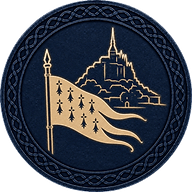
The banner of Brittany at Arthur's side, the mausoleum of Helena on Mont Saint-Michel, the sword that conquered Gaul
Tags
arthurian, hoel, person, brittany, arthur, gaul, mont-saint-michel, tristan
Introduction - Overview
Duke Hoel is the greatest ally King Arthur ever had, the Breton warlord who sailed from Brittany with fifteen thousand warriors to help his kinsman drive the Saxons from Britain and who later conquered Gaul in Arthur's name. He is the Duke of Brittany, the son of King Budic II of the Armorican Britons, a ruler of such standing that Geoffrey of Monmouth made him either Arthur's nephew or his first cousin depending on which chapter one reads. He is the general who fought beside Arthur at the Battle of Badon, who held Dumbarton Castle against the Picts and Scots while Arthur was away, and who led a division of Britons at the decisive battle of Saussy against the Romans. He is the uncle whose niece Helena was carried off by the Giant of Mont Saint-Michel, whose death drove Arthur to scale the mountain in the dead of night and slay the monster with his own hand. And he is the father, in the Prose Tristan tradition, of Isolde of the White Hands and Kaherdin, the family that would one day give Tristan his second, unloved bride.
Gallery
Main Article - Who or What was...
Hoel (Duke)
Hoel was born into the royal house of Brittany, the son of King Budic II, a ruler of the Armorican Britons whose kingdom covered the north-western peninsula of Gaul that the Britons had colonised in the late Roman period. His father was a man of sufficient power and piety to appear in several Breton saints' lives, and Hoel inherited both the throne and the military reputation that went with it. In Welsh tradition he is called Hywel, and the Welsh Triads name him as one of Arthur's three Royal Knights, a mark of the highest distinction in the early heroic tradition. He was said to be handsome, wise, and skilled at arms, and his court at Nantes was one of the great centres of Brittonic culture on the continent.
The defining moment of Hoel's military career came when Arthur, newly crowned and facing rebellion on every side, sent to Brittany for help. Hoel did not hesitate. He gathered fifteen thousand armed warriors, sailed to Southampton, and marched to join Arthur at the siege of Kaerluideoit, where the Saxons under Colgrim had the British forces pinned down. Together they broke the siege, and from that moment Hoel became Arthur's right hand in every campaign. He fought at the Battle of Dubglas, where the Saxon lines were shattered; at the Siege of Caer Ebrauc, the great fortress that the English call York; and at the Battle of Cat Celidon Coit, the battle of the Caledonian Wood. When Arthur was drawn away to fight elsewhere, Hoel was left to hold Dumbarton Castle against a combined force of Picts and Scots, and though he was sick and his garrison was outnumbered, he held the walls until Arthur returned to relieve him.
The conquest of Gaul was Hoel's greatest achievement. When Arthur turned his attention to the continent, determined to punish the Roman Emperor Lucius for demanding tribute, Hoel led one of the main divisions of the British army. He conquered Aquitaine and Gascony, subdued the Poitevins, and established Arthur's authority across the northern half of Gaul. At the battle of Saussy, the decisive engagement against the Romans, Hoel commanded the fourth division of Arthur's army, and his Breton warriors were among the fiercest fighters on the field. After the victory, Arthur made him governor of Gaul, a position of immense trust that reflected the bond between the two kinsmen. Hoel ruled the conquered territories with the same wisdom he had shown in Brittany, and for a time it seemed that the British empire on the continent might last.
The tragedy that broke Hoel's heart came not on the battlefield but on a mountain in Normandy. While Arthur and Hoel were campaigning in Gaul, news arrived that a giant of monstrous size had come from the shores of Spain, had carried off Helena, Hoel's niece, from her guard, and had fled with her to the top of what is now called Mont Saint-Michel. The giant had killed or devoured every soldier who pursued him, and Helena was already dead by the time Arthur heard the news. The king, taking only Sir Kay and Sir Bedivere, went out privately from the camp at the second hour of the night and climbed the mountain. He found the giant by a fire, his face besmeared with the clotted blood of swine, and after a terrible combat in which the giant nearly crushed him, Arthur struck his sword up through the monster's skull. Hoel, in grief for his niece, commanded a mausoleum to be built over her body on the mountain, and the place was called Helena's Tomb.
The end of Hoel's story is bound to the end of Arthur's. When Mordred seized the throne and declared himself king of Britain, Arthur was forced to abandon his continental conquests and return to deal with the traitor. He left Hoel in charge of Gaul with orders to keep the peace, and Hoel remained at his post even as the news came that Arthur had been mortally wounded at Camlann and borne away to the Isle of Avalon. In the later Prose Tristan tradition, Hoel's role expanded beyond the chronicles: he became the father of Isolde of the White Hands, the Breton princess whom Tristan married after he was banished from Cornwall, and of Kaherdin, the loyal companion who tried to bring Isolde of Ireland to Tristan's deathbed. In the Vulgate Lancelot, he is also called Aramont, the overlord of King Ban of Benoic and King Bors of Gannes, the two kings whose deaths at the hands of Claudas, the Frankish conqueror of Benoic and Gannes, set in motion the entire Lancelot saga. Whether as Arthur's cousin, his general, or the father of Tristan's second wife, Duke Hoel stands as the bridge between Britain and Brittany, the kinsman whose loyalty never wavered and whose sword conquered a continent.
Summary
Duke Hoel endures as the greatest ally in Arthurian chronicle, the Breton warlord who conquered Gaul for Arthur and held it until the kingdom fell. From the port of Southampton to the plains of Aquitaine, from Dumbarton Castle to the mausoleum on Mont Saint-Michel, his story is the reminder that the Round Table had allies beyond its own borders, and that the sword that defended Britain could also conquer a continent. He is the cousin who never wavered, the general who never retreated, and the father whose daughter became the second Isolde.
Now enter the Mythopouch World!
You’ve discovered:
Hoel (Duke)
From Myth to Game
Join to access FREE real-world mythology "Learn Quests" and "Courses". Sign up to the newsletter for new releases, game updates, insider news, and more as Mythopouch brings real mythology to life. EARN the right to purchase an offline board game by completing FREE modules.


It's FREE to join as a MEMBER!
Not ready to join? Get the newsletter instead below


Looking for others?
Click into the field below to search, or click the icon to go to full page search function!

Looking for Mythology Insights?


Click below to view our mythology blog article insights, where we delve into the current Mythopouch Tier regions, and what we think you should know!
Sources & Retellings
Explore the original mythological Source texts (most from over 75 years ago, some as translated, possibly with mature content) and Mythopouch's source Retellings (a modern retelling also suitable for 15+) connected to this mythological entity. We are growing this resource and will link these in the future; for now, check the References below, then find the Sources or Retellings on those pages!


References
Validation References:
- Geoffrey of Monmouth, Historia Regum Britanniae, c. 1136 - primary source; Hoel's arrival at Southampton with fifteen thousand men, the campaigns against the Saxons, the conquest of Gaul, the Helena episode at Mont Saint-Michel, and Hoel's governorship of Gaul
- Wace, Roman de Brut, c. 1155 - primary source; the Anglo-Norman verse adaptation of Geoffrey's account, including the naming of Helena as Eleine and the emotional impact of her death on Hoel
- Layamon, Brut, c. 1190-1215 - primary source; the Middle English alliterative version of the chronicle tradition, naming Helena as Elaine and emphasising Hoel's role as Arthur's kinsman
- Thomas Malory, Le Morte d'Arthur, 1485 - primary source; the English synthesis of Hoel as Howel, Duke of Brittany, and his relationship to Arthur's continental campaigns
- Anonymous, Prose Tristan, c. 1230-1235 - primary source; Hoel as the father of Isolde of the White Hands and Kaherdin, and his role in Tristan's Breton exile
- Anonymous, Lancelot en prose (Vulgate Cycle), c. 1215-1230 - primary source; Hoel as Aramont, overlord of Ban and Bors, and his place in the genealogy of the Round Table
- Bromwich, Rachel, Trioedd Ynys Prydein: The Welsh Triads (University of Wales Press, 1961; 3rd ed. 2006) - scholarly edition; the Welsh triad naming Hoel as one of Arthur's three Royal Knights
- Loomis, Roger Sherman, The Development of Arthurian Romance (Hutchinson, 1963) - scholarly analysis of Hoel's introduction to the Arthurian tradition by Geoffrey of Monmouth and his displacement of native Welsh heroes
- Charles-Edwards, T.M., Wales and the Britons 350-1064 (Oxford University Press, 2013) - scholarly historical analysis of the Breton-British connections and the historical context of Hoel's military campaigns
- Padel, O.J., Arthur in Medieval Welsh Literature (University of Wales Press, 2000) - scholarly study of the Welsh references to Hywel/Hoel and the evolution of the character from chronicle to romance
Cultural Context Notice
Mythology developed across different cultures, periods and traditions, and there is rarely one universally accepted version of a story. Mythopouch approaches these traditions with respect while remaining faithful to the complexity of the surviving material. Retellings and educational content may interpret or adapt historical sources, but are not presented as definitive accounts of any culture, religion or belief system.