Arthurian
Details
Region
Arthurian
Regional Information Additional (if applicable)

British / Celtic
Category
Creature/Monster/Animal
Historicity (actuality or factual truth of persons, events, and claims)
Mythological
Gender
Male
Time Period
6th century CE (mythic period); literary tradition c. 1100 CE
Symbol
The leash of Cors Hundred Claws, the collar of Canhastyr Hundred Hands, the chain of Cilydd Hundred Holds
Tags
arthurian, drudwyn, creature, hound, twrch-trwyth, culhwch-and-olwen, greid, mabon
Introduction - Overview
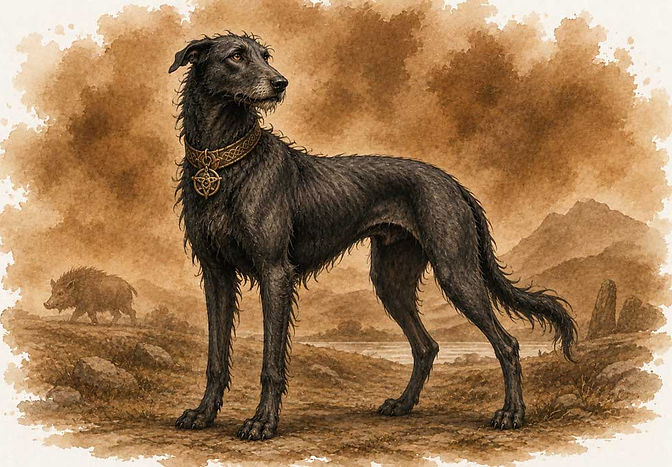
Drudwyn is the fiercest hunting hound in Welsh legend, the whelp of Greid son of Eri and the only dog in Britain capable of tracking the supernatural boar Twrch Trwyth across three kingdoms and two seas. He is the hound that no ordinary man could hold, a beast of such strength and ferocity that Ysbaddaden Chief Giant declared him indispensable for the hunt and Mabon ap Modron the only huntsman alive who could manage him. He is the dog who needed a leash fashioned by Cors Hundred Claws, a collar made by Canhastyr Hundred Hands, and a chain forged by Cilydd Hundred Holds, equipment so extraordinary that it took King Arthur himself to procure it. He is the tracker who followed Twrch Trwyth from Ireland to Wales to Cornwall, through rivers and across mountains, until the boar was finally driven into the sea. And he is the proof that in the oldest Arthurian tale, even a dog can be a hero, and even a hound can be the difference between a quest failed and a legend made.
Gallery
Main Article - Who or What was...
Drudwyn
Drudwyn was born as the whelp of Greid son of Eri, a figure who appears in the court list of Culhwch and Olwen as one of Arthur's own warriors and who was later taken prisoner by Gwyn ap Nudd, the king of the Welsh Otherworld. The name Drudwyn means something close to "fierce" or "strong" in the Brittonic tongue, and the hound lived up to it from the first. He was not a pet or a lapdog; he was a war-hound, bred for the chase of monsters, and his reputation was such that Ysbaddaden Chief Giant, when setting Culhwch his forty impossible tasks, named Drudwyn specifically as the only hound who could hunt Twrch Trwyth. The giant did not stop there. He added that Drudwyn could not be held with ordinary gear, and he listed the three pieces of equipment that would be needed: a leash made by Cors Hundred Claws, a collar made by Canhastyr Hundred Hands, and a chain made by Cilydd Hundred Holds. These were not mere craftsmen; their names suggest beings of supernatural dexterity, and the making of Drudwyn's harness was itself one of the lesser anoethau, the impossible tasks that littered Culhwch's path to Olwen.
The hunt for Twrch Trwyth was the greatest chase in Arthurian legend, and Drudwyn was at its centre. Twrch Trwyth was no ordinary boar. He was an Irish king named Taredd who had been transformed by God into a swine as punishment for his sins, and he carried between his ears a comb, a pair of scissors, and a razor that Ysbaddaden needed to shave his own beard. The boar had venom-dripping bristles, seven piglets who fought beside him as warriors, and a cunning that matched his strength. When Arthur and his host tracked him to Ireland, Twrch Trwyth defeated them and laid waste to a fifth of the island before swimming across the Irish Sea to Wales. The pursuit ranged across Pembrokeshire, Carmarthenshire, the Amman valley, and the Brecon Beacons, with Arthur losing men at every turn. Drudwyn, along with the two whelps of the bitch Rhymhi and the hounds Aned and Aethlem, formed the pack that finally cornered the beast.
The defining moment of Drudwyn's career came at the mouth of the Severn, where Arthur mustered his troops to halt the boar before it could reach Cornwall. The fight was desperate. Twrch Trwyth waded into the river, and Arthur's men managed to wrest the razor and scissors from between his ears while he was in the water, but the comb remained stuck fast. When the boar touched the riverbed with his feet, he bolted with such speed that no hound could hold him, and the chase continued across England and down into Cornwall. There, at the very edge of the land, Arthur and his warriors made their final stand. The comb was finally taken, and Twrch Trwyth was driven off the cliffs into the sea. The text of Culhwch and Olwen ends the episode with a haunting line: from then on it was not known where he and Aned and Aethlem went. Drudwyn's fate is not recorded separately, but the implication is that the greatest hunt in Welsh legend ended with the hounds still in pursuit, the boar vanished beneath the waves, and the quest fulfilled.
Drudwyn's service to Arthur extended beyond the hunt for Twrch Trwyth. The same hound was also used in the hunt for Ysgithyrwyn Chief Boar, the white-tusked monster whose tusk became the razor that shaved Ysbaddaden's face. In that hunt, Drudwyn was paired with Arthur's own hound Cafall and the pack that Caw of Picland brought from the north, a host of hounds so numerous that the forest shook with their baying. The two boar hunts - Ysgithyrwyn and Twrch Trwyth - are the twin pillars of the animal-chase tradition in Culhwch and Olwen, and Drudwyn is the only hound named in both. His owner, Greid son of Eri, was one of the three most unfortunate prisoners in the tale, held captive by Gwyn ap Nudd in the Otherworld, which suggests that Drudwyn's origins were as otherworldly as the beasts he was bred to hunt.
The legacy of Drudwyn is the legacy of the Celtic hunting hound itself, the ancestor of every greyhound and wolfhound that ever ran across the British Isles. In Welsh tradition, the hunting dog was not merely a tool but a companion of heroes, a creature that stood between the human world and the wilderness of monsters. Drudwyn, with his special leash and collar and chain, with his need for Mabon the huntsman, and with his role in the greatest chase ever told, embodies that tradition at its most extreme. He is not a pet; he is a weapon, a tracker, and a force of nature, and without him the comb of Twrch Trwyth would never have been taken, the beard of Ysbaddaden would never have been shaved, and Culhwch would never have won Olwen. In the end, the oldest Arthurian tale is as much the story of a hound as it is the story of a king.
Summary
Drudwyn endures as the fiercest hunting hound in Welsh Arthurian legend, the whelp of Greid whose tracking of Twrch Trwyth made him indispensable to the oldest quest in British literature. From the kennels of Greid son of Eri to the cliffs of Cornwall where the boar was driven into the sea, from the leash of Cors Hundred Claws to the hands of Mabon the huntsman, his story is the reminder that even a dog can be a hero when the quarry is a monster. He is the tracker who followed a king-turned-boar across three kingdoms, and the proof that in the world of Culhwch and Olwen, the hound is as vital to the quest as the knight.
Now enter the Mythopouch World!
You’ve discovered:
Drudwyn
From Myth to Game
Join to access FREE real-world mythology "Learn Quests" and "Courses". Sign up to the newsletter for new releases, game updates, insider news, and more as Mythopouch brings real mythology to life. EARN the right to purchase an offline board game by completing FREE modules.


It's FREE to join as a MEMBER!
Not ready to join? Get the newsletter instead below


Looking for others?
Click into the field below to search, or click the icon to go to full page search function!

Looking for Mythology Insights?


Click below to view our mythology blog article insights, where we delve into the current Mythopouch Tier regions, and what we think you should know!
Sources & Retellings
Explore the original mythological Source texts (most from over 75 years ago, some as translated, possibly with mature content) and Mythopouch's source Retellings (a modern retelling also suitable for 15+) connected to this mythological entity. We are growing this resource and will link these in the future; for now, check the References below, then find the Sources or Retellings on those pages!


References
Validation References:
- Anonymous, Culhwch and Olwen, c. 1100 (Red Book of Hergest and White Book of Rhydderch versions) - primary source; Ysbaddaden's naming of Drudwyn as the only hound who can hunt Twrch Trwyth, the required leash of Cors, collar of Canhastyr, and chain of Cilydd, Mabon as the only huntsman who can hold him, and the hunt across Ireland, Wales, and Cornwall
- Anonymous, Historia Brittonum, c. 829 - primary source; the earliest reference to Arthur's hunt of the boar Troynt with his dog Cabal, the prototype of the Twrch Trwyth chase
- Bromwich, Rachel, and Evans, D. Simon, Culhwch and Olwen (University of Wales Press, 1992) - scholarly edition with commentary; the Drudwyn episode, the etymology of the name, and the equipment required to hold the hound
- Charles-Edwards, T.M., Wales and the Britons 350-1064 (Oxford University Press, 2013) - scholarly historical analysis of the hunting traditions and animal lore in sub-Roman Britain reflected in the Drudwyn episode
- Padel, O.J., Arthur in Medieval Welsh Literature (University of Wales Press, 2000) - scholarly study of the early Arthurian references in Welsh literature and the significance of the Twrch Trwyth hunt
- Green, Thomas, Concepts of Arthur (Tempus, 2007) - scholarly examination of the mythological layers in early Arthurian tales, including the supernatural hounds and their Otherworld origins
- Sims-Williams, Patrick, "The Evidence for Vernacular Irish Literary Influence on Early Medieval Welsh Literature," in Ireland in Early Medieval Europe (Cambridge University Press, 1982) - scholarly analysis of the Irish origins of the Twrch Trwyth legend and the hunting hound tradition in Celtic literature
- Loomis, Roger Sherman, The Development of Arthurian Romance (Hutchinson, 1963) - scholarly analysis of the Welsh Arthurian traditions and the evolution of the animal-chase motif from Celtic narrative
Cultural Context Notice
Mythology developed across different cultures, periods and traditions, and there is rarely one universally accepted version of a story. Mythopouch approaches these traditions with respect while remaining faithful to the complexity of the surviving material. Retellings and educational content may interpret or adapt historical sources, but are not presented as definitive accounts of any culture, religion or belief system.