Arthurian
Calogrenant
Name in Non-English, or Alternative Name/s
Calogrenant (Old French), Cologrenant, Colgrevance (English), Kalogrenanz (German)
Also known as, and/or Titles and Roles
The Knight of the Fountain, the Cousin of Yvain, the Teller of Tales, the Man Who Rode Alone, the Knight of the Storm Stone
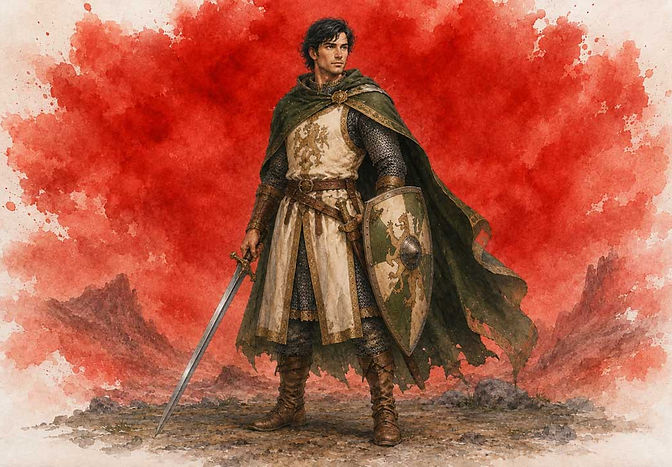
Mythopouch artistic interpretation
Details
Region
Arthurian
Regional Information Additional (if applicable)

British / Celtic / French
Category
Person
Historicity (actuality or factual truth of persons, events, and claims)
Legendary
Gender
Male
Time Period
5th-6th centuries CE (mythic period); literary tradition c. 1170-1485 CE
Symbol
The shattered lance at the fountain, the storm that rises from the basin, the emerald pillar, the shield with the bend
Tags
arthurian, calogrenant, person, yvain, broceliande, fountain, chretien-de-troyes, round-table, malory
Introduction - Overview
Calogrenant is the knight whose single tale changed the course of Arthurian romance, the cousin of Yvain who discovered a magic fountain in the forest of Broceliande and lived to tell the story at King Arthur's court. He is the Knight of the Round Table who rode alone into the forest of wonders, who found a herdsman tending bulls as big as oxen, who came to a clearing where a silver basin hung from an emerald pillar beside a chapel. He is the man who poured water from the basin onto the storm stone and raised a tempest so violent that it stripped the leaves from the trees, and who was then defeated in single combat by the Black Knight who guarded the fountain. He is the storyteller who, at Arthur's Pentecost feast, told the tale that sent his own cousin Yvain sneaking from the hall to seek the adventure that Calogrenant had failed to win. And he is the reminder that in Arthurian legend, the knight who tells the story is sometimes more important than the knight who wins it, for without Calogrenant's words there would be no Yvain, no lion, and no romance at all.
Gallery
Main Article - Who or What was...
Calogrenant
Calogrenant first appears in Chrétien de Troyes's Yvain, or The Knight with the Lion, written in the 1170s. In Chrétien's tale, Calogrenant is a Knight of the Round Table and the cousin of Yvain, the son of King Urien. He is a man of good birth and fair reputation, though not among the most celebrated knights of the fellowship. His importance lies not in his prowess but in his curiosity, the quality that leads him to ride alone into the forest of Broceliande when other knights are content to remain at court.
The adventure begins at Arthur's Pentecost feast, where the custom holds that the king will not eat until some marvel has been told. The knights sit in silence until Calogrenant rises and asks leave to tell of an adventure that befell him seven years before. He describes how he rode into Broceliande, a place of deep magic where noon is darker than dawn. He met a herdsman, a giant of a man, ugly and misshapen, who tended bulls as large as oxen and who directed him toward a clearing where a marvel awaited. In the clearing Calogrenant found a chapel, and beside it a beautiful tree and an emerald pillar with a silver basin hanging from a chain. A knight would pour water from the basin onto the stone beside the pillar, and immediately a storm would arise, so violent that the heavens seemed to fall.
Calogrenant, unable to resist, poured the water. The storm came instantly, black clouds and hail and wind that stripped the forest bare. From the chapel emerged the Black Knight, guardian of the fountain, furious that his stone had been disturbed. The two knights charged together with such force that both lances shattered, but the Black Knight was the stronger man. He unhorsed Calogrenant, seized his horse by the bridle, and drove him from the clearing in shame, sparing his life but taking his mount and his dignity. Calogrenant returned to court and told no one of his defeat, nursing the wound to his pride in silence for seven years.
At the Pentecost feast, Calogrenant's tale has an effect he never intended. His cousin Yvain, sitting among the knights, is so inflamed by the story that he cannot wait for Arthur's permission to seek the fountain himself. He slips from the hall, mounts his horse, and rides for Broceliande before the king can stop him. Yvain defeats the Black Knight, falls in love with his widow Laudine, and embarks on the adventures that make him the Knight with the Lion, one of the greatest heroes in Arthurian legend. Calogrenant's story, told in modesty and defeat, becomes the seed from which his cousin's glory grows. It is one of the most perfect examples in medieval literature of the tale within the tale, the narrative that exists only to launch a greater narrative.
Calogrenant appears again in later Arthurian tradition, though never with the prominence of his first appearance. In the First Continuation of Chrétien's Perceval, composed around 1200, he is one of the knights killed by the Green Knight, the terrifying challenger whose beheading game would later be made famous by Sir Gawain. In Thomas Malory's Le Morte d'Arthur, compiled around 1470, he appears as Colgrevance, a knight of lesser note who fights in various tournaments and battles but never again tells a story that changes the world. In the German tradition, Hartmann von Aue's Iwein, composed around 1203, gives him the name Kalogrenanz and preserves the fountain episode with the same essential shape: the cousin who fails, the cousin who succeeds, and the story that makes the difference.
Summary
Calogrenant endures as the knight whose tale was greater than his sword, the cousin who failed at the fountain and thereby created one of the greatest heroes in Arthurian legend. From the Pentecost feast at Camelot to the storm stone in Broceliande, from the shattered lance to the story that sent Yvain riding into the forest, his story is the story of the man who tells the truth about his own defeat and unwittingly inspires another to victory. He is the reminder that every great quest needs a beginning, and that the beginning is sometimes told by the knight who did not make it to the end.
Now enter the Mythopouch World!
You’ve discovered:
Calogrenant
From Myth to Game
Join to access FREE real-world mythology "Learn Quests" and "Courses". Sign up to the newsletter for new releases, game updates, insider news, and more as Mythopouch brings real mythology to life. EARN the right to purchase an offline board game by completing FREE modules.


It's FREE to join as a MEMBER!
Not ready to join? Get the newsletter instead below


Looking for others?
Click into the field below to search, or click the icon to go to full page search function!

Looking for Mythology Insights?


Click below to view our mythology blog article insights, where we delve into the current Mythopouch Tier regions, and what we think you should know!
Sources & Retellings
Explore the original mythological Source texts (most from over 75 years ago, some as translated, possibly with mature content) and Mythopouch's source Retellings (a modern retelling also suitable for 15+) connected to this mythological entity. We are growing this resource and will link these in the future; for now, check the References below, then find the Sources or Retellings on those pages!


References
Validation References:
- Chrétien de Troyes, Yvain, or The Knight with the Lion, c. 1170s - primary source; the fountain episode, Calogrenant's tale at the Pentecost feast, and his defeat by the Black Knight
- Hartmann von Aue, Iwein, c. 1203 - primary source; the German adaptation of the Calogrenant episode as Kalogrenanz
- First Continuation of Perceval, c. 1200 - primary source; Calogrenant's death at the hands of the Green Knight
- Thomas Malory, Le Morte d'Arthur, c. 1469-1470 - primary source; Colgrevance as a Knight of the Round Table in the English synthesis
- Loomis, Roger Sherman, The Development of Arthurian Romance (Hutchinson, 1963) - scholarly analysis of the Yvain tradition and Calogrenant's role as the failed precursor
- Kibler, William W. (trans.), Chrétien de Troyes: Arthurian Romances (Penguin Classics, 1991) - scholarly translation with notes on the fountain episode and its narrative function
- Frappier, Jean, Chrétien de Troyes: The Man and His Work (Ohio State University Press, 1968) - scholarly study of the Yvain romance and the role of the embedded tale
- Lacy, Norris J. (ed.), Lancelot-Grail: The Old French Arthurian Vulgate and Post-Vulgate in Translation (Garland Publishing, 1993-1996) - scholarly translation covering Calogrenant's later appearances in the prose cycles
Cultural Context Notice
Mythology developed across different cultures, periods and traditions, and there is rarely one universally accepted version of a story. Mythopouch approaches these traditions with respect while remaining faithful to the complexity of the surviving material. Retellings and educational content may interpret or adapt historical sources, but are not presented as definitive accounts of any culture, religion or belief system.