Arthurian
Alier (Count)
Name in Non-English, or Alternative Name/s
Alier (French), Le Comte Alier (Old French)
Also known as, and/or Titles and Roles
The Plunderer of Noroison, the Knight of the Narrow Pass, the False Wounded, the Oath-Breaker in Waiting, the Lord of the High Hill Fort

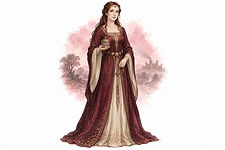
Mythopouch artistic interpretation
Details
Region
Arthurian
Regional Information Additional (if applicable)

British / Celtic / French
Category
Person
Historicity (actuality or factual truth of persons, events, and claims)
Legendary
Gender
Male
Time Period
6th century CE (mythic period); literary tradition c. 1177-1181 CE
Symbol
The burning torch of the plunderer, the shield surrendered at the hill fort, the oath sworn on his naked sword
Tags
arthurian, count-alier, person, yvain, noroison, plunderer, chretien-de-troyes, knight-with-the-lion
Introduction - Overview
Count Alier is the marauding knight whose campaign of plunder against Lady Noroison became the first test of a restored Yvain, the mad knight returned to sanity by a magic ointment and a lady's mercy. He is the lord who led knights and foot soldiers in a war of burning and laying waste, who struck at a castle's defences while its people armed themselves in haste, and who found himself outmatched by a single warrior whose heart had been broken and whose mind had wandered the wilderness like a beast. He is the false wounded who feigned injury to escape the battlefield, only to be caught at the foot of his own high hill fort with no one left to lend him aid. He is the captive who surrendered his helmet, his shield, and his naked sword, who swore by his faith to live in peace and restore every loss he had caused. And he is the reminder that in Arthurian romance, even the villain who burns a lady's lands may become, by the end of a single afternoon, a penitent who rebuilds what he has destroyed.
Gallery
Main Article - Who or What was...
Alier (Count)
Count Alier was a lord of sufficient power to raise a private army and sufficient ambition to turn it against a neighbour who had done him no visible wrong. His domain lay somewhere in the borderlands of Arthurian Britain, near the forest of Broceliande where enchantments were common and the rules of ordinary warfare did not always apply. He was not a giant like Harpin of the Mountain, nor a sorcerer like the sons of evil at Pesme Avanture, nor a traitor like Mordred. He was simply a knight with more soldiers than scruples, a man who saw weakness in Lady Noroison's holdings and decided to take what he could by force. His methods were direct: he burned fields, plundered stores, and laid waste to everything that could not be carried off, pressing his attack until the people of Noroison armed themselves in haste and prepared to defend their castle to the last.
The defining encounter of Alier's life came on a Tuesday, when his forces advanced against Noroison in full array. He did not know that the lady had recently found a naked madman sleeping under a tree in the forest, that she and her maids had bathed him, shaved him, and anointed him with a magic ointment created by Morgan le Fay herself, the sorceress queen who was Yvain's own mother. The ointment had restored the knight's wits, and the lady had given him armour, a steed, and a cause. When Alier's army approached the narrow pass before the castle, Yvain charged against the mass of them with a fury that seemed to come from the madness he had only lately escaped. He struck one knight so hard that the man's heart burst and his spine broke, toppling both horse and rider in a single blow. He felled four brave knights in quick succession, and the men who fought beside him took fresh courage from his example, standing their ground against an enemy that had seemed unstoppable only moments before.
Alier watched the battle from the field until he saw that his cause was lost. Rather than face Yvain in single combat, he turned his horse and fled, feigning a wound to explain his retreat to any who saw him. But Yvain was not deceived. The knight pressed hard on the heels of the fleeing army, pursuing them through the pass and across the open country until the dead and the living stumbled together, horses disembowelled and men struck down from behind. Alier rode for the high hill fort that was his own stronghold, hoping to reach its walls before his pursuer caught him. He did not make it. Yvain found him at the foot of the hill, near the entrance to the fort, with not a single retainer left to stand between him and the man he had tried to destroy.
The surrender was as complete as it was swift. Alier had no way to turn, no room to resist, and no hope of escape. He yielded to Yvain and accepted his surrender, handing over his helmet, his shield, and his naked sword. Yvain led him back to Lady Noroison as a prisoner, and the lady came out to meet them at the head of her household, her delight at the reversal plain for all to see. She told Alier her demands, and he acceded most willingly, swearing by his faith that he would live in peace with her, restore every loss she could prove and more besides, and rebuild wherever his burning had caused need. He gave his word and his pledge both, and the oath was sealed upon his naked sword. Then Yvain, having refused the lady's offer of marriage and her offer to become his mistress, rode away in search of new adventures, leaving Alier to keep the peace he had sworn or break it at his peril.
Count Alier disappears from the story after that Tuesday, his name never mentioned again in the romances of Yvain or in the wider Arthurian tradition. Unlike the giant Harpin, who died by the lion's claws, or the false seneschal who burned on the pyre he had prepared for Lunete, Alier survives his defeat and is never heard from again. This silence is itself significant: he is not important enough to kill, not wicked enough to destroy, and not honourable enough to remember. He is one of dozens of minor antagonists who populate the margins of Arthurian romance, the local lords who make war on their neighbours until a knight of the Round Table happens to pass through and set things right. His legacy lies in the contrast he provides to Yvain's greater adventures, the small-scale villainy that reminds the reader how much the world needs knights who will defend the weak, even when those knights are themselves broken men fresh from the wilderness.
Summary
Count Alier endures as a minor but telling figure in Arthurian romance, the plundering knight whose defeat marked the first victory of Yvain after his restoration from madness. From the burning fields of Noroison to the surrender at the high hill fort, from the feigned wound to the oath sworn on his naked sword, his story is the reminder that not every villain in the Arthurian world is a traitor to a kingdom or a monster from the dark. Some are simply men with more soldiers than conscience, and their defeat requires only a single knight who has nothing left to lose.
Now enter the Mythopouch World!
You’ve discovered:
Alier (Count)
From Myth to Game
Join to access FREE real-world mythology "Learn Quests" and "Courses". Sign up to the newsletter for new releases, game updates, insider news, and more as Mythopouch brings real mythology to life. EARN the right to purchase an offline board game by completing FREE modules.


It's FREE to join as a MEMBER!
Not ready to join? Get the newsletter instead below




Looking for others?
Click into the field below to search, or click the icon to go to full page search function!

Looking for Mythology Insights?


Click below to view our mythology blog article insights, where we delve into the current Mythopouch Tier regions, and what we think you should know!
Sources & Retellings
Explore the original mythological Source texts (most from over 75 years ago, some as translated, possibly with mature content) and Mythopouch's source Retellings (a modern retelling also suitable for 15+) connected to this mythological entity. We are growing this resource and will link these in the future; for now, check the References below, then find the Sources or Retellings on those pages!


References
Validation References:
- Chretien de Troyes, Yvain, or The Knight with the Lion, c. 1177-1181 - primary source; the attack on Lady Noroison's lands, the battle in the narrow pass, Alier's feigned wound, his surrender at the high hill fort, and his oath to live in peace
- Anonymous, Yvain (Welsh Owain), medieval Welsh prose adaptation - primary source; the Welsh version of the Noroison episode and Alier's role as Yvain's adversary
- Anonymous, Owain, or the Lady of the Fountain, c. 1300-1325 (Llyfr Gwyn Rhydderch/White Book of Rhydderch) - primary source; the Welsh prose romance corresponding to Chretien's Yvain, with the Noroison episode adapted to Welsh heroic tradition
- Loomis, Roger Sherman, The Development of Arthurian Romance (Hutchinson, 1963) - scholarly analysis of the Yvain tradition and the function of minor antagonists like Alier in Chretien's narrative structure
- Frappier, Jean, Chretien de Troyes: The Man and His Work (Ohio State University Press, 1968) - scholarly study of the Knight with the Lion and the thematic significance of Yvain's restoration through combat against Alier
- Kibler, William W., Chretien de Troyes: An Analytic Introduction (Cambridge University Press, 1984) - scholarly analysis of the Noroison episode as a turning point in Yvain's psychological recovery
- Topsfield, L.T., Chretien de Troyes: A Study of the Arthurian Romances (Cambridge University Press, 1981) - scholarly examination of the minor villains in Chretien's romances and their contrast with the hero's moral development
- Burns, E. Jane, Bodytalk: When Women Speak in Old French Literature (University of Pennsylvania Press, 1993) - scholarly study of Lady Noroison's role and the gendered dynamics of the Alier episode in the context of Yvain's broader narrative
Cultural Context Notice
Mythology developed across different cultures, periods and traditions, and there is rarely one universally accepted version of a story. Mythopouch approaches these traditions with respect while remaining faithful to the complexity of the surviving material. Retellings and educational content may interpret or adapt historical sources, but are not presented as definitive accounts of any culture, religion or belief system.