Arthurian
Avalon
Name in Non-English, or Alternative Name/s
Ynys Afallach (Welsh), Insula Pomorum (Latin), Avilion (Malory and Tennyson), Avalun (Marie de France)
Also known as, and/or Titles and Roles
The Isle of Apples, the Fortunate Isle, the Island of the Nine Sisters, the Vale of Avalon, the Isle of the Blessed, the Resting Place of the King

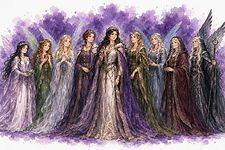
Mythopouch artistic interpretation
Details
Region
Arthurian
Regional Information Additional (if applicable)

British/Celtic
Category
Location
Historicity (actuality or factual truth of persons, events, and claims)
Mythological
Gender
N/A
Time Period
5th-6th centuries CE (mythic Arthurian period); literary tradition c. 1136-present
Symbol
The apple branch, the black barge bearing the wounded king, the mourning queens, the lead cross of Glastonbury
Tags
arthurian, avalon, island, otherworld, glastonbury, morgan-le-fay, king-arthur, camlann, excalibur, once-and-future-king, morgen, apples
Introduction - Overview
Avalon is the enchanted island at the edge of the Arthurian world, the Isle of Apples where Excalibur was forged and where King Arthur was carried, mortally wounded, after the last battle at Camlann. It is the island ruled by Morgen, the great enchantress and healer, and her eight sisters, where orchards bear fruit without sowing, where no plough is needed and no winter comes, and where the people live a hundred years and more. It is the destination of the black barge with the weeping queens that came out of the mist to take the dying king from the shore, and the bower where Morgan le Fay promised to heal his wounds if he would stay with her for long ages. It is the island that the monks of Glastonbury claimed to prove in 1191, when they dug up a hollowed oak and a leaden cross naming Arthur in the isle of Avalon. And it is the last hope of the Arthurian legend, the place where the once and future king sleeps or heals, waiting for the day of Britain's greatest need.
Gallery
Main Article - Who or What was...
Avalon
The island enters literature with Geoffrey of Monmouth, the writer who gave Arthur his European fame. In the Historia Regum Britanniae, completed around 1136, Geoffrey names Avalon twice and changes mythology with both mentions.
The sword Caliburnus, the blade later called Excalibur, was forged in the isle of Avalon. And when Arthur fell, mortally wounded in the last battle against the treachery of Mordred, he was carried away to the isle of Avalon so that his wounds might be tended by Morgen, handing his crown to his kinsman Constantine. About fifteen years later, in his long poem the Vita Merlini, Geoffrey painted the island in full. He calls it the Insula Pomorum, the Island of Apples, also named the Fortunate Isle: a place that bears harvest without plough or seed, where orchards fruit untended and the people live a hundred years and more. Nine sisters rule it - Morgen, Moronoe, Mazoe, Gliten, Glitonea, Gliton, Tyronoe, Thiten and Thiton - and the eldest and most gifted is Morgen, mistress of healing, who can change her shape and fly on strange wings like Daedalus. She received the wounded Arthur after the battle, examined his wound, and promised she could heal him if he remained with her a long time and accepted her medicine.
Geoffrey did not invent from nothing. The name Avalon comes from the Welsh afal, apple, and Welsh tradition knew an Ynys Afallach, an Isle of Apples, on the border of Annwn, the Otherworld. Gerald of Wales, writing later in the 12th century, offered two explanations for the name: the island of apples that grew without cultivation, or the realm of a certain Avalloc who lived there with his daughters. Older still is the Irish Emain Ablach, Emain of the Apples, the island home of the sea god Manannan mac Lir, to which heroes were ferried and from which they returned healed, or not at all. Behind the Celtic material stands the classical world Geoffrey had read: Isidore of Seville's description of the Fortunate Isles, where the fields bear without sowing, and the garden of the Hesperides with its golden apples of immortality. The apple is the oldest fruit of the undying land, and Avalon is where Celtic Otherworld, classical paradise and Arthurian tragedy meet.
The romances took the island and wove it into the pattern of the stories. Chretien de Troyes names Guingamor, the lover of Morgan le Fay, as lord of Avalon in Erec et Enide. In Marie de France's Lanval, the fairy mistress carries the ruined knight away on her palfrey to Avalun, a very beautiful island, and no man in the mortal world ever sees him again. Above all there is the great departure scene. In the Vulgate Cycle, and most famously in Malory's Le Morte d'Arthur, the dying Arthur commands Bedivere to cast Excalibur into the lake, and then down to the shore comes a little barge, black and hung with black cloth, bearing four queens in black hoods, all weeping: Morgan le Fay herself, the Queen of Northgales, the Queen of the Waste Lands, and Nimue, the chief lady of the lake. They lay the king in the barge, Morgan takes his head in her lap, and the barge moves from the shore into the mist. Arthur's last words to Bedivere carry the whole weight of the legend: he will go into the vale of Avalon to heal his grievous wound.
Malory refuses to let the king simply die. He writes that some men say in many parts of England that Arthur is not dead but taken into another place by the will of God, and that he shall come again; Malory himself will not affirm it, saying only that here in this world he changed his life. But he adds that many men say there is written upon Arthur's tomb the verse Hic jacet Arthurus, rex quondam, rexque futurus: Here lies Arthur, the once and future king. With that single Latin line Avalon stops being a grave and becomes a promise. Arthur joins the sleeping heroes of Europe, the kings under mountains and in caves who will wake at the hour of greatest need, and Avalon becomes the name of the door through which he will return.
The earthly address was supplied by Glastonbury Abbey. The great abbey in Somerset, set among the marshes of the Levels with the strange cone of the Tor rising above them, had nearly been an island in older times, and its monks had long claimed the oldest Christianity in Britain. In 1184 the abbey burned to the ground. Seven years later the monks announced a discovery that solved their rebuilding funds at a stroke. Acting, they said, on information passed down from King Henry II by way of a Welsh bard, they dug between two ancient pyramid stones in their cemetery and found, deep in the earth, a coffin hollowed from an oak trunk, and with it a lead cross inscribed with the words: Here lies buried the renowned King Arthur in the isle of Avalon. Gerald of Wales saw and handled the cross himself and described the bones: a giant of a man, his shin bone three fingers longer than that of the tallest man present, his skull marked with ten wounds, and beside him the bones of a woman with a lock of yellow hair, Queen Guinevere, which crumbled to dust when an eager monk snatched at it. The discovery was almost certainly a pious fraud, and a politically useful one, since a dead Arthur in English soil ended Welsh hopes of his return. But it fixed Avalon in the English landscape for ever. In 1278 Edward I and Queen Eleanor had the remains reburied in a black marble tomb before the high altar, and there they rested until the Dissolution destroyed the abbey in 1539. When Ralegh Radford excavated the site in 1962 he confirmed that a grave had indeed been opened in the 12th century exactly where the monks claimed, though whose grave it was, no spade can say.
The afterlife of the island flows through the poets. Tennyson made it the island-valley of Avilion, "Where falls not hail, or rain, or any snow, Nor ever wind blows loudly", and his dying Arthur passes toward it at dawn with the sound of a great welcome on the water. Marion Zimmer Bradley's The Mists of Avalon retold the whole cycle from the perspective of Morgan and the women of the island, making Avalon the last stronghold of the old religion against the new. On screen and in song the name has become shorthand for any hidden, healing otherworld. And Glastonbury itself, Tor and abbey ruins and all, remains a place of pilgrimage for everyone who wants the story to be true, which in the end is what Avalon has always been for: the island where the story is not allowed to end, where the king is not dead but only changed, and where beyond the mist the apple trees are still in bloom.
Summary
Avalon endures as the most beautiful consolation in Arthurian legend, the Isle of Apples where the wounded king went to be healed and from which he has never quite returned. From Geoffrey's Fortunate Isle of nine enchantresses to the black barge of Malory's weeping queens, from the monks' leaden cross at Glastonbury to Tennyson's island valley, it has always stood at the border of death and hope. It is the reminder that the Arthurian story refuses to end, that the king is not dead but changed, and that somewhere beyond the mist the orchards are still in bloom and the healing hands are waiting.
Now enter the Mythopouch World!
You’ve discovered:
Avalon
From Myth to Game
Join to access FREE real-world mythology "Learn Quests" and "Courses". Sign up to the newsletter for new releases, game updates, insider news, and more as Mythopouch brings real mythology to life. EARN the right to purchase an offline board game by completing FREE modules.


It's FREE to join as a MEMBER!
Not ready to join? Get the newsletter instead below



Looking for others?
Click into the field below to search, or click the icon to go to full page search function!

References
Validation References:
- Geoffrey of Monmouth, Historia Regum Britanniae, c. 1136 - first appearance of Avalon; Caliburn forged there; the wounded Arthur carried there
- Geoffrey of Monmouth, Vita Merlini, c. 1150 - the full description of the Insula Pomorum, Morgen and her nine sisters
- Chretien de Troyes, Erec et Enide, c. 1170 - Guingamor, lord of Avalon, and Morgan his lover
- Marie de France, Lanval, c. 1170-1210 - the knight carried away to Avalun by his fairy mistress
- Gerald of Wales, Liber de Principis Instructione, c. 1193 - eyewitness account of the lead cross and the exhumed bones at Glastonbury
- Isidore of Seville, Etymologiae, 7th century - the Fortunate Isles tradition behind Geoffrey's description
- Lancelot-Grail (Vulgate Cycle), c. 1215-1235 - the barge and Arthur's passage to Avalon
- Thomas Malory, Le Morte d'Arthur, c. 1470 (Caxton edition 1485) - the four queens, the vale of Avalon and the "once and future king" epitaph
- Tennyson, Alfred Lord, Idylls of the King, 1859-1885 - the island-valley of Avilion
- Bradley, Marion Zimmer, The Mists of Avalon, 1983 - modern retelling from the perspective of Morgan and the women of Avalon
- Ashe, Geoffrey, King Arthur's Avalon: The Story of Glastonbury (Collins, 1957) - classic study of the Glastonbury tradition
- Carley, James P., Glastonbury Abbey: The Holy House at the Head of the Moors Adventurous (St. Martin's Press, 1988) - scholarly history of the abbey and the 1191 exhumation