
Details
Region
Greek
Regional Information Additional (if applicable)

Category
Deity
Historicity (actuality or factual truth of persons, events, and claims)
Mythological
Gender
Female
Time Period
Mythological Age
Symbol
Wheat Sheaf
Tags
greek, god, agriculture, harvest, rebirth
Introduction - Overview
Demeter is the goddess who holds the power of life and death over every field of grain, every orchard, and every vine across the earth. She is the mother whose grief for her stolen daughter Persephone stopped the world from turning, plunging the earth into famine until the gods themselves begged for mercy. She is the founder of the Eleusinian Mysteries, the secret rites that promised initiates a blessed afterlife and drew thousands of pilgrims to her sanctuary near Athens for nearly two thousand years. She is the teacher who gave the gift of agriculture to the prince Triptolemos, sending him across the world in a winged chariot drawn by serpents to spread the knowledge of wheat and barley. And she is the fierce protector who nearly burned a mortal baby alive in her attempt to make him immortal, only to be interrupted by the child's terrified mother. Every harvest, every spring blossom, and every winter frost is a chapter in her story.
Gallery


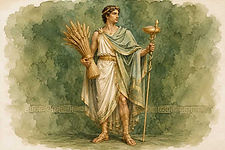
Demeter Olympian goddess of harvest in various depictions.
Main Article - Who or What was...
Demeter
Demeter was born to the Titans Cronus and Rhea, the sister of Hestia, Hera, Poseidon, Hades, and Zeus. When Cronus, fearing a prophecy that one of his children would overthrow him, swallowed each newborn god, Rhea saved Zeus by hiding him on Crete. Zeus later forced Cronus to disgorge his siblings, and together they waged the Titanomachy, the war between the old Titans and the young Olympian gods. When the Olympians won, Zeus divided the world among himself and his brothers. Poseidon took the sea, Hades took the underworld, and Zeus took the sky. Demeter received no realm of her own, but her power was greater than any territory: she controlled the fertility of the earth itself, the grain that fed every mortal city and every god's feast. She bore a daughter to Zeus, Persephone, a girl of such beauty that the flowers themselves seemed to bend toward her.
One day, while Persephone was gathering flowers in a meadow near Enna in Sicily, the earth split open with a deafening crack. Hades, the grim ruler of the underworld, burst forth in his golden chariot drawn by immortal black horses, seized the screaming girl, and plunged back into the darkness. Only Hecate, the goddess of the crossroads who heard all cries in the night, and Helios, the sun god whose bright chariot sees everything upon the earth, witnessed the abduction. Demeter heard her daughter's cry and tore across the land in fury, carrying two blazing torches, searching day and night without rest or food. For nine days she wandered, until Hecate led her to Helios, who told her the terrible truth: Zeus had given Persephone to his brother Hades as a bride. Demeter's grief turned to rage. She abandoned Olympus, disguised herself as an old mortal woman, and wandered the earth in despair, forbidding any seed to sprout or tree to bear fruit. Famine gripped the world. The gods begged Zeus to intervene, for without Demeter's blessing, mortals would die and the gods would have no sacrifices to sustain them.
Zeus sent Hermes, the swift messenger god, to the underworld to demand Persephone's return. Hades agreed, but before she left, he offered her a pomegranate. Hungry after her ordeal, Persephone ate several seeds--some say four, others six or seven. Because anyone who tastes the food of the underworld is bound to return, Persephone was now tied to Hades's realm for part of every year. Zeus brokered a compromise: Persephone would spend part of the year with her mother and part with Hades. When Demeter has her daughter, the earth blooms and the grain ripens in spring and summer. When Persephone descends again to the underworld, Demeter's grief returns, and the earth grows barren in autumn and winter. This is why the seasons turn, why the fields die and are reborn, and why no mortal can escape the cycle of loss and return.
During her wandering, Demeter came to Eleusis, a town on the coast of Attica fourteen miles northwest of Athens. Disguised as an old woman named Doso, she was taken into the royal household of King Celeus and Queen Metaneira. She was offered the job of nurse to the infant prince Demophoon. Each night, Demeter anointed the baby with ambrosia and placed him in the fire to burn away his mortal flesh and make him immortal. But one night, Metaneira spied on the nurse and screamed when she saw her baby in the flames. Demeter revealed her true divine form in a blinding flash, and the palace shook. Enraged that her gift had been interrupted, she demanded that the Eleusinians build her a great temple and sanctuary. There, she taught the secrets of agriculture to the king's son Triptolemos, and she established the Eleusinian Mysteries, the most sacred and secret rites in all of Greece. For nearly two thousand years, initiates from every corner of the Mediterranean--slaves and emperors alike--journeyed to Eleusis to walk the Sacred Way, to fast and purify themselves, and to drink the kykeon, a sacred barley potion, in the hope of gaining a blessed afterlife.
Demeter's worship was not confined to Eleusis. She had temples across the Greek world, from Sicily to Asia Minor. The Thesmophoria, her most important women's festival, was celebrated in autumn by married women across Greece, who camped for three days on hillsides, fasting and performing secret rites with piglets and pine cones to ensure the fertility of the next year's crops. At Syracuse, her festivals drew massive crowds. Even after the Christian emperor Theodosius I banned the Mysteries in 392 CE, the memory of Demeter endured. Her name survives in the word "cereal," derived from her Roman counterpart Ceres. Every loaf of bread, every autumn harvest, and every spring planting is a quiet echo of the goddess who once stopped the world to mourn her daughter.
Summary
Demeter stands as the eternal guardian of the harvest, the mother whose love and loss shape the turning of the seasons. From the golden fields of Eleusis to the secret caves of Crete, from the torches that lit her nine-day search to the winged serpent chariot of Triptolemos, her story binds the mortal world to the divine. Every kernel of wheat, every pomegranate seed, and every autumn frost carries her memory, a reminder that abundance and grief are inseparable, and that the earth itself mourns and rejoices in the rhythm of a daughter's return.
Now enter the Mythopouch World!
You’ve discovered:
Demeter
From Myth to Game
Join to access FREE real-world mythology "Learn Quests" and "Courses". Sign up to the newsletter for new releases, game updates, insider news, and more as Mythopouch brings real mythology to life. EARN the right to purchase an offline board game by completing FREE modules.


It's FREE to join as a MEMBER!
Not ready to join? Get the newsletter instead below



Looking for others?
Click into the field below to search, or click the icon to go to full page search function!

Looking for Mythology Insights?


Click below to view our mythology blog article insights, where we delve into the current Mythopouch Tier regions, and what we think you should know!
Sources & Retellings
Explore the original mythological Source texts (most from over 75 years ago, some as translated, possibly with mature content) and Mythopouch's source Retellings (a modern retelling also suitable for 15+) connected to this mythological entity. We are growing this resource and will link these in the future; for now, check the References below, then find the Sources or Retellings on those pages!


References
Validation References:
- Homeric Hymn 2 to Demeter (abridged), trans. Evelyn-White (Greek epic C7th or C6th BCE) - Persephone's abduction, Demeter's search, and the founding of the Mysteries
- Hesiod, Theogony 912 ff (trans. Evelyn-White) (Greek epic C8th or C7th BCE) - parentage of Demeter and birth of Persephone
- Pseudo-Apollodorus, Bibliotheca 1.29 (trans. Aldrich) (Greek mythographer C2nd CE) - the abduction and the pomegranate
- Pausanias, Description of Greece 1.38.5, 8.42 (Greek travelogue C2nd CE) - the rape at Eleusis and the sanctuary
- Foley, Helene P., The Homeric Hymn to Demeter: Translation, Commentary, and Interpretive Essays (Princeton University Press, 1999)
- Burkert, Walter, Greek Religion (Harvard University Press, 1985) - Chapter 4, "The Eleusinian Mysteries"
- Mylonas, George E., Eleusis and the Eleusinian Mysteries (Princeton University Press, 1961)
- Kerenyi, Karl, The Gods of the Greeks (Thames and Hudson, 1951) - Chapter 6, "Demeter and Kore"
Cultural Context Notice
Mythology developed across different cultures, periods and traditions, and there is rarely one universally accepted version of a story. Mythopouch approaches these traditions with respect while remaining faithful to the complexity of the surviving material. Retellings and educational content may interpret or adapt historical sources, but are not presented as definitive accounts of any culture, religion or belief system.