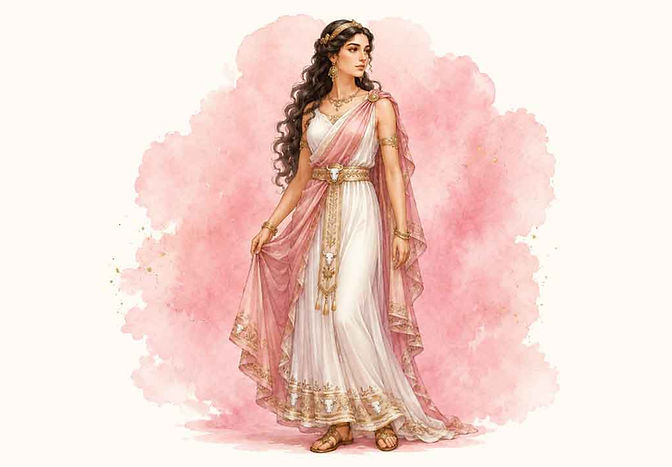

Details
Regional Information Additional (if applicable)
Greek
Region
Category
Person
Historicity (actuality or factual truth of persons, events, and claims)
Legendary
Gender
Female
Time Period
c. 8th-7th century BCE (literary tradition); mythic Bronze Age
Symbol
Cow head
Tags
greek-mythology, europa, zeus, white-bull, crete, minos, europe, taurus
Introduction - Overview
Europa is the Phoenician princess whose abduction by Zeus, the king of the gods, in the form of a magnificent white bull gave her name to the continent of Europe and set in motion her brother Cadmus's founding of Thebes. She is the daughter of King Agenor of Tyre and Queen Telephassa, the sister of Cadmus who sowed the dragon's teeth to found Thebes, of Cilix who gave his name to Cilicia, and of Phoenix who gave his name to the Phoenicians. She is the mother of Minos, the king of Crete whose labyrinth held the Minotaur, a creature half man and half bull; of Rhadamanthus, who would become one of the three judges of the dead in the underworld; and of Sarpedon, the Lycian prince who would fall at Troy. She is the maiden who rode the bull across the Mediterranean Sea from the shores of Tyre to the island of Crete, where Zeus revealed his true form beneath a cypress on Mount Ida. And she is the namesake of an entire continent, the word "Europe" deriving from her name, a legacy that has outlasted every empire that rose and fell upon the land.
Gallery
Main Article - Who or What was...
Europa
Europa was born in Tyre, the Phoenician city on the coast of Lebanon, to King Agenor and Queen Telephassa. She had three brothers: Cadmus, who would found Thebes by sowing dragon's teeth; Cilix, whose name would be given to Cilicia; and Phoenix, whose name became that of the Phoenicians. Europa was renowned for her extraordinary beauty. She dreamed Asia and a nameless land fought over her, with the nameless land prevailing. The dream was an omen, though Europa did not understand it.
One day, while Europa played with her maidens on the seashore near Tyre, a white bull appeared among them. The creature was beautiful, hide gleaming like snow, horns curved like the crescent moon, breath smelling of crocuses. It was gentle and tame, and the maidens dared to approach it. Europa, enchanted, wove flowers into its horns and climbed upon its broad back. The moment she was seated, the bull plunged into the sea and began to swim. It was Zeus, the king of the gods, who had transformed himself to escape his wife Hera, queen of Olympus, notoriously jealous of his affairs with mortal women. The bull swam across the Mediterranean with Europa on its back, while the Nereids, fifty sea-nymph daughters of the old sea-god Nereus, rose to marvel, and Poseidon calmed the waters.
They landed on Crete, beneath a cypress on Mount Ida, the mountain where Zeus had been hidden as an infant to escape his father Cronus, the Titan who swallowed his own children. There Zeus shed his bull form and revealed himself. He lay with Europa beneath the cypress, and from their union three sons were born. The first was Minos, who would become king of Crete. The second was Rhadamanthus, a man of such justice that after his death he would be made a judge of the dead in the underworld, realm ruled by Hades. The third was Sarpedon, who would rule Lycia and fight at Troy. After bearing these sons, Europa married Asterion, king of Crete, who raised the boys as his own heirs.
Minos became the most famous of her children. He prayed to Poseidon for a sign of divine favour, and Poseidon sent a white bull from the waves. Minos was supposed to sacrifice it, but he kept it, and in revenge Poseidon caused Minos's wife Pasiphae, daughter of the sun-god Helios, to fall in love with the bull. From that union came the Minotaur, a creature half man and half bull that fed on human flesh, which Minos imprisoned in the Labyrinth designed by Daedalus. Rhadamanthus was driven from Crete by Minos and became a judge of the dead in the underworld. Sarpedon went to Lycia and became a great warrior. When the Trojan War broke out, he led the Lycian forces to Troy and was slain by Patroclus, beloved companion of Achilles.
Europa herself did not return to Phoenicia. She remained on Crete, honoured as wife of the king and mother of heroes. But her name lived on in ways she never imagined. The land to the north and west of the Greek world came to be called Europe in her honour, and the name eventually covered the continent. In the heavens, Zeus placed the image of the white bull among the stars as the constellation Taurus, so that the animal that carried her across the sea would be remembered. In art, Europa was depicted riding the bull across the waves, her garments flowing behind her, a scene that became one of the most enduring images of Greek mythology, painted by artists from vase-painters to the Renaissance masters.
Summary
Europa stands as the bridge between East and West, the Phoenician princess whose abduction by a god gave her name to a continent and whose sons shaped legends of Crete, justice, and war. From the seashore of Tyre to the cypress groves of Mount Ida, from the white bull that carried her across the sea to the constellation that remembers it, her story is one of beauty that launches empires and names that outlast. Every map that shows Europe, every star chart that marks the Bull, and every painting of a maiden riding a wave-borne beast carries the memory of the girl who crossed the Mediterranean on the back of a god and changed the world forever.
Now enter the Mythopouch World!
You’ve discovered:
Europa
From Myth to Game
Join to access FREE real-world mythology "Learn Quests" and "Courses". Sign up to the newsletter for new releases, game updates, insider news, and more as Mythopouch brings real mythology to life. EARN the right to purchase an offline board game by completing FREE modules.


It's FREE to join as a MEMBER!
Not ready to join? Get the newsletter instead below


Looking for others?
Click into the field below to search, or click the icon to go to full page search function!

References
Validation References:
- Moschus, Europa (c. 2nd century BCE) - Lines 1-165 (the complete narrative of Europa's abduction by Zeus as a bull)
- Homer, Iliad (c. 750 BCE) - Book 2, Lines 876-877; Book 16, Lines 419-683 (Sarpedon at Troy, his lineage and death)
- Apollodorus, Bibliotheca (1st-2nd century CE) - Book 3, Chapter 1 (Europa and the bull, her sons and their fates)
- Ovid, Metamorphoses (c. 8 CE) - Book 2, Lines 833-875 (the abduction of Europa, the bull, the sea journey)
- Pausanias, Description of Greece (2nd century CE) - Book 3.13.3 (Europa at Amyclae); Book 7.20.1-7.20.2 (Europa at Sparta)
- Herodotus, Histories (c. 440 BCE) - Book 1.1-1.2 (Europa as a Phoenician woman); Book 4.45 (Europe named after her)
- West, M.L. The Hesiodic Catalogue of Women: Its Nature, Structure, and Origins (1985) - Oxford University Press, pp. 120-128 (Europa in the Catalogue of Women)
- Burkert, Walter. Greek Religion (1985) - Harvard University Press, Chapter 3 (Europa and the bull cult in Greek religion)
- Gantz, Timothy. Early Greek Myth: A Guide to Literary and Artistic Sources (1993) - Johns Hopkins University Press, Vol. 1, pp. 208-213 (Europa narrative survey)
- Lopez-Ruiz, Carolina. When the Gods Were Born: Greek Cosmogonies and the Near East (2010) - Johns Hopkins University Press, Chapter 4 (Europa and Near Eastern parallels)
- Dowden, Ken. The Uses of Greek Mythology (1992) - Routledge, Chapter 3 (Europa as colonisation myth)