Details
Regional Information Additional (if applicable)
Greek
Region
Category
Creature/Monster/Animal
Historicity (actuality or factual truth of persons, events, and claims)
Mythological
Gender
N/A (masculine form)
Time Period
c. 3rd century BCE (literary record in Apollonius Rhodius's Argonautica)
Symbol
Bronze Guard
Tags
greek, guardian, bronze-sentinel, relentless, protector, protect
Introduction - Overview
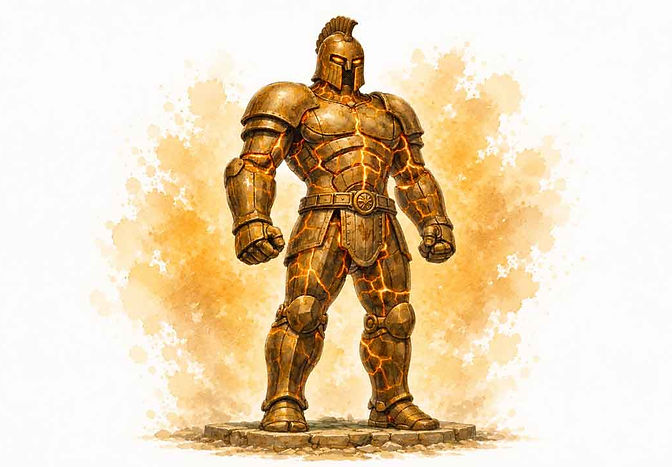
Talos is the bronze giant who circled the island of Crete three times each day, hurling boulders at any ship that approached its shores, the last survivor of the bronze race of men and the most terrifying guardian in all of Greek mythology. He is the automaton forged by Hephaestus, the divine smith whose forge lay beneath a volcano and whose skill with hammer and anvil could craft wonders beyond mortal imagination, or given by Zeus, the king of the gods and wielder of the thunderbolt, to his lover Europa, the Phoenician princess whom the god had carried to Crete in the form of a white bull, to protect her and her descendants. He is the giant whose body was made entirely of bronze, impenetrable to sword or spear, and whose single vein of ichor, the golden blood of the gods, ran from his neck to his ankle, sealed at the end by a bronze nail or a membrane of skin. He is the sentinel who was finally destroyed by the witch-goddess Medea, the sorceress princess of Colchis who had helped Jason steal the Golden Fleece and who used her magic to drive Talos mad or to remove the nail that sealed his lifeblood, causing the ichor to drain out and the giant to fall dead upon the Cretan rocks. He is the ancestor of every robot and automaton in Western imagination, the first artificial being in literature, a creature of metal and divine craft that walked, thought, and died like a man. And he is the symbol of the boundary between the age of bronze and the age of heroes, the last remnant of an older world that the gods had replaced with flesh and blood.
Gallery
Main Article - Who or What was...
Talos
Talos was born in the earliest age of the world, when the gods had not yet created mortal men as they would later be known. According to Hesiod, the poet who sang of the origins of the gods and the cosmos, there were five ages of man: the golden age, when men lived like gods without toil or pain; the silver age, when men were foolish and impious; the bronze age, when men were made of bronze and destroyed themselves with war; the age of heroes, when the great warriors of Greek myth lived and died; and the iron age, the present age of toil and sorrow. The bronze race was a generation of men born from the ash trees, hard and warlike, their weapons and their armor and their very bodies made of bronze. They were terrible and strong, and they destroyed one another in endless combat until none remained. But Talos, or so the later poets said, was the last of this race, preserved by the gods to serve as a guardian rather than a warrior, a sentinel rather than a soldier, and he was given to Europa, the Phoenician princess whose beauty had so moved Zeus that he had transformed himself into a magnificent white bull, carried her across the sea to Crete, the large island south of the Greek mainland, and made her the mother of Minos, the legendary king who would build the Labyrinth and rule the first great sea empire of the ancient world.
Talos's body was a marvel of divine craftsmanship, or of natural wonder, depending on the telling. He stood as tall as a mountain, or as tall as a man, the sources disagree, but his form was always of bronze, not flesh, and his strength was beyond any mortal's. He circled the island of Crete three times each day, walking the coast with giant strides, his bronze feet striking sparks from the rocks, his eyes scanning the horizon for any ship that dared to approach. When he saw a vessel, he tore boulders from the cliffs and hurled them with the force of a catapult, smashing hulls and drowning crews before they could land. He was not malicious but dutiful, a guardian who knew no other purpose, and the Cretans left offerings for him at the shore, knowing that his vigilance protected them from pirates and invaders. Some said he was a gift from Hephaestus to Minos, forged in the divine smith's volcano-forge and animated by the gods' power. Others said he was the last survivor of the bronze race, preserved by Zeus as a favor to Europa. Still others said he was the son of the Cretan smith Kres, or of the goddess Thetis, the sea-nymph who was the mother of Achilles, the greatest warrior of the Trojan War. But all agreed on his nature: he was a being of metal and ichor, not flesh and blood, and his death would come not from battle but from the loss of the divine fluid that animated him.
The destruction of Talos came during the voyage of the Argonauts, the band of heroes led by Jason who sailed in the ship Argo to claim the Golden Fleece from the distant kingdom of Colchis. On their return journey, the Argonauts approached Crete, hoping to land and take on fresh water and supplies. But Talos saw them from the cliffs and began his attack, hurling boulders that smashed the water around the Argo and threatened to sink her. The heroes could not fight him, for his bronze body was impenetrable, and no sword or arrow could harm him. It was Medea, the witch-princess of Colchis who had joined the Argonauts after helping Jason steal the fleece with her magic, who devised the means of his death. Medea was a sorceress of terrifying power, the granddaughter of Helios, the sun god who drove his blazing chariot across the sky, and she knew the secrets of drugs, poisons, and spells that could bend the will of gods and men. She approached Talos, or sent her magic against him, and in the most famous version of the story, she used her powers to drive him mad, promising him immortality if he would remove the bronze nail that sealed the vein of ichor at his ankle. Talos, in his confusion, did so, and the golden blood of the gods poured out like molten metal, draining his life away. He fell upon the rocks of Crete with a crash that shook the island, and the bronze giant moved no more.
In another version, Medea did not deceive Talos but attacked him directly with her magic. She cast a spell of binding upon him, or sent a demon to torment him, and while he was distracted, the hero Poeas, an Argonaut of great skill with the bow, shot an arrow that struck the membrane covering the vein at his ankle, causing the ichor to leak out. In yet another version, the Argonauts themselves managed to wrestle Talos to the ground and hold him while Medea removed the nail. But all versions agree on the essential fact: Talos was destroyed by the loss of his ichor, the divine blood that animated his bronze form, and that without it, he was nothing but a statue, a hollow shell of metal upon the rocks. The Argonauts landed safely, took what they needed, and sailed away, leaving the giant's body where it fell, and the Cretans mourned the loss of their guardian, for no other power could replace him.
Talos has haunted the Western imagination for three thousand years as the first artificial being in literature, the ancestor of every robot, android, and automaton that followed. The Greeks did not have a word for robot, but they had the concept: a being made by craft rather than nature, animated by divine power rather than birth, and capable of thought and action but not truly alive. Talos was not a man, for he was made of bronze, but he was not a statue, for he walked and watched and threw boulders. He existed in the uncanny valley between the living and the made, and his death raised questions that still resonate today: what is the difference between a creature and a machine? Can a being of metal have a soul? And if it can, does its destruction count as murder? The myth of Talos was revived in the Renaissance, when automata became fashionable in European courts, and again in the modern age, when science fiction has made the robot a central figure of anxiety and wonder. Every story of a machine that thinks, every debate about artificial intelligence and consciousness, every fear of the made thing that turns against its maker, carries the shadow of Talos, the bronze giant who guarded Crete until a witch and an arrow brought him down, and whose fall marked the end of the age of bronze and the beginning of the age of heroes, when men were made of flesh and their guardians were made of courage rather than metal.
Summary
Talos endures as the primal automaton, the bronze sentinel whose destruction marks the boundary between divine craft and mortal courage, between the age of metal men and the age of flesh. From the forge of Hephaestus to the cliffs of Crete, from the boulders that smashed ships to the ichor that drained upon the rocks, his story is a meditation on what it means to be alive, what it means to be made, and what happens when the made thing outlasts the age that created it. Every robot in fiction, every fear of artificial intelligence, every wonder at the machine that moves like a man has its ancestor in Talos, the bronze giant who circled Crete three times a day and fell to a single nail.
Now enter the Mythopouch World!
You’ve discovered:
Talos
From Myth to Game
Join to access FREE real-world mythology "Learn Quests" and "Courses". Sign up to the newsletter for new releases, game updates, insider news, and more as Mythopouch brings real mythology to life. EARN the right to purchase an offline board game by completing FREE modules.


It's FREE to join as a MEMBER!
Not ready to join? Get the newsletter instead below


Looking for others?
Click into the field below to search, or click the icon to go to full page search function!

References
Validation References: - Hesiod, Works and Days, lines 140-155 (c. 700 BCE) - the five ages of man, the bronze race
- Apollonius Rhodius, Argonautica, Book 4, lines 1638-1688 (3rd century BCE) - Medea and the destruction of Talos
- Apollodorus, Bibliotheca, Book 1, chapter 9.26 (1st-2nd century CE) - Talos as the last of the bronze race, guardian of Crete
- Pausanias, Description of Greece, Book 1, chapter 21.4 (2nd century CE) - bronze statue of Talos at Olympia
- Simonides, Fragment 568 (6th-5th century BCE) - early reference to Talos as the Cretan guardian
- Diodorus Siculus, Bibliotheca Historica, Book 4, chapter 77.1 (1st century BCE) - Talos as the son of Kres, the Cretan smith
- Mayor, Adrienne, Gods and Robots: Myths, Machines, and Ancient Dreams of Technology (Princeton University Press, 2018) - comprehensive study of Talos and ancient automata in Greek myth
- Kang, Minsoo, Sublime Dreams of Living Machines: The Automaton in the European Imagination (Harvard University Press, 2011) - discussion of Talos as the ancestor of the robot in Western literature