
Details
Region
Greek
Regional Information Additional (if applicable)
Category
Creature/Monster/Animal
Historicity (actuality or factual truth of persons, events, and claims)
Mythological
Gender
Female
Time Period
Archaic Greek mythology (8th century BCE onward); localized in the Strait of Messina by the Classical period
Symbol
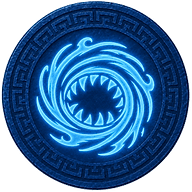
Teeth Whirlpool
Tags
greek, monster, sea, whirlpool, strait-of-messina
Introduction - Overview
Charybdis is the whirlpool monster of the Strait of Messina, a creature condemned by Zeus himself to swallow and spew the sea three times each day, a terror so absolute that even the earthquake god Poseidon could not save a man caught in her maw. She is the daughter of Poseidon, the god-king of the sea, and Gaia, the Earth mother from whom all life sprang, a being born of the two most ancient forces of the world and twisted into an instrument of endless hunger. She is the monster that nearly destroyed Odysseus, the hero of the Trojan War, swallowing his ship and crew whole after they had already survived the six-headed Scylla, leaving him clinging to a wild fig tree above her abyss until she vomited forth the wreckage he could ride to safety. She is the impossible choice that gave rise to one of the most enduring phrases in human language, the origin of "between Scylla and Charybdis," which means to be caught between two evils with no safe path between them. And she is the eternal symbol of the sea's treacherous power, the proof that the ocean does not need teeth or claws to kill, only the patience to wait and the strength to swallow everything that comes within her reach.
Gallery
Main Article - Who or What was...
Charybdis
Charybdis first appears in the eighth-century BCE epic poetry of Homer, in Book 12 of the Odyssey, where the sorceress Circe, the powerful witch who had transformed Odysseus's men into swine and later became his lover and guide, warned the hero of the terrors that awaited him on his voyage home to Ithaca. Circe described two cliffs that lay side by side in a narrow strait, an arrow-shot apart, each bearing a monster that no ship could pass without facing death. The first cliff was jagged and high, wreathed in dark cloud that never parted, and halfway up its face was the cave of Scylla, a six-headed monster with twelve feet and three rows of sharp teeth in each mouth, a creature born from the jealousy of the sorceress Circe herself in another tale. But the second cliff was lower, and upon it grew a great fig-tree with shaggy leaves. Beneath that tree, awesome Charybdis sucked the dark water down. Three times a day she belched it forth, three times in hideous fashion she swallowed it down again. Circe's warning was stark and absolute: pray not to be caught there when the whirlpool swallows down, for not even Poseidon, the earthquake god and ruler of the sea, could save a man from destruction then.
The origin of Charybdis lies in her parentage and her crime. She was the daughter of Poseidon, the god-king of the sea whose chariot was drawn by horses with brazen hooves across the waves, and Gaia, the primordial Earth goddess who had given birth to the Titans and the Giants before the Olympian gods rose to power. In some accounts, she was the daughter of Pontus, the ancient personification of the sea itself, and Gaia, an even older lineage that made her a creature of the deep places before the gods of Olympus claimed dominion. Charybdis served her father loyally, aiding him in his feud against her paternal uncle Zeus, the king of the gods who ruled from Mount Olympus with his thunderbolt. She helped Poseidon expand his kingdom by engulfing lands and islands in water, flooding the earth to claim it for the sea. For this transgression, for the land she stole from him and the chaos she spread, Zeus struck her down with a thunderbolt and cast her into the sea, chaining her to the seabed in the strait that would bear her terror for eternity. In another version of her origin, she was a voracious woman who stole the cattle of Heracles, the greatest of Greek heroes, during his tenth labor when he seized the cattle of the triple-bodied giant Geryon. Zeus hurled her into the sea with the same thunderbolt, and there she retained her voracious nature, transformed into a living hunger that could never be satisfied.
The first encounter between Odysseus and Charybdis came as the hero and his crew rowed through the strait after surviving the island of the Sirens, the singing creatures whose voices lured sailors to destruction on the rocks. Circe had advised Odysseus to steer closer to Scylla's cliff and row past as quickly as possible, for while Scylla would take six of his men, one for each of her six heads, Charybdis would swallow the entire ship and every man aboard. It was the lesser of two evils, a choice no captain should ever have to make. Odysseus followed her counsel, and as they rowed past the lower cliff, he saw Charybdis sucking the salt water in, the sea seething and swirling through all her depths like a cauldron set on a great fire, the spray falling down on the tops of the two rocks. When she spewed it forth, the sea-floor came to view, dark and sandy, the rock roaring hideously around her. Ashy terror seized the crew. At that very moment, even as they stared at the whirlpool in fear of death, Scylla snatched up the six strongest men from inside the ship and devoured them screaming, her heads darting down from the high cave while Charybdis churned below. Odysseus had chosen the path Circe recommended, but the price was paid in blood either way.
The second encounter was worse. After leaving the island of Thrinacia, where Odysseus's crew had slaughtered the sacred cattle of Helios, the sun god, despite the hero's warnings, Zeus sent a raging storm to punish their impiety. The west wind abated, but the south wind came at once to plague them, forcing the ship backward toward the strait they had barely survived. All night they were carried thus, and at sunrise they reached Scylla's rock and murderous Charybdis once more. Just as they arrived, the whirlpool swallowed the salt water, and the ship was drawn into her maw. The timbers were torn apart, the mast splintered, and the crew were lost in the churning darkness. Odysseus alone survived, thrown clear by the violence of the water. He grasped the wild fig tree that grew on the rock above Charybdis's lair, clinging to it like a bat, for there was no firm foothold and no chance of climbing, the roots far below and the branches hanging out of reach overhead. He held on grimly, hands and feet wrapped around the trunk, while the father of gods and men, Zeus himself, ensured that Scylla did not spy him from her high cave, or he would never have escaped the precipice of destruction. For hours he hung there, waiting, until about the hour when a judge in court stands up and goes home to dine, the timbers of his ship swam up again from Charybdis's depths. He let himself drop, hands and feet together, and fell with a crash into mid-strait, clambering onto the wreckage and rowing with his hands. The raft drifted to the island of Ogygia, where the nymph Calypso would hold him captive for seven years before the gods finally ordered his release.
Charybdis was not the only hero's trial. Jason and the Argonauts, sailing home from Colchis with the Golden Fleece after retrieving it from the dragon-guarded grove of King Aeetes, also had to pass through the strait. But Jason was favored by Hera, the queen of the gods and protector of heroes, and she asked the Nereid Thetis, one of the fifty sea-nymph daughters of the old sea-god Nereus, to guide the Argo safely through. Thetis and her sisters steered the ship past both monsters, and the Argonauts emerged unscathed, the only crew in Greek legend to survive the passage without loss. In Virgil's Aeneid, the Trojan hero Aeneas, fleeing the burning ruins of Troy to found the city that would become Rome, was warned by the prophet Helenus to take a longer detour around Sicily rather than risk the strait, and so he avoided Charybdis entirely, a wisdom that Odysseus had not possessed. The whirlpool itself was real enough to the Greeks, a natural terror in the Strait of Messina caused by currents meeting between the Ionian and Tyrrhenian Seas, dangerous to small craft in extreme conditions. But the myth made it immortal, a creature that personified the impossible choice, the danger that could not be fought, only endured or avoided. From Homer's eighth-century verses to the medieval proverb recorded by Erasmus in his Adagia, from the Latin evitata Charybdi in Scyllam incidi to the modern English "between a rock and a hard place," Charybdis has remained the symbol of being trapped between two mortal perils with no clean escape, a monster whose legacy is woven into the very language of dilemma.
Summary
Charybdis endures as one of the most terrifying monsters of the ancient world, not because she had teeth or claws or a hunger for flesh, but because she was a force of nature given monstrous form, an endless whirlpool that swallowed ships whole and left no survivors to tell the tale. From her origins as the daughter of Poseidon and Gaia, punished by Zeus's thunderbolt for flooding the earth, to her two devastating encounters with Odysseus that cost him his ship and all his remaining crew, to the safe passage she granted only to Jason's Argo through divine intervention, Charybdis represents the sea at its most impersonal and deadly. She is the ancestor of every whirlpool and maelstrom that haunts the sailor's imagination, the reason the phrase "between Scylla and Charybdis" still means choosing between two evils with no safe path, and the eternal proof that the ocean's greatest terrors need no face, only the patience to wait and the strength to swallow everything that drifts within their reach.
Now enter the Mythopouch World!
You’ve discovered:
Charybdis
From Myth to Game
Join to access FREE real-world mythology "Learn Quests" and "Courses". Sign up to the newsletter for new releases, game updates, insider news, and more as Mythopouch brings real mythology to life. EARN the right to purchase an offline board game by completing FREE modules.


It's FREE to join as a MEMBER!
Not ready to join? Get the newsletter instead below


Looking for others?
Click into the field below to search, or click the icon to go to full page search function!

Looking for Mythology Insights?


Click below to view our mythology blog article insights, where we delve into the current Mythopouch Tier regions, and what we think you should know!
Sources & Retellings
Explore the original mythological Source texts (most from over 75 years ago, some as translated, possibly with mature content) and Mythopouch's source Retellings (a modern retelling also suitable for 15+) connected to this mythological entity. We are growing this resource and will link these in the future; for now, check the References below, then find the Sources or Retellings on those pages!


References
Validation References:
- Homer, Odyssey, Book 12, lines 73-110 (8th century BCE) - Circe's warning to Odysseus about Charybdis and Scylla
- Homer, Odyssey, Book 12, lines 231-259 (8th century BCE) - first passage through the strait, Scylla takes six men while Charybdis churns
- Homer, Odyssey, Book 12, lines 430-446 (8th century BCE) - second encounter, ship destroyed, Odysseus clings to fig tree
- Homer, Odyssey, Book 23, line 322 (8th century BCE) - reference to grim Charybdis and Scylla
- Pseudo-Apollodorus, Bibliotheca, Epitome 7.21-23 (2nd century CE) - Odysseus's raft sucked into Charybdis, he grabs fig tree and escapes
- Scholia on Homer's Odyssey (ancient Greek scholia) - parentage as daughter of Pontus and Gaia or Poseidon and Gaia, chained to seabed by Zeus
- Virgil, Aeneid, Book 3, lines 420-423 (1st century BCE) - Helenus warns Aeneas to avoid Charybdis by sailing around Sicily
- Servius, Commentary on Virgil's Aeneid 3.420 (4th-5th century CE) - Charybdis as voracious woman who stole Heracles' cattle, cast into sea by Zeus
- Erasmus, Adagia, 3.3.6 (1515 CE) - proverb "evitata Charybdi in Scyllam incidi" and Greek equivalent
- Papadopoulos, John K. and Ruscillo, Deborah, "A Ketos in Early Athens: An Archaeology of Whales and Sea Monsters in the Greek World," American Journal of Archaeology 106.2 (2002): 187-227
Cultural Context Notice
Mythology developed across different cultures, periods and traditions, and there is rarely one universally accepted version of a story. Mythopouch approaches these traditions with respect while remaining faithful to the complexity of the surviving material. Retellings and educational content may interpret or adapt historical sources, but are not presented as definitive accounts of any culture, religion or belief system.