Details
Region
Greek
Regional Information Additional (if applicable)

Category
Person
Historicity (actuality or factual truth of persons, events, and claims)
Legendary
Gender
Male
Time Period
Mythological Age (traditionally dated to 12th/13th century BCE)
Symbol
Bow & Arrow
Tags
greek, hero, travel, wisdom, war
Introduction - Overview
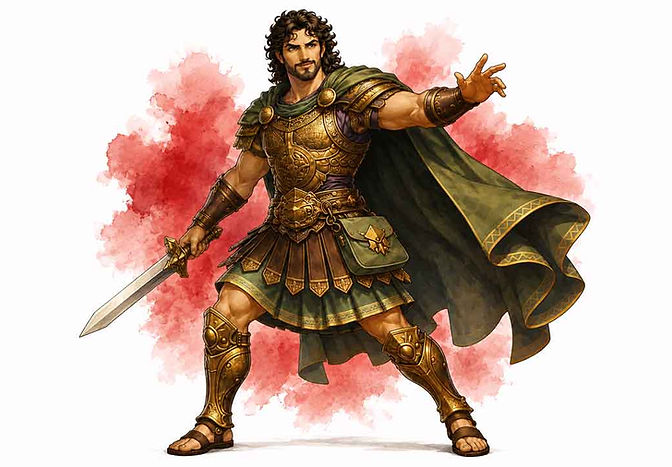
Odysseus is the hero who spent ten years fighting at Troy and another ten years trying to get home, the most cunning man in all of Greek mythology and the only warrior whose wits were sharper than his sword. He is the architect of the Trojan Horse, the giant hollow wooden horse that the Greeks hid inside to infiltrate and destroy the city of Troy, ending a war that had lasted ten years. He is the wanderer who faced the Cyclops Polyphemus, a one-eyed giant who devoured his men, and escaped by tricking the monster into drunkenness and blinding him with a sharpened stake. He is the castaway who survived the wrath of Poseidon, the god of the sea, who pursued him across the Mediterranean with storms and shipwrecks for the crime of blinding his son Polyphemus. He is the husband who resisted the nymph Calypso, who offered him immortality and eternal youth on her island for seven years, because his heart belonged to Penelope, his wife waiting in Ithaca. And he is the king who returned in disguise, strung the bow that no other man could bend, and slaughtered the suitors who had invaded his house, reclaiming his throne through blood and cunning.
Gallery
Main Article - Who or What was...
Odysseus
Odysseus was born on the island of Ithaca, a rocky kingdom in the Ionian Sea off the western coast of Greece, to Laertes, a former king who had stepped aside, and Anticleia, a noblewoman of sharp wit. From his earliest years, Odysseus was known for his cleverness rather than his strength. When the Greeks assembled to sail for Troy, the greatest war in living memory, Odysseus tried to avoid the draft by pretending to be mad, plowing his fields and sowing them with salt instead of seed. But the recruiter Palamedes, a Greek prince of legendary cleverness himself, placed Odysseus's infant son Telemachus in the path of the plow, and Odysseus swerved to avoid the child, proving his sanity and sealing his fate. He sailed for Troy with twelve ships from Ithaca and its neighboring islands, leaving behind his young wife Penelope, a princess of Sparta renowned for her faithfulness and her cunning, and their infant son.
At Troy, Odysseus proved himself not as the mightiest warrior, for that title belonged to Achilles, the hero born of the sea-nymph Thetis and the mortal king Peleus, whose rage and grief defined the war, but as the most indispensable strategist. When Achilles was slain by Paris, the Trojan prince whose arrow found the one weak spot on the hero's heel, Odysseus and Ajax the Greater, the mightiest Greek warrior after Achilles, competed for the dead hero's armor. Odysseus won through eloquence, and Ajax, driven to madness by the loss, slaughtered a flock of sheep believing them to be his enemies, then fell upon his own sword in shame. As the war dragged into its tenth year, Odysseus devised the plan that ended it. He had the Greeks build a giant wooden horse, hollow inside, and hide their best warriors within it while the rest of the army pretended to sail away. The Trojans, believing the horse was a gift to the gods, dragged it inside their walls despite warnings. That night, Odysseus and his men emerged, opened the gates, and Troy burned to the ground.
The journey home should have taken weeks, but Odysseus and his fleet were blown off course by storms and cursed by the gods. They came first to the island of the Lotus-Eaters, whose honey-sweet fruit made men forget their homes and their purpose, and Odysseus had to drag his men back to the ships by force. Then they reached the island of the Cyclops, one-eyed giants who lived in caves and herded sheep. Odysseus and twelve of his men entered the cave of Polyphemus, the son of Poseidon, the god of the sea, who ruled the oceans from his underwater palace of coral and pearl. The giant sealed the cave with a boulder and devoured two of Odysseus's men for dinner. When Polyphemus asked his name, Odysseus replied "Nobody," and when he blinded the giant with a sharpened olive-wood stake, Polyphemus cried out that "Nobody" was killing him. His fellow Cyclops ignored his screams. But as Odysseus sailed away, his pride overcame him, and he shouted his true name, allowing Polyphemus to pray to his father Poseidon, who cursed Odysseus to wander the seas for ten years, lose all his ships and men, and return home alone and destitute.
The wanderings that followed are the most famous voyage in Western literature. Odysseus survived the island of Aeolus, the keeper of the winds, who gave him a bag of breezes to speed him home, only to have his men open the bag in greed and blow the fleet back across the sea. He escaped the Laestrygonians, a race of man-eating giants who destroyed eleven of his twelve ships with boulders hurled from cliffs. He resisted the witch-goddess Circe, who turned his men into pigs with her magic wand, by using a protective herb given to him by Hermes, the messenger god, and then spent a year in her palace before she released him with directions to the underworld. There, in the realm of Hades, the god of the dead who ruled from the darkness beneath the earth, Odysseus poured blood to summon the spirits of the dead and received prophecy from the blind seer Tiresias, who told him that he would reach home only if he left the cattle of the sun-god Helios untouched. His men ignored this warning on the island of Thrinacia, slaughtered the sacred cattle, and Zeus, the king of the gods, destroyed their ship with a thunderbolt, drowning all but Odysseus, who clung to a raft and washed ashore on the island of Calypso, the nymph daughter of the Titan Atlas who was condemned to hold up the heavens.
Calypso kept Odysseus as her lover for seven years, offering him immortality and eternal youth if he would stay forever. But Odysseus wept daily for his home and his wife, and finally the gods, at the prompting of Athena, the goddess of wisdom who had always favored Odysseus for his cunning, ordered Calypso to release him. He built a raft and sailed again, only to be shipwrecked by Poseidon's final storm and washed up on the island of the Phaeacians, a blessed people who lived in a hidden harbor and were beloved of the gods. There, the princess Nausicaa, daughter of King Alcinous, found him naked and starving on the shore, clothed him, and brought him to her father's palace. The Phaeacians, moved by his tale, gave him a ship and treasure and sailed him to Ithaca while he slept, depositing him on his own shore in a secret cove. He awoke to find twenty years had passed, his palace overrun by suitors who demanded Penelope choose a new husband, and his son Telemachus grown to manhood. Disguised as a beggar by Athena, Odysseus entered his own house, endured the insults of the suitors, and revealed himself only when Penelope announced she would marry the man who could string his husband's great bow and shoot an arrow through twelve axe heads. The suitors failed, but Odysseus strung the bow with ease, and with Telemachus at his side, he slaughtered every suitor in the hall, reclaimed his throne, and was reunited with the wife who had waited twenty years, weaving and unweaving a shroud by day and night to keep the suitors at bay.
Summary
Odysseus stands as the supreme hero of intelligence and endurance in Greek mythology, the man who survived what no warrior's strength could conquer through the power of his mind and the unbreakable will to return home. From the burning towers of Troy to the cave of the Cyclops, from the witch's palace to the nymph's island, his journey across the Mediterranean became the template for every tale of adventure and homecoming that followed. The Romans called him Ulysses, and his name became synonymous with the long voyage, the patient return, and the cunning that outlasts every storm. Every traveller who finds their way home against the odds walks, in some sense, the road of Odysseus.
Now enter the Mythopouch World!
You’ve discovered:
Odysseus
From Myth to Game
Join to access FREE real-world mythology "Learn Quests" and "Courses". Sign up to the newsletter for new releases, game updates, insider news, and more as Mythopouch brings real mythology to life. EARN the right to purchase an offline board game by completing FREE modules.


It's FREE to join as a MEMBER!
Not ready to join? Get the newsletter instead below


Looking for others?
Click into the field below to search, or click the icon to go to full page search function!

Looking for Mythology Insights?


Click below to view our mythology blog article insights, where we delve into the current Mythopouch Tier regions, and what we think you should know!
Sources & Retellings
Explore the original mythological Source texts (most from over 75 years ago, some as translated, possibly with mature content) and Mythopouch's source Retellings (a modern retelling also suitable for 15+) connected to this mythological entity. We are growing this resource and will link these in the future; for now, check the References below, then find the Sources or Retellings on those pages!


References
Validation References:
- Homer, Odyssey, Books 1-24 (8th century BCE) - complete account of Odysseus's wanderings and return
- Homer, Iliad, Books 2-4, 9, 11, 19 (8th century BCE) - Odysseus at Troy
- Apollodorus, Bibliotheca, Epitome, Book 3, chapters 7-14 (1st-2nd century CE) - summary of Trojan War and Odysseus's adventures
- Pausanias, Description of Greece, Book 3, chapter 12.1 (2nd century CE) - traditions of Odysseus in Sparta and Ithaca
- Stanford, W.B., The Ulysses Theme: A Study in the Adaptability of a Traditional Hero (Basil Blackwell, 1954) - comprehensive study of the Odysseus figure across literature
- Finley, M.I., The World of Odysseus (Viking Press, 1954) - historical and social analysis of the Homeric world
- Clay, Jenny Strauss, The Wrath of Athena: Gods and Men in the Odyssey (Princeton University Press, 1983) - analysis of divine and mortal relations in the epic
- Murnaghan, Sheila, Disguise and Recognition in the Odyssey (Princeton University Press, 1987) - study of identity and reunion in the epic
Cultural Context Notice
Mythology developed across different cultures, periods and traditions, and there is rarely one universally accepted version of a story. Mythopouch approaches these traditions with respect while remaining faithful to the complexity of the surviving material. Retellings and educational content may interpret or adapt historical sources, but are not presented as definitive accounts of any culture, religion or belief system.