Details
Region
Greek
Regional Information Additional (if applicable)

Category
Deity
Historicity (actuality or factual truth of persons, events, and claims)
Mythological
Gender
Male
Time Period
Archaic through Classical Greek period (c. 8th-5th century BCE)
Symbol
Heart
Tags
greek, god, love, desire
Introduction - Overview
Eros is the Greek god who strikes the heart with irresistible desire, the winged archer whose golden arrows make gods and mortals fall in love against their will. He is the primordial force who emerged from Chaos at the dawn of creation, a cosmic power that bound the elements together and brought order to the universe before the first mountain rose. He is the mischievous child of Aphrodite, the goddess of love and beauty, and Ares, the god of war, who tormented his mother with pranks and disobedience. He is the lover of Psyche, the mortal woman whose name means "soul," whose beauty rivaled the goddess herself and who endured impossible trials to win his forbidden love. He is the torch-bearer who lights the flame of passion in the heart, and the namesake of every romantic impulse that has ever shaken a human being. And he is the ancestor of the modern Cupid, the chubby cherub on Valentine's cards, whose ancient origins stretch back to the very birth of the cosmos.
Gallery


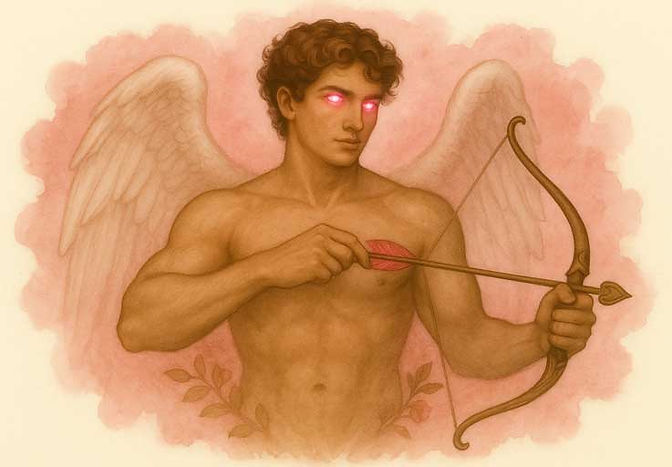
Various images depicting Eros, the son of Aphrodite and Aries, includes his famous two types of arrows.
Main Article - Who or What was...
Eros
In the beginning, before the gods, there was only Chaos, the yawning void. Then Gaia, the Earth, arose, and Tartarus, the deep pit beneath the world. And then came Eros, primordial powers, born without parentage from the void itself. Hesiod, writing his Theogony around 700 BCE, describes him as "the fairest among the gods, who loosens the limbs and weakens the mind of all gods and mortals alike." Eros was a fundamental force of the universe, the power of attraction that drew unlike things together and created the bonds of nature. Without him, the cosmos would have remained scattered elements, never forming the ordered world.
But the Greeks told many stories about Eros, and over time his image changed. By the lyric poets in the 7th and 6th centuries BCE, he had become the son of Aphrodite, the goddess who rose from the sea-foam at the shore of Cyprus. Sappho wrote that he was born of Aphrodite and Ouranos, the Sky, while others said his father was Ares, making Eros the brother of Deimos (Fear) and Phobos (Panic). He appeared as a beautiful youth with golden wings, armed with a bow and arrows. His golden arrows caused irresistible love, while his lead-tipped arrows produced cold indifference. He was capricious, shooting at targets without warning.
The most famous tale is his love for Psyche, a mortal princess whose beauty was so extraordinary her people began to worship her instead of Aphrodite. The goddess, enraged, commanded Eros to make Psyche fall in love with the most hideous creature. But when Eros saw Psyche sleeping, he pricked himself with his own arrow and fell in love with her instead. He carried her to a hidden palace where he visited her only in darkness, forbidding her to look upon his face. For a time they lived in bliss, but Psyche's jealous sisters convinced her that her invisible husband was a monstrous serpent. One night, she lit a lamp and looked upon him as he slept, and saw his beauty. A drop of hot oil fell and woke him. Betrayed, Eros fled, and Psyche was cast out.
Aphrodite set Psyche impossible tasks. She had to sort a mountain of mixed grains in a single night, completed by ants who helped. She had to fetch the golden wool of deadly sheep, and fill a flask with water from the river Styx, the underworld. Finally she descended to the underworld to bring back a box of Persephone's beauty. Persephone, queen of the dead and wife of Hades, king of the underworld, gave her the box but warned her not to open it. Overcome by curiosity, Psyche opened the box and fell into a deathlike sleep. Eros found her and woke her with a touch. He flew to Zeus, king of the gods, and begged him to make Psyche immortal. Zeus granted the request, and Eros and Psyche were married on Olympus. Their daughter was Hedone, goddess of pleasure.
Eros was worshipped across Greece, but most famously at Thespiae in Boeotia, where his earliest image was a simple unworked stone. The city celebrated the Erotidia, festivals with games. In Athens, an altar to Eros stood at the entrance of the Academy, where Plato and his students later gathered. Praxiteles sculpted him as a bow-armed youth of perfect beauty. Over centuries, artists depicted him younger and younger, until by the Hellenistic period he had become a plump winged infant, the putto who would become the Roman Cupid and cherub. Plato, in his Symposium, elevated Eros to a cosmic principle, the force that drives the soul toward beauty and truth.
Summary
Eros stands as the eternal spark of desire, the god who has shaped the hearts of mortals and immortals from the dawn of creation to the present day. From the primordial void where he bound the elements together, to the hidden palace where he loved the mortal Psyche, to the festivals of Thespiae and the altars of Athens, his story weaves through every layer of Greek culture. Every arrow shot on Valentine's Day, every heart pierced by sudden longing, carries the memory of the winged archer who first taught the world that love is both a cosmic force and a personal fire, burning without warning and enduring beyond death.
Now enter the Mythopouch World!
You’ve discovered:
Eros
From Myth to Game
Join to access FREE real-world mythology "Learn Quests" and "Courses". Sign up to the newsletter for new releases, game updates, insider news, and more as Mythopouch brings real mythology to life. EARN the right to purchase an offline board game by completing FREE modules.


It's FREE to join as a MEMBER!
Not ready to join? Get the newsletter instead below


Looking for others?
Click into the field below to search, or click the icon to go to full page search function!

Looking for Mythology Insights?


Click below to view our mythology blog article insights, where we delve into the current Mythopouch Tier regions, and what we think you should know!
Sources & Retellings
Explore the original mythological Source texts (most from over 75 years ago, some as translated, possibly with mature content) and Mythopouch's source Retellings (a modern retelling also suitable for 15+) connected to this mythological entity. We are growing this resource and will link these in the future; for now, check the References below, then find the Sources or Retellings on those pages!


References
Validation References:
- Hesiod, Theogony (c. 700 BCE) - lines 116-122, 176-206
- Apuleius, The Golden Ass (late 2nd century CE) - Books 4-6, "Cupid and Psyche"
- Plato, Symposium (c. 385-370 BCE) - 178a-180b, 189c-193d
- Aristophanes, The Birds (414 BCE) - lines 690-699
- Sappho, Fragment 198 (c. 600 BCE) - from Scholiast on Theocritus
- Pausanias, Description of Greece (2nd century CE) - Book 9.27.1, 9.31.3
- Nonnus, Dionysiaca (5th century CE) - Book 48.470 ff
- Caldwell, Richard. "Hesiod's Theogony: Focus Classical Library" (1987) - pp. 3, 35
- Mikalson, Jon D. "The Sacred and Civil Calendar of the Athenian Year" (2015) - Princeton University Press, p. 186
- Guthrie, W.K.C. "Orpheus and Greek Religion" (1952/1993) - Princeton University Press, pp. 80-83
Cultural Context Notice
Mythology developed across different cultures, periods and traditions, and there is rarely one universally accepted version of a story. Mythopouch approaches these traditions with respect while remaining faithful to the complexity of the surviving material. Retellings and educational content may interpret or adapt historical sources, but are not presented as definitive accounts of any culture, religion or belief system.