Details
Region
Greek
Regional Information Additional (if applicable)

Category
Giant
Historicity (actuality or factual truth of persons, events, and claims)
Mythological
Gender
Male
Time Period
Archaic Greek period (c. 8th century BCE in Hesiod's Theogony)
Symbol
Eye
Tags
greek, monster, fire, thunder
Introduction - Overview
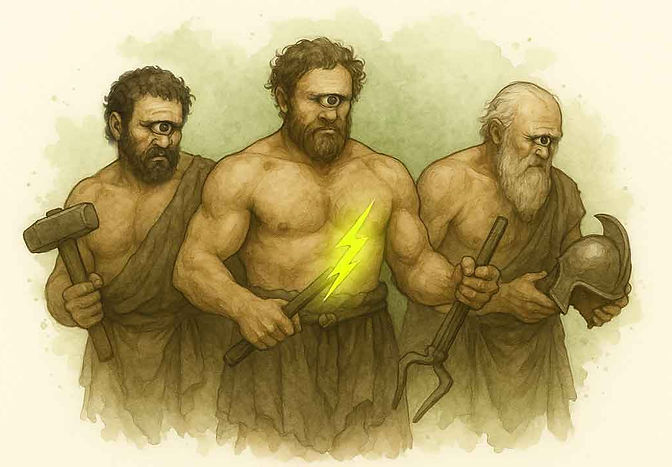
The Cyclopes are the one-eyed giants who thundered across the Greek imagination, three brothers whose single eye in the center of their foreheads made them both terrifying and tragic. They are Brontes, the Thunderer, Steropes, the Lightning-Maker, and Arges, the Bright One, the first generation born from Uranus, the starry sky, and Gaia, the broad-breasted Earth, who forged the thunderbolts of Zeus himself. They are the master craftsmen who built the palaces of the gods, who crafted the weapons that no mortal hand could make, and who were imprisoned in Tartarus by their own brother Cronus until Zeus set them free. They are the monsters who appear in two very different forms: the divine smiths who serve Olympus, and the savage cannibals who devour Odysseus's men in the cave of Polyphemus. And they are the reason the Greeks believed that the most powerful forces in nature were born from the most monstrous forms, a legacy that still echoes in every cyclops who appears in fantasy and film.
Gallery
Main Article - Who or What was...
Cyclops
The first Cyclopes were born from the union of Uranus, the starry sky, and Gaia, the broad-breasted Earth, in the earliest days of the cosmos. They were three brothers, each with a single round eye in the middle of his forehead, a feature that gave them their name, which means "circle-eyed." Brontes brought the thunder, Steropes forged the lightning, and Arges shone with the brightness of the bolt itself. They were not merely strong but skilled, the first craftsmen of the divine world, and they possessed a power that even the Titans feared. But their father Uranus, who hated all his children, cast them into the depths of Tartarus, the misty pit beneath the earth, where they were chained in darkness alongside their brothers the Hecatoncheires, the hundred-handed giants. There they remained, forgotten and imprisoned, until the world above them changed.
When Zeus, the youngest son of Cronus, rose up against the Titans in the great war called the Titanomachy, he knew he needed weapons that could shake the cosmos. He descended into Tartarus and freed the Cyclopes, who in gratitude forged for him the thunderbolt, the weapon that would become the symbol of his power forever. For Poseidon, the god of the sea, they crafted the trident, a three-pronged spear that could stir the waves and split the earth. For Hades, the god of the dead, they made the helm of darkness, a cap that rendered its wearer invisible. With these weapons the three brothers of Olympus defeated the Titans, and the Cyclopes earned their place as the divine smiths of the new order, working at their forge beneath Mount Etna where the fire of their hammers was said to cause the volcano's eruptions.
But the Cyclopes were not only divine smiths. In a later tradition, they were also the sons of Poseidon, the god of the sea, a race of savage one-eyed giants who lived in caves and herded sheep. The most famous of these was Polyphemus, the son of Poseidon and the nymph Thoosa, who lived on the island of Hypereia in Sicily. He was a giant of terrible strength, with a single eye in his forehead and a taste for human flesh. When Odysseus, the hero of the Trojan War, landed on his island with twelve of his men, Polyphemus trapped them in his cave, sealed the entrance with a great boulder, and devoured two of them for dinner. The Greeks had no name for this creature in the older tradition, but later poets and storytellers called him a Cyclops too, and the two traditions merged into one.
Odysseus, watching his men being eaten, devised a plan that relied on cunning rather than strength. He offered Polyphemus a skin of strong wine, which the giant drank greedily until he fell into a drunken stupor. Then Odysseus and his remaining men heated a wooden stake in the fire and drove it into the giant's single eye, blinding him. Polyphemus roared in agony and tore the stake from his socket, but he could not see who had struck him. In the morning, he rolled away the boulder to let his sheep out to pasture, feeling the backs of the animals to make sure no men escaped among them. But Odysseus had tied his men beneath the bellies of the rams, and they slipped out unseen. The blinded giant stood at the mouth of his cave, calling to his father Poseidon for vengeance, and the god of the sea answered with a curse that would pursue Odysseus across the ocean for ten long years.
The Cyclopes have outlasted the ancient world in ways that few monsters have. The divine smiths who forged the thunderbolts of Zeus became the model for every craftsman in mythology who works with fire and metal, from Hephaestus to the dwarves of Norse legend. The savage Polyphemus became the archetype of the blinded giant, the monster who is defeated not by strength but by wit, and his story has been told and retold for three thousand years. The word "cyclops" still means a one-eyed creature in modern biology, and the image of the single eye has become one of the most enduring symbols of the monstrous in human culture. From the forge of Mount Etna to the cave of Sicily, the Cyclopes remain the giants who proved that the most powerful forces in nature come in the most unexpected forms.
Summary
The Cyclopes stand as the eternal embodiment of raw power and tragic isolation, the one-eyed giants who shaped the cosmos and haunted the nightmares of mortals. From the thunderbolts they forged for Zeus to the sheep they herded for Polyphemus, they moved between the divine and the monstrous, the craftsman and the cannibal. Their single eye, set in the center of their foreheads, made them unforgettable, a symbol of the way power concentrates and distorts. And their stories, of imprisonment and freedom, of blindness and vengeance, remain as vivid today as they were when Homer first sang them, a reminder that the most frightening monsters are often the ones who are most like us.
Now enter the Mythopouch World!
You’ve discovered:
Cyclops
From Myth to Game
Join to access FREE real-world mythology "Learn Quests" and "Courses". Sign up to the newsletter for new releases, game updates, insider news, and more as Mythopouch brings real mythology to life. EARN the right to purchase an offline board game by completing FREE modules.


It's FREE to join as a MEMBER!
Not ready to join? Get the newsletter instead below


Looking for others?
Click into the field below to search, or click the icon to go to full page search function!

Looking for Mythology Insights?


Click below to view our mythology blog article insights, where we delve into the current Mythopouch Tier regions, and what we think you should know!
Sources & Retellings
Explore the original mythological Source texts (most from over 75 years ago, some as translated, possibly with mature content) and Mythopouch's source Retellings (a modern retelling also suitable for 15+) connected to this mythological entity. We are growing this resource and will link these in the future; for now, check the References below, then find the Sources or Retellings on those pages!


References
Validation References:
- Hesiod, Theogony (c. 700 BCE) - Lines 139-146 (Birth of the Cyclopes from Uranus and Gaia)
- Hesiod, Theogony (c. 700 BCE) - Lines 501-506 (The Cyclopes forge the thunderbolt for Zeus)
- Homer, Odyssey (c. 750 BCE) - Book 9, Lines 105-566 (Odysseus and Polyphemus)
- Apollodorus, Bibliotheca (c. 1st-2nd century CE) - Book 1, Chapter 1, Section 2 (The Cyclopes and the Titanomachy)
- West, M.L., Hesiod: Theogony (1966) - Commentary on lines 139-146, pp. 193-195
- Burkert, Walter, Greek Religion (1985) - Chapter 3: "The Giants and Monsters" (pp. 130-135)
- Mondi, Robert, "The Homeric Cyclopes: Folktale, Tradition, and Theme" (1983) - Transactions of the American Philological Association, Vol. 113, pp. 17-38
- Heubeck, Alfred, et al., A Commentary on Homer's Odyssey (1988) - Volume 2, Book 9, pp. 1-45 (Polyphemus episode)
Cultural Context Notice
Mythology developed across different cultures, periods and traditions, and there is rarely one universally accepted version of a story. Mythopouch approaches these traditions with respect while remaining faithful to the complexity of the surviving material. Retellings and educational content may interpret or adapt historical sources, but are not presented as definitive accounts of any culture, religion or belief system.