Details
Region
Greek
Regional Information Additional (if applicable)

Category
Deity
Historicity (actuality or factual truth of persons, events, and claims)
Mythological
Gender
Male
Time Period
Mythological Age (Olympian period)
Symbol
Thunderbolt
Tags
greek, god, thunder, sky, king, justice
Introduction - Overview
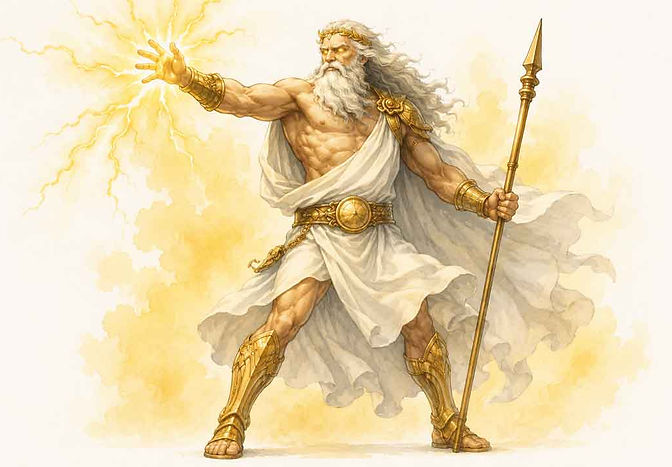
Zeus is the king of the Olympian gods, the wielder of the thunderbolt who rules the sky and commands the storms. He is the son who escaped his father Cronus's belly to lead a ten-year war against the Titans and seize control of the cosmos. He is the husband of Hera who fathered gods and heroes across the Greek world, from Athena who sprang fully armed from his forehead to Heracles, the greatest of mortal heroes. He is the god who sits in judgment upon Mount Olympus, whose nod shakes the earth and whose will none may defy. He is the patron of kings and lawgivers, the guardian of oaths and the protector of strangers. And he is the namesake of the planet Jupiter, the Roman Jupiter, and countless words from "zealous" to "zenith," a legacy that has shaped Western civilization for three millennia.
Gallery


Various depictions of Zeus, with Hera, and his famous lighting bolt.
Main Article - Who or What was...
Zeus
Zeus was born to the Titan Cronus and his sister-wife Rhea, the last of six children. Cronus, having overthrown his own father Uranus, had been warned by Gaia and Uranus that one of his own children would one day overthrow him in turn. To prevent this prophecy, Cronus swallowed each child as soon as Rhea gave birth: first Hestia, then Demeter, Hera, Hades, and Poseidon. When Rhea became pregnant with Zeus, she sought help from her parents Gaia and Uranus. Following their plan, she travelled to Lyctus in Crete and gave birth to Zeus in a cave on Mount Ida or Mount Aegaeon. She left the infant with Gaia to raise, nursed by the goat Amalthea and guarded by the Curetes, young warriors who clashed their weapons to drown out the baby's cries so Cronus would not hear him. Rhea then returned to Cronus and presented him with a stone wrapped in swaddling clothes, which he swallowed without examining it. This stone, the Omphalos, would later be placed at Pytho on Mount Parnassus as a sacred relic.
When Zeus grew to manhood, he returned to confront his father. According to some accounts, the Oceanid Metis gave Zeus a potion or emetic to mix into Cronus's drink. When Cronus swallowed it, he was forced to vomit up all the children he had devoured, now fully grown: Hestia, Demeter, Hera, Hades, and Poseidon. The stone came up last. Zeus now had his siblings at his side, but he needed more allies to challenge the Titans. He descended into the deepest abyss of Tartarus and freed the Cyclopes, three one-eyed giants who were master craftsmen, and the Hecatoncheires, three monstrous beings with a hundred hands and fifty heads each. In gratitude, the Cyclopes forged weapons for the young gods: a thunderbolt for Zeus, a trident for Poseidon, and a helmet of darkness for Hades that made the wearer invisible. The Hecatoncheires, with their overwhelming strength and ability to hurl massive boulders, swelled the ranks of Zeus's army.
The war that followed was called the Titanomachy, the war between the old Titans and the young Olympian gods, and it lasted ten years. The Titans, led by Cronus and with Atlas as their battlefield commander, fought from Mount Othrys while Zeus and his allies made their base on Mount Olympus. The earth shook and the heavens thundered as the two sides clashed. Several Titans, including Themis and her son Prometheus, sided with Zeus. Eventually the Olympians and their allies overpowered the Titans. Cronus and most of his supporters were cast into the dark pit of Tartarus, imprisoned behind bronze gates. Atlas was given a unique punishment: he was condemned to stand at the western edge of the world and hold up the heavens upon his shoulders for eternity. Zeus, Poseidon, and Hades then drew lots to divide the cosmos: Poseidon received the sea, Hades the underworld, and Zeus the sky and the heavens, though the earth remained common to all three.
But Zeus's reign was not yet secure. Gaia, angered by the imprisonment of her children the Titans, bore a final monstrous son: Typhon, a creature with a hundred serpent heads that breathed fire, whose body stretched across the horizon and whose voices roared like bulls, lions, and hissing serpents all at once. Struck with terror, the other Olympian gods fled to Egypt, transforming themselves into animals to hide. Zeus alone stood his ground. He faced Typhon in a battle that shook the earth to its foundations. Armed with his thunderbolts, Zeus struck the monster again and again until Typhon was cast down into Tartarus beneath the volcanic Mount Etna, where his struggles are said to cause the eruptions that still thunder from that peak. This victory cemented Zeus's position as the undisputed king of gods and the protector of cosmic order.
Zeus's rule was marked by both justice and caprice. He married his sister Hera, making her queen of Olympus, though his many affairs with goddesses and mortal women produced a vast divine and heroic lineage. From his union with the Titaness Metis, Athena sprang fully grown and armed from his forehead after he swallowed Metis to prevent a prophecy that her child would overthrow him. With Leto he fathered the twins Apollo and Artemis. With Maia he fathered Hermes, the messenger god. With Semele, a mortal woman, he fathered Dionysus, the god of wine and ecstasy. With Alcmene he fathered Heracles, the hero forced to complete twelve impossible labours. He presided over the assembly of the gods on Olympus, settled disputes, enforced oaths, and sent thunderbolts against those who broke divine law. He was worshipped across the Greek world at Dodona, where priests interpreted his will from the rustling of oak leaves, and at Olympia, where the Olympic Games were held in his honour every four years. His image in the great temple at Olympia, a colossal seated statue of ivory and gold created by the sculptor Phidias, was one of the Seven Wonders of the Ancient World.
Summary
Zeus stands as the supreme symbol of cosmic authority in Greek mythology, the thunder-wielding king who overthrew the old order and established a new divine regime upon Olympus. From the cave in Crete where he was hidden from his devouring father to the throne from which he hurls his lightning bolts, his story is the story of power itself: how it is seized, how it is defended, and how it is exercised. Every thunderclap still carries his name, every king who claims divine right traces his lineage to this god, and every Olympic torch still burns in memory of the games first held at his sacred precinct in Olympia. He is the eternal father of gods and men, and the sky itself is his throne.
Now enter the Mythopouch World!
You’ve discovered:
Zeus
From Myth to Game
Join to access FREE real-world mythology "Learn Quests" and "Courses". Sign up to the newsletter for new releases, game updates, insider news, and more as Mythopouch brings real mythology to life. EARN the right to purchase an offline board game by completing FREE modules.


It's FREE to join as a MEMBER!
Not ready to join? Get the newsletter instead below


Looking for others?
Click into the field below to search, or click the icon to go to full page search function!

Looking for Mythology Insights?


Click below to view our mythology blog article insights, where we delve into the current Mythopouch Tier regions, and what we think you should know!
Sources & Retellings
Explore the original mythological Source texts (most from over 75 years ago, some as translated, possibly with mature content) and Mythopouch's source Retellings (a modern retelling also suitable for 15+) connected to this mythological entity. We are growing this resource and will link these in the future; for now, check the References below, then find the Sources or Retellings on those pages!


References
Validation References:
- Hesiod, Theogony (c. 700 BCE) - Lines 453-500 (birth and upbringing of Zeus), Lines 617-735 (Titanomachy), Lines 820-868 (Typhonomachy)
- Homer, Iliad (c. 750 BCE) - Book 1, Lines 175-222 (Zeus's authority and nod), Book 15, Lines 187-193 (division of realms by lot)
- Homer, Odyssey (c. 700 BCE) - Book 9, Lines 105-115 (Zeus as guardian of strangers and suppliants)
- Apollodorus, Bibliotheca (1st-2nd century CE) - Book 1, Chapters 1-2 (birth of Zeus, Titanomachy, division of cosmos)
- Pausanias, Description of Greece (2nd century CE) - Book 5, Chapter 11 (temple and statue of Zeus at Olympia)
- Burkert, Walter, Greek Religion (Harvard University Press, 1985) - Chapters 3-4 (Zeus's cult and mythology)
- West, M. L., Hesiod: Theogony (Oxford University Press, 1966) - Commentary on Zeus's birth and rise to power
- Cook, Arthur Bernard, Zeus: A Study in Ancient Religion (Cambridge University Press, 1914-1925) - Volume 1, Chapters 1-3 (comprehensive study of Zeus cult and iconography)
- Callimachus, Hymn to Zeus (c. 270 BCE) - Lines 1-95 (birth and upbringing in Arcadia)
- Pindar, Olympian Odes (5th century BCE) - Olympian 1, Lines 1-12 (Zeus at Olympia and the games)
Cultural Context Notice
Mythology developed across different cultures, periods and traditions, and there is rarely one universally accepted version of a story. Mythopouch approaches these traditions with respect while remaining faithful to the complexity of the surviving material. Retellings and educational content may interpret or adapt historical sources, but are not presented as definitive accounts of any culture, religion or belief system.