
Details
Region
Greek
Regional Information Additional (if applicable)
Category
Location
Historicity (actuality or factual truth of persons, events, and claims)
Mythological
Gender
Female
Time Period
c. 8th - 7th century BCE (Homer's Iliad and Odyssey; Hesiod's Theogony)
Symbol
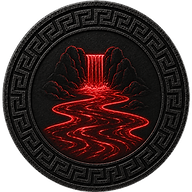
Waterfall into River
Tags
greek, styx, river, underworld, oath, oceanid, zeus, charon
Introduction - Overview
The Styx is the black river of the underworld whose cold water is the most sacred substance in the cosmos, the stream by which the gods themselves swear their most terrible and unbreakable oaths. She is the Titaness daughter of Oceanus, the world-encircling river, and Tethys, the queen of the waters, and the mother of four children who stand forever beside Zeus: Nike, Victory, Kratos, Strength, Bia, Force, and Zelus, Rivalry. She is the first immortal to aid Zeus in the Titanomachy, the ten-year war between the old Titans and the young Olympians, and her reward was to become the Great Oath of heaven, the test no god may fail. She is the doom of perjured immortals, who lie voiceless for a year and are exiled from Olympus for nine more if they swear falsely. She is the river into which the goddess Thetis dipped the infant Achilles to make him invulnerable, leaving only the heel by which she held him. And she is a real waterfall in the Arcadian mountains of Greece, whose black water was said to shatter every vessel except a horse's hoof, and which rumour blamed for the death of Alexander the Great.
Gallery
Main Article - Who or What was...
River Styx
Styx was born the eldest of the Oceanids, the three thousand water nymphs of Oceanus, the river that rings the world, and his sister-queen Tethys. Her name comes from stygein, to hate and to shudder, and she was the river of abhorrence made divine, the cold black water that the whole world dreads. In the deep geography of the cosmos, she is a branch torn from her father's own stream: nine parts of Oceanus roll around the earth and the sea, but a tenth part falls away beneath the roots of the world and winds through the dark under the earth as the Styx, flowing beneath towering cliffs in a blackness no sunlight has ever touched. The other rivers of the dead are her kin, the Acheron, the river of woe, the Cocytus, the river of lamentation, and the Pyriphlegethon, the river of fire, but none of them shares her dread honour.
When Zeus rose against his father Cronus and the old order of Titans, he sent word through the gods that all who fought beside him would keep their honours in the new cosmos, and Styx was the very first immortal to answer. On the advice of her own father Oceanus, she gathered her four children and brought them to Mount Olympus, the gods' high fortress. They were a fearsome family to offer: Nike, the winged Victory, Kratos, Strength, Bia, brutal Force, and Zelus, the fire of Rivalry that drives men and gods to compete. Zeus welcomed them with joy and set them beside his throne forever, which is why Victory, Strength, Force and Rivalry never leave the king of heaven to this day. To Styx herself he gave the highest honour in his gift: he made her the Great Oath of the gods. In a universe where even immortals might lie, there would now be one thing that could bind them absolutely, and it was the black water of the underworld's eldest daughter.
The machinery of the oath was as solemn as its power. When the gods swore their deepest vows, as when the goddess Hera swore to the Sleep god Hypnos in the Iliad, Homer's epic of the Trojan War, or when the nymph Calypso swore to the shipwrecked hero Odysseus in the Odyssey, they called upon the inviolable water of the Styx. Zeus sends Iris, the rainbow messenger of the gods, flying with a golden jug to the far cliff where the dread stream leaps from the rock, and she brings back the cold water. The swearing god pours it out and speaks the vow. And if any immortal swears falsely by that water, the punishment is terrible beyond imagining: the forsworn god falls down breathless and voiceless, wrapped in a deathly stupor for a full circle of the year, unable to eat nectar or ambrosia, and when the year has passed, nine more years of exile follow, cut off from every feast and every council of the gods, barred from the laughter of Olympus until the tenth year brings readmission. No threat in heaven carries more weight than those nine silent years.
The strangest chapter of her story is real. In the mountains of Arcadia in the Peloponnese, the mountainous heart of southern Greece, near the village of Nonacris and beneath the snow-capped peak of Mount Chelmos, a thin thread of black water falls down a sheer cliff into a guarded pool, and the Greeks swore that this was the Styx itself, the one place where the underworld river touches the living world. The water was death to drink, and no vessel could hold it: it shattered pottery and glass, corroded bronze and iron, and only a cup made from the hoof of a horse or mule could carry it away. The traveller Pausanias, who wrote a guidebook to Greece in the second century CE, saw the place with his own eyes and recorded the wall built around the pool. The historian Herodotus tells how the Spartan king Cleomenes once made the Arcadians swear loyalty at that dread water. And when Alexander the Great, the conqueror of Persia, died suddenly in Babylon in 323 BCE, one rumour whispered that he had been poisoned with Styx water smuggled out of Arcadia in a mule's hoof, the only cup that could have carried it.
For the dead, the Styx was the border of everything. In the Aeneid, the Roman epic of the hero Aeneas, the river's marsh coils around the underworld nine times, a moat no soul may pass unaided, and on its dark water plies Charon, the sullen ferryman of the dead, who carries souls across for the coin placed in a corpse's mouth. Thetis, the sea nymph mother of Achilles, once gripped her baby by the heel and plunged him into the Styx to arm his body against all wounds, and the one dry spot she held became the fatal heel where an arrow would one day kill him. More than a thousand years later the Italian poet Dante Alighieri found her waiting in his Inferno, where the marsh of Styx forms the fifth circle of Hell, the swamp where the wrathful tear at one another on the surface and the sullen gurgle beneath the mud. From a Titan's daughter to a mountain waterfall to the permanent border of death, no river in human imagination has carried more fear or more honour.
Summary
The Styx stands as the one river that even the gods fear, the Titaness who traded her freedom in the war of heaven for an honour no other being holds: the binding of immortal truth. From the cliffs of Arcadia to the ninefold marsh of the dead, from Hera's golden-jugged vows to the heel of Achilles and the drowning wrathful of Dante, her story is the story of what happens when water itself becomes sacred. The English language still pours from her name whenever it calls a darkness Stygian, and the phrase crossing the Styx remains the world's oldest euphemism for dying. She was the first to stand beside Zeus, and every unbreakable promise since has stood beside her.
Now enter the Mythopouch World!
You’ve discovered:
River Styx
From Myth to Game
Join to access FREE real-world mythology "Learn Quests" and "Courses". Sign up to the newsletter for new releases, game updates, insider news, and more as Mythopouch brings real mythology to life. EARN the right to purchase an offline board game by completing FREE modules.


It's FREE to join as a MEMBER!
Not ready to join? Get the newsletter instead below


Looking for others?
Click into the field below to search, or click the icon to go to full page search function!

Looking for Mythology Insights?


Click below to view our mythology blog article insights, where we delve into the current Mythopouch Tier regions, and what we think you should know!
Sources & Retellings
Explore the original mythological Source texts (most from over 75 years ago, some as translated, possibly with mature content) and Mythopouch's source Retellings (a modern retelling also suitable for 15+) connected to this mythological entity. We are growing this resource and will link these in the future; for now, check the References below, then find the Sources or Retellings on those pages!


References
Validation References:
- Hesiod, Theogony (c. 700 BCE) - Lines 361-383 (Styx the Oceanid and her children); Lines 383-403 (Styx first to aid Zeus and made the Great Oath); Lines 775-806 (the oath ritual and the punishment of forsworn gods)
- Homer, Iliad (c. 8th century BCE) - Book 14.271-279 and 15.37-38 (Hera swears by the Styx); Book 2.751-755 (the Titaressos, a branch of the Styx)
- Homer, Odyssey (c. 8th century BCE) - Book 5.184-187 (Calypso swears by the Styx)
- Herodotus, Histories (c. 430 BCE) - Book 6.74 (Cleomenes and the oath at the Arcadian Styx)
- Pausanias, Description of Greece (c. 150 CE) - Book 8.17.6-18.6 (the real Styx waterfall at Nonacris and its deadly water)
- Plutarch, Life of Alexander (c. 100 CE) - Chapter 77 (the rumour that Alexander was poisoned with Styx water)
- Virgil, Aeneid (19 BCE) - Book 6.323-330 (Charon's ferry on the Styx); Book 6.438-439 (the Styx encircling the underworld nine times)
- Statius, Achilleid (c. 95 CE) - Book 1.268-270 and 480-481 (Thetis dips the infant Achilles in the Styx)
- Dante Alighieri, Inferno (c. 1320) - Canto 7 (the marsh of Styx and the punishment of the wrathful)
- Gantz, Timothy, Early Greek Myth: A Guide to Literary and Artistic Sources (Johns Hopkins University Press, 1993) - Volume 1, pp. 29-30 (Styx and the oath of the gods)
- West, M. L., Hesiod: Theogony (Oxford University Press, 1966) - Commentary on lines 383-403 and 775-806
- Burkert, Walter, Greek Religion (Harvard University Press, 1985) - Sections on oaths and the rivers of the underworld
- Vermeule, Emily, Aspects of Death in Early Greek Art and Poetry (University of California Press, 1979) - Chapter on the rivers of the dead
Cultural Context Notice
Mythology developed across different cultures, periods and traditions, and there is rarely one universally accepted version of a story. Mythopouch approaches these traditions with respect while remaining faithful to the complexity of the surviving material. Retellings and educational content may interpret or adapt historical sources, but are not presented as definitive accounts of any culture, religion or belief system.