Details
Regional Information Additional (if applicable)
Greek
Region
Category
Group
Historicity (actuality or factual truth of persons, events, and claims)
Mythological
Gender
Female
Time Period
Archaic Greek period (c. 8th century BCE in Hesiod's Theogony)
Symbol
Dolphin
Tags
greek, spirit, sea
Introduction - Overview
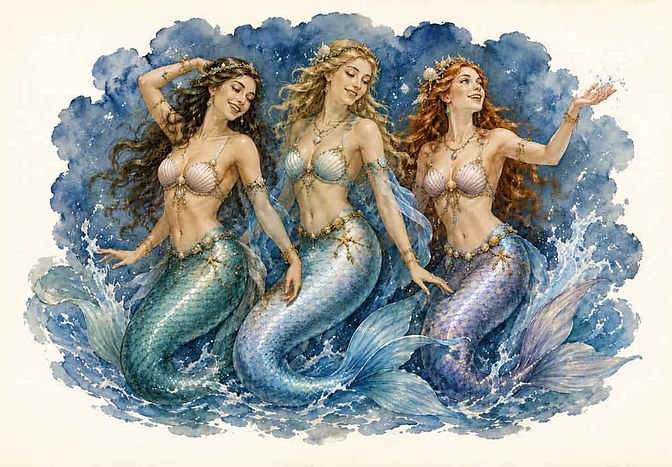
The Nereids are the fifty daughters of Nereus, the Old Man of the Sea, and they are the most beloved sea-nymphs in all of Greek mythology, graceful spirits who danced upon the waves and guided sailors through storm and calm. They are the attendants of the sea-god Poseidon, who ruled the oceans from his underwater palace of coral and pearl, and they are the companions of the hero Achilles, the greatest warrior of the Trojan War, who was born of a Nereid mother and mourned by his sea-nymph kin when he fell. They are the rescuers of the Argonauts, the crew of heroes who sailed in search of the Golden Fleece, when their ship was trapped between the crushing rocks of the Symplegades. They are the weepers at the funeral of Patroclus, Achilles' dearest friend, whose death drove the hero to a rage that nearly turned the tide of the Trojan War. And they are the eternal spirits of the Mediterranean itself, the silver shapes that ancient sailors glimpsed in the foam and mist, a reminder that the sea was never empty but always alive with divine presence.
Gallery
Main Article - Who or What was...
Nereids
The Nereids were born to Nereus, a sea-god so ancient that he was called the Old Man of the Sea, a shape-shifter who could transform into any form and who possessed the gift of prophecy. Their mother was Doris, one of the three thousand Oceanids, the daughters of the Titan Oceanus and his sister-wife Tethys, who together encircled the world with their vast waters. The Nereids numbered fifty, each one beautiful and gentle, each one named and known to the poets who sang of them. They lived in a gleaming palace beneath the waves, built of coral and gold, where the light of the surface filtered down in shifting patterns and the fish of the sea swam through their halls as birds fly through the air. Their father Nereus was a kindly god, unlike the stormy and violent Poseidon, and the Nereids inherited his gentle nature. They were not creatures of tempest and shipwreck but of calm seas and safe harbors, of the silver light on gentle waves and the soft murmur of water against a hull.
The most famous of the Nereids was Thetis, the mother of Achilles, the hero whose rage and grief defined the course of the Trojan War. Thetis was so beautiful that both Zeus, the king of the gods, and Poseidon, the lord of the sea, had desired her. But a prophecy warned that her son would grow greater than his father, and so the gods arranged her marriage to Peleus, a mortal king, to ensure no god would sire a child who might overthrow heaven itself. When Achilles was born, Thetis tried to make him immortal, dipping him in the waters of the River Styx, the boundary between the world of the living and the dead, which made every part of him invulnerable except the heel by which she held him. When Achilles went to war at Troy, Thetis wept and pleaded with the gods to protect him, and when he was slain by Paris, the prince of Troy whose arrow found the one weak spot on Achilles' heel, Thetis led the Nereids from the sea to mourn him. They came up from the waves in a column of silver and foam, their voices raised in a lament so piercing that it echoed across the battlefield and into the camps of both armies.
The Nereids played a crucial role in the voyage of the Argonauts, the band of heroes led by Jason who sailed in the ship Argo to claim the Golden Fleece from the distant kingdom of Colchis. On their return journey, the Argo was caught between the Symplegades, two massive clashing rocks at the mouth of the Black Sea that destroyed any ship that tried to pass between them. The heroes despaired, but the goddess Hera, who favored Jason's quest, sent the Nereids to guide them. The sea-nymphs rose from the water and passed the ship from hand to hand, their silver forms flashing in the spray, moving the Argo through the gap with such speed that the rocks crashed together behind them only on the ship's stern ornament. The heroes escaped, and the Nereids returned to the depths, their task complete.
In another tale, the Nereids were associated with the birth and upbringing of the god Dionysus, the deity of wine and ecstatic revelry. When Zeus's mortal lover Semele was destroyed by the sight of the god's true glory, Zeus rescued their unborn child by sewing him into his own thigh. After Dionysus was born, the Nereids were said to have received him into their care, hiding the infant god in the depths of the sea to protect him from the vengeful Hera, queen of the gods, who hunted the children of Zeus's affairs with relentless fury. In the Nereids' underwater palace, the young god was kept safe until he was old enough to claim his divine power and begin his wanderings across the earth.
The Nereids were worshipped across the Greek world, particularly in coastal cities where sailors and fishermen depended upon the mercy of the sea. They had shrines and altars at harbors, and sailors would pour libations of wine and oil into the water to honor them before setting sail. In art, they were depicted as beautiful young women, sometimes with the lower bodies of fish, sometimes entirely human in form but crowned with seaweed and shells, riding dolphins or hippocamps, the sea-horses of Poseidon's chariot. The most famous artistic representation of the Nereids was the monumental tomb built for a king of Lycia in the 4th century BCE, now called the Nereid Monument, where sculpted sea-nymphs stood in the roles of mourners and guardians, their garments swirling as if caught in an underwater current. To this day, the name Nereid evokes the mystery and beauty of the Mediterranean, the sense that beneath the surface of the familiar sea lies a world of ancient grace and power.
Summary
The Nereids endure as the gentle face of the ancient Greek sea, fifty sisters who bridged the terror of the ocean and the beauty of its depths. From the mourning of Achilles to the rescue of the Argonauts, from the protection of the infant Dionysus to the prayers of countless sailors, their stories weave through the greatest myths of Greece. The Nereid Monument in Lycia still stands as testimony to their hold on the Greek imagination, and every wave that breaks in silver foam carries the echo of their name, a reminder that the sea was never merely water but a realm alive with divine daughters.
Now enter the Mythopouch World!
You’ve discovered:
Nereids
From Myth to Game
Join to access FREE real-world mythology "Learn Quests" and "Courses". Sign up to the newsletter for new releases, game updates, insider news, and more as Mythopouch brings real mythology to life. EARN the right to purchase an offline board game by completing FREE modules.


It's FREE to join as a MEMBER!
Not ready to join? Get the newsletter instead below


Looking for others?
Click into the field below to search, or click the icon to go to full page search function!

References
Validation References:
- Homer, Iliad, Book 18, lines 35-69 (8th century BCE) - Thetis and the Nereids mourning Achilles' armor
- Homer, Iliad, Book 19, lines 1-39 (8th century BCE) - Thetis bringing armor to Achilles
- Hesiod, Theogony, lines 240-264 (c. 700 BCE) - genealogy and names of the Nereids
- Apollonius Rhodius, Argonautica, Book 4, lines 922-960 (3rd century BCE) - Nereids guiding the Argo through the Symplegades
- Apollodorus, Bibliotheca, Book 1, chapter 2.7 (1st-2nd century CE) - Thetis, Peleus, and the birth of Achilles
- Burkert, Walter, Greek Religion (Harvard University Press, 1985) - chapter on sea deities and Nereus cult
- Larson, Jennifer, Greek Nymphs: Myth, Cult, Lore (Oxford University Press, 2001) - comprehensive study of nymph categories including Nereids
- Stafford, Emma, Worshipping Virtues: Personification and the Divine in Ancient Greece (Classical Press of Wales, 2000) - discussion of Nereid cult and iconography