Details
Region
Greek
Regional Information Additional (if applicable)

Category
Deity
Historicity (actuality or factual truth of persons, events, and claims)
Mythological
Gender
Female
Time Period
Mythological Age
Symbol
Flower
Tags
greek, god, marriage, family, queen
Introduction - Overview
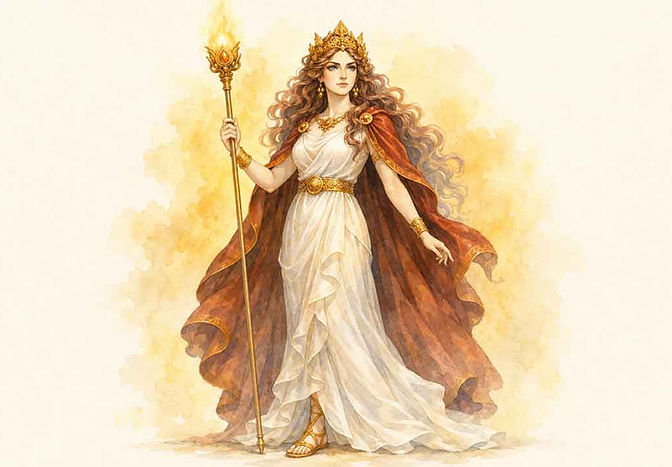
Hera is the queen of the Olympian gods, the wife of Zeus who rules from the throne beside him but wages a private war against his endless infidelities. She is the goddess of marriage, childbirth, and the sacred bond between husband and wife, a protector of women in labor who could ease their pain or multiply it. She is the relentless pursuer of Zeus's illegitimate children, the illegitimate offspring of her husband's affairs with mortal women and nymphs, whom she hounded across the earth with curses and monsters. She is the mother of Ares, the god of war, and Hephaestus, the crippled smith whom she cast from heaven in shame. She is the deity who drove Heracles, the greatest Greek hero, to murder his own family in a fit of madness, and who made the Trojan War far bloodier than it needed to be. She is the peacock goddess, whose sacred bird carries the eyes of her hundred-eyed watchman Argus in its tail feathers, and whose temples at Argos and Samos were among the most magnificent in the ancient world. Every wedding vow and every jealous quarrel echoes her name.
Gallery
Main Article - Who or What was...
Hera
Hera was born to Cronus and Rhea, the Titan rulers who had swallowed their own children to prevent a prophecy that one of them would overthrow the father. Zeus, her youngest brother, was hidden away on the island of Crete and grew to adulthood in secret. When he returned to challenge Cronus, he forced the Titan to vomit up his swallowed children: Hestia, the goddess of the hearth; Demeter, the goddess of grain; Hera herself; Hades, the grim lord of the dead; and Poseidon, the god of the sea. The siblings united against their father in a war called the Titanomachy, the war between the old Titans and the young Olympian gods, and after ten years of battle they cast Cronus down and divided the world among themselves. Zeus took the sky, Poseidon the sea, Hades the underworld, and Hera became the queen of Olympus, the bride of Zeus in a marriage that would define the politics of heaven for eternity.
The wedding of Zeus and Hera was celebrated with a feast that lasted three hundred years, and the earth itself blossomed in joy. But the joy did not last. Zeus was incapable of fidelity. He pursued mortal women, nymphs, goddesses, and even other men's wives with relentless appetite. Hera, whose very domain was the sanctity of marriage, could not tolerate this. She did not weep or plead. She struck back. When Zeus fell in love with the mortal woman Alcmene, Hera delayed the birth of her son Heracles so that a rival heir would be born first, and then sent serpents to kill the infant in his cradle. When the boy grew to manhood and became a hero, Hera drove him mad. In his frenzy, Heracles murdered his own wife Megara and their children, a crime that would haunt him for the rest of his life and force him to complete twelve impossible labors as penance. Every labor was made harder by Hera's interference. She sent monsters against him, raised storms, and turned allies against him. Her hatred was not personal against Heracles as a man; it was absolute against him as the living proof of Zeus's betrayal.
In the Trojan War, a conflict that began when Paris, a Trojan prince, awarded a golden apple to Aphrodite, the goddess of love and beauty, rather than to Hera or Athena, the goddess of wisdom and war, Hera's vengeance knew no bounds. She hated Troy with a ferocity that shocked even the other gods. She bribed Sleep, the personification of slumber, to put Zeus into a deep unconsciousness so she could manipulate the battle without his interference. She seduced him with charms borrowed from Aphrodite herself, then while he slept she turned the tide of war against the Trojans. She armed the Greeks, inspired their warriors, and even descended to the battlefield in disguise to rally the troops. When Zeus woke and discovered what she had done, he raged and threatened to hang her from Olympus by golden chains, but she did not flinch. She had been queen too long to fear his temper. The war dragged on for ten years, and Hera made sure that every Trojan death was a payment for the insult of Paris's choice.
Hera's cruelty was not indiscriminate. She was a protector of married women and a guardian of legitimate children. Women in labor prayed to her, and cities that honored marriage and family built her temples with special devotion. The island of Samos was sacred to her, and her temple there was one of the largest in the Greek world. At Argos, her ancient sanctuary was served by a priestess who held the office for life and wielded political influence that rivaled kings. The peacock became her sacred bird after the death of Argus, the hundred-eyed giant whom she had set to watch over the maiden Io, one of Zeus's lovers whom the king of gods had transformed into a white heifer to hide her from his wife's wrath. Hera knew the trick. She sent Argus to watch the cow, and his hundred eyes never all closed at once. Zeus sent Hermes, the messenger god who moved between worlds, to kill Argus, and Hermes lulled the giant to sleep with music before striking him down. In grief and honor, Hera took Argus's hundred eyes and placed them upon the tail of the peacock, where they remain to this day, watching still.
Hera bore Zeus several children: Ares, the god of war, whom even his parents found brutal and unpleasant; Hebe, the goddess of youth who served nectar to the gods; Eileithyia, the goddess of childbirth; and Hephaestus, the crippled smith whom she cast from Olympus in disgust at his deformity. Some say she conceived Hephaestus alone, without Zeus, in retaliation for his birthing of Athena from his own head. The story of her rejection of Hephaestus would return to wound her when the grown god trapped her in a golden throne, and she was forced to swallow her pride to beg for release. In the Roman world, the Greeks identified her with Juno, the queen of the Roman gods and the protector of the Roman state. The month of June is named for her, and weddings in that month still carry her ancient blessing. She remains the most complex of the Olympians: a goddess of loyalty who was betrayed, of marriage who was mocked, of power who was constrained by the very throne she shared. Every quarrel between husband and wife, every legitimate child born in wedlock, every jealous glance across a crowded room, belongs to her domain.
Summary
Hera stands as the eternal queen of Olympus, the goddess of marriage who turned the pain of betrayal into an instrument of divine vengeance. From the war against the Titans to the ten years of Troy, from the serpents sent against infant Heracles to the peacock's hundred watching eyes, her story is one of power exercised through patience and fury. She is the most human of the great gods, driven by emotions that mortals understand all too well: jealousy, pride, loyalty, and the desperate need to be honored. Every temple raised to her, every wedding sworn in her name, and every peacock that spreads its tail carries her memory across the centuries.
Now enter the Mythopouch World!
You’ve discovered:
Hera
From Myth to Game
Join to access FREE real-world mythology "Learn Quests" and "Courses". Sign up to the newsletter for new releases, game updates, insider news, and more as Mythopouch brings real mythology to life. EARN the right to purchase an offline board game by completing FREE modules.


It's FREE to join as a MEMBER!
Not ready to join? Get the newsletter instead below


Looking for others?
Click into the field below to search, or click the icon to go to full page search function!

Looking for Mythology Insights?


Click below to view our mythology blog article insights, where we delve into the current Mythopouch Tier regions, and what we think you should know!
Sources & Retellings
Explore the original mythological Source texts (most from over 75 years ago, some as translated, possibly with mature content) and Mythopouch's source Retellings (a modern retelling also suitable for 15+) connected to this mythological entity. We are growing this resource and will link these in the future; for now, check the References below, then find the Sources or Retellings on those pages!


References
Validation References:
- Homer, Iliad, Book 1 (lines 533-611) - Hera's quarrel with Zeus and her scheming
- Homer, Iliad, Book 14 (lines 153-351) - Hera seduces Zeus to aid the Greeks
- Hesiod, Theogony (lines 453-506, 921-929) - Hera's birth and children
- Apollodorus, Bibliotheca, Book 2 (chapters 4-7) - Hera's persecution of Heracles and Io
- Pindar, Nemean Ode 1 (lines 33-72) - Heracles' birth and Hera's interference
- Burkert, Walter, Greek Religion (1985) - Chapter 3: "The Olympian Gods," pp. 131-135
- Krenkel, Werner, "Hera und Io" in Wissenschaftliche Zeitschrift der Universitat Rostock (1960)
- Seaford, Richard, "The Tragic Wedding" in Journal of Hellenic Studies (1987), pp. 106-130
Cultural Context Notice
Mythology developed across different cultures, periods and traditions, and there is rarely one universally accepted version of a story. Mythopouch approaches these traditions with respect while remaining faithful to the complexity of the surviving material. Retellings and educational content may interpret or adapt historical sources, but are not presented as definitive accounts of any culture, religion or belief system.