Details
Region
Greek
Regional Information Additional (if applicable)

Category
Deity
Historicity (actuality or factual truth of persons, events, and claims)
Mythological
Gender
Female
Time Period
Mythological Age
Symbol
Dove
Tags
greek, aphrodite, love, desire, beauty, ares, hephaestus, adonis, cyprus
Introduction - Overview
Aphrodite is the Olympian goddess of love, beauty, and desire, the most beautiful of all the gods and the one whose power can bend the will of mortals and immortals alike. She was born from the sea foam that gathered around the severed genitals of the sky-god Uranus, cast into the ocean by his son the Titan Cronus, and rose from the waves at Cyprus as a fully grown woman of breathtaking beauty. She is the goddess whose bribe of the most beautiful mortal woman, Helen, to the Trojan prince Paris set in motion the ten-year Trojan War that destroyed a city and shaped the course of Greek legend. She is the wife of Hephaestus, the lame smith-god, and the lover of Ares, the god of war, whose adulterous affair was exposed when Hephaestus trapped them in an invisible net and called all the gods to witness their shame. And she is the mother of Aeneas, the Trojan prince whose descendants would one day found Rome, a legacy that carried her influence from the Greek world into the heart of the Roman Empire.
Gallery


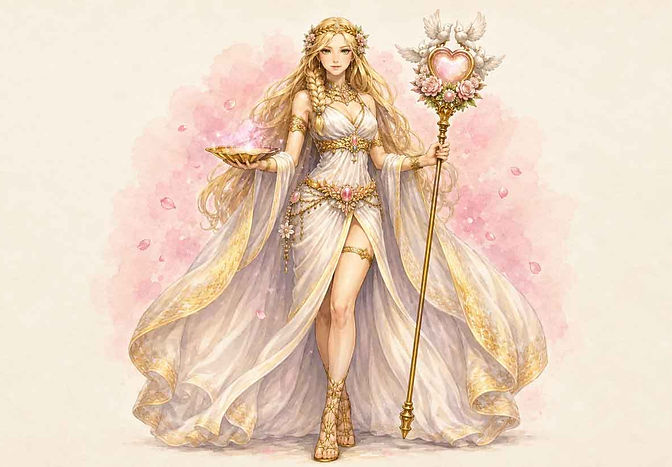
Aphrodite depictions, including her with her sons Eros & Himeros and her emerging from a clamshell as suggested
Main Article - Who or What was...
Aphrodite
Aphrodite came into being in the most violent and strange of circumstances. The sky-god Uranus, father of the Titans, had grown tyrannical and oppressive, and his son Cronus, the youngest of the Titans, resolved to overthrow him. Gaia, the Earth herself and mother of all, gave Cronus a jagged sickle of adamant. When Uranus lay upon her, Cronus struck from ambush and severed his father's genitals, casting them into the heaving sea. From the immortal flesh and the white foam that gathered around it, a maiden grew within the waves. She first approached the island of Cythera, then came to Cyprus, and stepped forth onto the shore as a goddess of awesome beauty. Beneath her delicate feet, grass and flowers sprang up. Eros, the god of love, and Himeros, the god of desire, accompanied her to the assembly of the gods on Mount Olympus, where every immortal who saw her desired her for his wife. Zeus, the king of the gods, gave her in marriage to Hephaestus, the divine smith, a skilled craftsman but lame and unattractive, a match that pleased neither of them.
Aphrodite's power was not merely romantic; it was world-shaping. When the Trojan prince Paris was asked to judge which of three goddesses was the most beautiful, Hera, Athena, and Aphrodite each offered him a bribe. Hera promised him wealth and power; Athena promised him wisdom and invincibility in battle; Aphrodite promised him the love of Helen, the most beautiful mortal woman in the world. Paris chose Aphrodite, and the goddess kept her word. Helen was already married to Menelaus, the king of Sparta, and Paris's abduction of her triggered the Greek expedition to Troy, the ten-year war that would consume heroes and cities alike. Hera and Athena, who had been rejected, became the bitter enemies of Troy, and their divine vendetta prolonged the war and deepened its destruction. Aphrodite, for her part, protected Paris and the Trojan cause throughout the siege, though she was wounded in battle by the Greek warrior Diomedes when she tried to shield her son Aeneas from harm.
Aphrodite's marriage to Hephaestus was a failure from the start. She had no love for the crippled smith, and her heart turned instead to Ares, the god of war, a handsome and violent figure who was everything Hephaestus was not. Their affair was secret at first, conducted in the palace Hephaestus had built for her. But Helios, the sun-god who sees all that happens beneath his light, discovered them and told Hephaestus. The smith, rather than confront them directly, used his cunning. He forged a net of bronze so fine that it was invisible to the eye, yet so strong that it could not be broken, and laid it across the bed. Then he pretended to leave for his beloved island of Lemnos. Ares came as soon as Hephaestus was gone, and the two lovers lay down together, only to find themselves trapped in the mesh, unable to move. Hephaestus returned, called all the gods to witness the humiliation, and demanded that Zeus return the bride-price he had paid for his unfaithful wife. The gods laughed at the sight, but Poseidon, the god of the sea, intervened and promised to stand surety for Ares' debt. Hephaestus released them, and the lovers fled: Ares to Thrace, and Aphrodite to her sanctuary at Paphos in Cyprus. The marriage was effectively ended, and in later stories Hephaestus took a new bride, the goddess Aglaia.
Aphrodite's mortal loves were as famous as her divine ones. The most significant was her union with Anchises, a Trojan prince of the royal house. Disguising herself as a mortal woman, she came to him on Mount Ida, and from their union was born Aeneas, the Trojan hero who would survive the fall of Troy and sail to Italy. Aphrodite warned Anchises never to reveal that he had lain with a goddess, for Zeus punished mortals who boasted of such unions with thunderbolts. Anchises kept the secret for a time, but later, drunk at a feast, he revealed it and was struck by lightning, crippled but not killed. Aeneas grew to be a great warrior and a pious man, and after the destruction of Troy he led the survivors on a long voyage across the Mediterranean, eventually landing in Italy where his descendants, the Romans, would build one of the greatest empires in history. The Roman name for Aphrodite was Venus, and she became one of the most important deities of the Roman state, the divine ancestor of the Julian family to which Julius Caesar and Augustus belonged.
Aphrodite's worship was centered on Cyprus and Cythera, the islands most associated with her birth, but her temples spread across the Greek world. At Corinth, her temple was famous for its sacred prostitutes, priestesses who considered their union with worshippers an act of devotion. She was celebrated in festivals such as the Aphrodisia and the Adonia, the latter commemorating her mortal lover Adonis, a beautiful youth killed by a boar and mourned by the goddess. In art, she was depicted as a woman of perfect beauty, often nude or draped in flowing garments, accompanied by doves, swans, roses, and myrtle. The most famous image of her birth, Botticelli's Renaissance painting The Birth of Venus, shows her standing on a scallop shell as she rises from the sea, a visual that has defined her in the Western imagination for over five hundred years. Her name lives on in the word "aphrodisiac," and her power over love and desire remains one of the most enduring concepts in human culture.
Summary
Aphrodite stands as the eternal force of love and beauty in human imagination, the goddess whose birth from sea foam and whose power over desire have shaped art, literature, and culture for nearly three thousand years. From the bloody overthrow of Uranus to the Judgement of Paris, from the invisible net of Hephaestus to the founding of Rome through her son Aeneas, her story is one of beauty that disrupts, desire that destroys, and love that outlasts empires. Every painting of a woman rising from the waves, every poem about the terrible power of attraction, every discussion of what beauty costs and what it wins, carries the shadow of Aphrodite, the foam-born goddess who made the world fall in love and then made it pay for the privilege.
Now enter the Mythopouch World!
You’ve discovered:
Aphrodite
From Myth to Game
Join to access FREE real-world mythology "Learn Quests" and "Courses". Sign up to the newsletter for new releases, game updates, insider news, and more as Mythopouch brings real mythology to life. EARN the right to purchase an offline board game by completing FREE modules.


It's FREE to join as a MEMBER!
Not ready to join? Get the newsletter instead below


Looking for others?
Click into the field below to search, or click the icon to go to full page search function!

Looking for Mythology Insights?


Click below to view our mythology blog article insights, where we delve into the current Mythopouch Tier regions, and what we think you should know!
Sources & Retellings
Explore the original mythological Source texts (most from over 75 years ago, some as translated, possibly with mature content) and Mythopouch's source Retellings (a modern retelling also suitable for 15+) connected to this mythological entity. We are growing this resource and will link these in the future; for now, check the References below, then find the Sources or Retellings on those pages!


References
Validation References:
- Hesiod, Theogony, lines 188-206, 933-938 (c. 8th-7th century BCE) - Aphrodite's birth from Uranus's severed genitals and her children by Ares
- Homer, Iliad, Books 3, 5, 14, 24 (c. 8th century BCE) - Aphrodite's role in the Trojan War and protection of Paris and Aeneas
- Homer, Odyssey, Book 8, lines 267-366 (c. 8th century BCE) - The adultery of Ares and Aphrodite and Hephaestus's trap
- Homeric Hymn to Aphrodite (c. 7th-6th century BCE) - Aphrodite's union with Anchises and the birth of Aeneas
- Pindar, Pythian Ode 4.171 (c. 5th century BCE) - Aphrodite's birth and power
- Burkert, Walter. Greek Religion (1985) - Chapter 3 on Aphrodite's Eastern origins and cult worship
- Pirenne-Delforge, Vinciane. L'Aphrodite grecque (1994) - Aphrodite's cults, epithets, and religious significance
- Rosenmeyer, Patricia A. "Aphrodite's Tortoise: The Symbolism of the Scallop Shell" in Classical Antiquity (2001) - Iconography and symbolism of Aphrodite
Cultural Context Notice
Mythology developed across different cultures, periods and traditions, and there is rarely one universally accepted version of a story. Mythopouch approaches these traditions with respect while remaining faithful to the complexity of the surviving material. Retellings and educational content may interpret or adapt historical sources, but are not presented as definitive accounts of any culture, religion or belief system.