Arthurian Mythology List


Welcome to the Mythopouch list of Arthurian Legend mythology entries! We also delve into the early history of Britain, Wales, and the Celtic and medieval traditions that shaped the Arthurian world. From kings, queens, knights and mages to castles, quests, monsters, artefacts, weapons, enchanted objects, creatures and more, this collection will continue to grow over time. Mythopouch provides real-world background and mythological information drawn from early chronicles, Welsh tales and medieval romances such as: the Welsh Triads, Culhwch and Olwen, the Historia Brittonum, the Annales Cambriae, Geoffrey of Monmouth, Chrétien de Troyes, the Lancelot-Grail or Vulgate Cycle, Sir Gawain and the Green Knight, and Thomas Malory’s Le Morte d’Arthur. Arthurian legend carries powerful ideas about courage, honour, loyalty, temptation, sacrifice, prophecy, betrayal and the dream of a better kingdom - messages passed from storyteller to storyteller for centuries, many of which still speak to modern life. Our unique imagery is meant to capture the imagination and ignite the Arthurian spark within us all. Our “token mark” coin symbol assigned to each record is a visual representation of the entity, for use in Mythopouch learning modules and games.
"Nothing is given, everything is earned" at Mythopouch!
Learn - Earn - Play
Arthurian Entity Quick Index
Our current list of ancient British mythology (Arthurian Legend) and ancient history entities are here - which are growing day by day!
Search by using the:
-
"Search Mythology Records" function to browse all mythology records and blog pages;
-
Browse the visual cards with overviews by clicking "Go to Visual A-Z";
-
Or just browse and click the A-Z entries below....
See more list entries
Read Arthurian Legend Insights
Click below to view our Arthurian Legend (ancient British) mythology blog article insights, where we delve into the current Mythopouch Tier regions and what we think you should know!


Arthurian Entity Card Index
See more card entries

Archimedes, Commander (Arthurian)
Archimedes is a minor Arthurian commander of the Vulgate Grail cycle, remembered for leading the third battalion of King Evalach of Sarras in the great war against Tholome Cerastre of Babylon. He is the nephew of Evalach, although the medieval text does not name his father or mother and therefore does not reveal through which side of the family the kinship passed. He is the old, worthy warrior chosen to command one of the four divisions of the Sarrasian army assembled for the decisive campaign around La Choine and Castle Valachim. He is the commander whom Tholome's battle plan singles out by assigning two battalions against him while Evalach and Seraphe each face one. He is a character of rank and experience rather than adventure: the narrative gives him no quest, no duel, no conversion scene and no closing fate. He is the obscure Arthurian namesake who must be distinguished from Archimedes of Syracuse, the Greek mathematician, and from Archimedes the owl of Merlin in modern Arthurian adaptations. And he is one of the Vulgate cycle's small, functional figures whose presence reveals the scale and formality of the Grail cycle's imagined Eastern warfare.

Arthur (King)
King Arthur is the central figure of the Matter of Britain, a legendary monarch who, according to medieval chronicles and romances, united the British people against Saxon invaders and established a golden age of chivalry. The earliest references to Arthur appear in Welsh poetry, notably the Y Gododdin (c. 600 CE) and the Historia Brittonum (c. 829 CE) by Nennius, where he is described as a military leader rather than a king. Geoffrey of Monmouth's Historia Regum Britanniae (c. 1136) provides the first comprehensive biography, establishing many of the elements that would define Arthur's legend for centuries.
Arthur's significance extends beyond the historical question of whether a real person lies behind the legend. He embodies the ideal of rightful kingship, the dream of national unity, and the moral aspirations of the chivalric code. The stories of his birth, his sword Excalibur, the Knights of the Round Table, and his final battle at Camlann form one of the most enduring narrative cycles in Western literature.

Astolat
Astolat is the castle and city near Camelot where the most famous tragedy of unrequited love in Arthurian legend unfolded, the home of Sir Bernard and his daughter Elaine, the Fair Maid of Astolat, who died for love of Sir Lancelot and floated down the river to Camelot in a white barge with a lily in her hand. It is the place where Lancelot stayed before a great tournament, where he accepted a maiden's red sleeve upon his helmet, and where he was nursed back to health from wounds that should have killed him. It is the castle whose daughter's devotion was so absolute that she refused all food and drink after Lancelot rejected her, pining to death in ten days and leaving a letter that accused no one but confessed everything. It is the town that gave Tennyson his "Lady of Shalott," the island tower and the curse and the mirror, though the poet moved the scene to a more remote and mysterious setting. And it is the Arthurian location that Thomas Malory identified with Guildford in Surrey, a real English town that still stands beside the River Wey, a place where the boundary between history and legend has always been as thin as the water's surface.

Avalon
Avalon is the enchanted island at the edge of the Arthurian world, the Isle of Apples where Excalibur was forged and where King Arthur was carried, mortally wounded, after the last battle at Camlann. It is the island ruled by Morgen, the great enchantress and healer, and her eight sisters, where orchards bear fruit without sowing, where no plough is needed and no winter comes, and where the people live a hundred years and more. It is the destination of the black barge with the weeping queens that came out of the mist to take the dying king from the shore, and the bower where Morgan le Fay promised to heal his wounds if he would stay with her for long ages. It is the island that the monks of Glastonbury claimed to prove in 1191, when they dug up a hollowed oak and a leaden cross naming Arthur in the isle of Avalon. And it is the last hope of the Arthurian legend, the place where the once and future king sleeps or heals, waiting for the day of Britain's greatest need.

Balan
Balan is the brother of Balin le Savage, the knight who bore two swords and dealt the Dolorous Stroke, and he is the other half of the most tragic fratricide in Arthurian legend. He is the knight who found his brother weeping by the bodies of Lanceor and Colombe, who rode with him to capture King Rience and to victory at the battle of Terrabil, and who was called by King Arthur one of the two most marvellous knights in the world. He is the warrior who killed a cursed knight on an island bridge and was trapped in his place, condemned to challenge every traveller who passed. He is the man who looked at his opponent's two swords and thought he knew his brother, but the strange shield convinced him otherwise, and so he fought his own flesh and blood to the death. He is the brother who died first, crawling on his hands and knees to remove his brother's helm, and who was buried in a single tomb with the man he had loved most. And he is the reminder that in Arthurian story, even the best knights can be destroyed by a borrowed shield and a moment's doubt.

Balin
Balin is the Knight with the Two Swords, the ill-fated hero of Arthurian legend whose every good intention ended in catastrophe, from the beheading of the Lady of the Lake to the Dolorous Stroke that laid waste to a kingdom and doomed the Grail quest before it began. He is the Northumberland knight who spent six months in Arthur's prison for killing a cousin of the king, who drew a cursed sword from its scabbard when no other knight at court could move it, and who ignored the damsel's warning that the blade would cause him to slay the man he loved most in the world. He is the warrior who delivered the most terrible blow in Arthurian romance, striking King Pellam with the Spear of Longinus in self-defence and bringing the castle down around them both, turning the fertile land of Listenois into the Wasteland that would fester until Galahad came to heal it. He is the brother who fought his own twin, Sir Balan, to the death without recognising him, the two men killing each other in mutual combat because one wore unfamiliar armour and the other had traded his shield. And he is the knight whom Merlin declared would have been Arthur's best and bravest had he lived, a man of peerless prowess cursed by a sword he refused to surrender.

Ban of Benoic
Ban of Benoic is the king whose death created the greatest knight in Arthurian legend, the father of Lancelot du Lac and the lord of a marsh-bound castle no army could breach until treachery set it alight. He is the warrior who rode beside his brother Bors to aid the young King Arthur against the rebel kings at Bedegraine, turning the tide with their French knights and earning Arthur's eternal gratitude. He is the husband of Elaine, the queen who bore him Lancelot and who would one day retire to a nunnery rather than live in a world without him. He is the king who held his infant son as he fled from Claudas, the enemy who had sworn to destroy him, and who looked back from the hilltop to see his beloved castle of Trebes blazing in the night. He is the man whose heart broke at that sight, who fell from his horse and died on the road, leaving his queen to rush to his side and his son to be taken by the Lady of the Lake. And he is the shadow behind every deed Lancelot ever performed, the father whose lost kingdom his son would one day reclaim.

Banw
Banw is one of the seven piglet-warriors of Twrch Trwyth, the transformed Irish king who became the most famous boar in Arthurian legend, and it is the little swine whose name may carry the echo of the Welsh word for pigling itself. It is the son of Twrch Trwyth, born not from a sow but from the same divine curse that turned its father from a human king into a venom-bristled monster. It is the warrior who fought beside its six brothers across Ireland and Wales, defending its father against Arthur's host with tusk and fury. It is the beast that fell at Dyffryn Amanw, the Amman Valley, slain alongside its brother Benwig when Arthur's hunters finally cornered the brood. It is one of the five named piglets who died so that their father might keep running, and whose death left only two sons to follow Twrch Trwyth to the final sea. And it is the reminder that in the oldest Arthurian tales, even the piglets were warriors, transformed kings who fought to the death for the father who had led them into monstrosity.
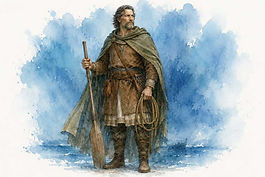
Barinthus
Barinthus is the steersman who guided the wounded King Arthur to the Isle of Avalon after the battle of Camlann, the pilot whose knowledge of the seas and the stars of heaven made him the only man alive who could find the way. He is the navigator mentioned in Geoffrey of Monmouth's Vita Merlini, the Latin poem that gave the medieval world its first explicit account of Arthur's final journey. He is the man at the tiller when Taliesin, Merlin, and the weeping queens placed the dying king aboard the barge and set sail into the western ocean. He is the figure whose name echoes an Irish tradition, for a Barrintus appears in the Navigatio Sancti Brendani, the Voyage of Saint Brendan, as the man who told the saint of a wonderful island beyond the western waves. He is the silent helmsman who asked no questions and needed no map, steering by the stars while the wounded king lay on a golden bed below. And he is the reminder that every great journey needs a pilot, and that the man who knows the way to paradise is sometimes more important than the king who is carried there.

Bedivere (Sir)
Sir Bedivere is the oldest companion of King Arthur still remembered by name, a knight whose story began in Wales centuries before Camelot was ever built. He is Bedwyr of the Welsh tales, the handsome one-handed warrior who fought beside the steward Cai in Arthur's first war-band, a man said to draw more blood with one hand than any three warriors with six. He is Beduerus the cup-bearer of Geoffrey of Monmouth's chronicle, made Duke of Normandy and killed with honour in Arthur's war against Rome. He is the last knight alive on the field of Camlann, the one who carried the dying Arthur on his back down to the water. He is the hand that threw Excalibur back into the lake after twice betraying his king's command, and the eyes that saw a woman's arm rise from the waves, catch the sword, and brandish it three times before drawing it under. And he is the witness who watched the black barge carry Arthur away to Avalon, the knight left behind to tell the tale.

Belinus
Belinus is a legendary king of the Britons in Geoffrey of Monmouth's History of the Kings of Britain, where he is the elder son of Dunvalo Molmutius and the brother of Brennius. Their rivalry begins as a dispute over succession, develops into civil war, and eventually ends in reconciliation before the brothers carry their armies into Gaul and towards Rome. Geoffrey credits Belinus with renewing the laws associated with his father, founding or restoring cities, and building a gate at Trinovantum that later tradition connected with Billingsgate. The story belongs to medieval British legendary history rather than securely documented ancient history, but it became an influential part of the imagined past of Britain. Welsh versions of Geoffrey's chronicle render the king as Beli ap Dyfnwal Moelmud. That Welsh form should not be confused with Beli Mawr, the separate legendary figure corresponding to Geoffrey's later king Heli.

Benwig
Benwig is one of the seven piglet-warriors of Twrch Trwyth, the transformed Irish king who became the most famous boar in Arthurian legend, and it is the little swine who fought and fell beside its brother Banw in the Amman Valley. It is the son of Twrch Trwyth, born not from a sow but from the same divine curse that turned its father from a human king into a venom-bristled monster. It is the warrior who defended its father across Ireland and Wales, buying time with tusk and fury as Arthur's host closed in. It is the beast that died at Dyffryn Amanw, slain alongside Banw when the hunters finally cornered two of the brood together. It is one of the five named piglets who perished so that their father might keep running toward the western sea. And it is the reminder that in the oldest Arthurian tales, even the nameless little boars fought like kings, and that the valley where two piglets fell remembers both their names.