
Mythopouch Mythological Retellings List

Mythopouch Mythological Retellings List
What is a retelling?
Some of the original mythology source documents date back thousands of years. Many were first written in ancient languages, in dialects no one speaks now, and storytellers often emphasised and embellished them for maximum impact. Mythopouch offers a modern, easier version of the same cycle. It is no different from watching a film of the source, except it stays much closer to the source, with only minor changes for readers aged 15+.
That is not a replacement for the source material, and it does not rewrite the old book. The original sources are available for you to read and access. The retelling is just an easier, more readable path through the same stories.
As with everything on Mythopouch more content is going to be added soon!
Retelling Description of Greece

Greek
Alternate Names
Description of Greece Retelling; Pausanias Retelling; Pausanias's Description of Greece Retelling; Mythopouch Retelling
Summary
This is the Mythopouch retelling of Description of Greece by Pausanias. It is a modern educational version for readers aged 15 and up, written in original Mythopouch wording and organised around the geographical journey of Pausanias rather than inventing a single continuous plot.
The complete retelling is 41 pages and follows all ten books of Pausanias. It focuses on the mythology, sacred places, monuments, local traditions and historical memories most useful for Mythopouch readers, while preserving Pausanias's habit of distinguishing between what he saw, what local people said and what he himself accepted or doubted.
Retelling The Odyssey

Greek
Alternate Names
The Odyssey Retelling; Homer's Odyssey Retelling; Mythopouch Odyssey Retelling; Odysseus Retelling
Summary
This is the Mythopouch retelling of The Odyssey, Homer's epic of wandering, homecoming, identity, loyalty and restoration. It is a modern educational version for readers aged 15 and up, written in original Mythopouch wording rather than as a translation of the ancient Greek or of Samuel Butler.
The complete retelling is 123 pages. It follows the full arc from Telemachus in the occupied palace, through Odysseus's wanderings and return, to Penelope's recognition and the final peace on Ithaca. Reference chapters provide pronunciation guidance, themed discussion questions and character tables.
Retelling Perceval, or The Story of the Grail

Arthurian
Alternate Names
Perceval; Perceval, or The Story of the Grail; Le Conte du Graal; Mythopouch Retelling
Summary
This is the Mythopouch retelling of Perceval, or The Story of the Grail by Chretien de Troyes. It is written for readers aged 15 and up and uses original Mythopouch wording.
The retelling follows Chretien's surviving unfinished romance rather than supplying an ending from the later Continuations, the Vulgate Cycle, Wolfram von Eschenbach or Malory. It is not Chretien's Old French poem and it is not a translation.
Retelling Isis and Osiris

Egyptian
Alternate Names
Isis and Osiris; On Isis and Osiris; De Iside et Osiride; Mythopouch Retelling
Summary
This is the Mythopouch retelling of the core Isis and Osiris myth preserved in Plutarch's On Isis and Osiris. It is written for readers aged 15 and up and uses original Mythopouch wording.
The retelling is not Plutarch's text and is not a translation. It follows the principal mythic sequence from the five intercalary births and Osiris's kingship through Typhon's plot, Isis's search, the dismemberment of Osiris, Horus's war with Typhon and Plutarch's closing interpretation of the sacred story.
Retelling The Iliad

Greek
Alternate Names
The Iliad Retelling; Homer's Iliad Retelling; Trojan War Retelling; Mythopouch Retelling
Summary
This is the Mythopouch retelling of Homer's Iliad, written for readers aged 15 and up. It is original modern educational wording, not Homer and not a translation of the Greek. The complete retelling brings all seven volumes together in one 160-page PDF, and each volume is also supplied as a separate shorter PDF.
The retelling follows the poem from the quarrel between Achilles and Agamemnon through the fighting at Troy, the deaths of Patroclus and Hector, Priam's journey to Achilles, and Hector's funeral. Volume VII adds pronunciation guidance, discussion questions and character reference tables.
Retelling Shabaka Stone

Egyptian
Alternate Names
Shabaka Stone Retelling; Memphite Theology Retelling; Mythopouch Retelling
Summary
This is the Mythopouch educational retelling of the Shabaka Stone and the Memphite Theology, written for readers aged 15 and up.
It explains the surviving monument, King Shabaka's restoration claim, Ptah's creation theology through heart and tongue, the settlement between Horus and Seth, the Osirian material, the debate over the text's date and the later history of the stone. It is original Mythopouch wording and is not the hieroglyphic inscription or a translation of it.
Retelling The Vulgate Cycle

Arthurian
Alternate Names
The Vulgate Cycle; Lancelot-Grail Cycle; Lancelot-Grail; Mythopouch Retelling
Summary
This is the Mythopouch retelling of the Vulgate Cycle, also called the Lancelot-Grail Cycle. It is a modern educational retelling of the medieval Old French prose tradition, written for readers aged 15 and up.
The retelling uses original Mythopouch wording. It is not the Old French text and it is not a translation. H. Oskar Sommer's public-domain scholarly edition is kept separately on the Sources page as the historical source witness.
Retelling The Homeric Hymns
Greek
Alternate Names
The Homeric Hymns; Homeric Hymns; Mythopouch Retelling
Summary
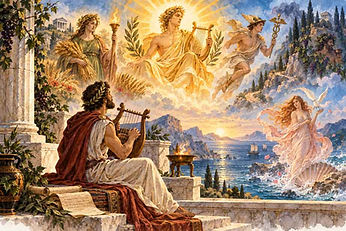
This is the Mythopouch retelling of the Homeric Hymns, a collection of thirty-three ancient Greek hymns to gods and divine figures. It is written for readers aged 15 and up.
Each hymn is presented beside Hugh G. Evelyn-White's 1914 public-domain English translation, followed by a modern Mythopouch retelling in Australian English. The retelling is original Mythopouch wording and is not a replacement for the historical source text.
Retelling Idylls of the King

Arthurian
Alternate Names
Idylls of the King Retelling; Tennyson Arthurian Retelling; Mythopouch Retelling
Summary
This is the Mythopouch retelling of Alfred, Lord Tennyson's Idylls of the King, checked against the public-domain 1896 Henry Altemus edition. It is a modern educational prose reading for readers aged 15 and up.
The retelling follows nine selected idylls from Arthur's rise through Geraint and Enid, Merlin and Vivien, Lancelot and Elaine, the Grail quest, Pelleas and Ettarre, the last tournament, Guinevere and Arthur's final passing. It is original Mythopouch wording and is not Tennyson's verse or a transcription.
Retelling The History of the Kings of Britain

Arthurian
Alternate Names
Historia Regum Britanniae Retelling; British History Retelling; Geoffrey of Monmouth Retelling; Mythopouch Retelling
Summary
This is the Mythopouch retelling of Geoffrey of Monmouth's The History of the Kings of Britain, also called Historia Regum Britanniae. It is a modern educational reading of Geoffrey's legendary account of Britain, written for readers aged 15 and up.
The retelling follows the broad movement of Geoffrey's twelve books, from Brutus and the early kings through Leir, Rome, Vortigern, Merlin, Uther Pendragon and Arthur to Mordred, Cadwallader and the end of British rule. It is original Mythopouch wording and is not Geoffrey's Latin text or the 1842 English translation.
Retelling Herodotus: The Histories

Greek
Alternate Names
Herodotus: The Histories; The Histories of Herodotus; The Histories; Mythopouch Retelling
Summary
This is the Mythopouch retelling of Herodotus' Histories, written for readers aged 15 and up. It follows the inquiry from Lydia and the rise of Persia through Egypt, Scythia and the Ionian Revolt to Marathon, Thermopylae, Salamis, Plataea and Mycale.
The retelling is original Mythopouch wording. It is not the ancient Greek text and it is not Henry Cary's 1904 translation, which is used separately as the public-domain narrative source witness.
Retelling Hatshepsut's Divine Birth

Egyptian
Alternate Names
Hatshepsut's Divine Birth; The Inscriptions at Deir el-Bahari; Mythopouch Retelling
Summary
This is the Mythopouch retelling of Hatshepsut's Divine Birth, based on the reliefs and inscriptions at her mortuary temple at Deir el-Bahari. It follows the divine-birth sequence from Amun's decision to father Hatshepsut through her conception, creation by Khnum, birth, presentation to Amun and divine nursing.
It is written for readers aged 15 and up. It is not the ancient Egyptian text and it is not James Henry Breasted's 1906 translation. The historical source witness sits separately on the Sources page. This retelling uses original Mythopouch wording.
Retelling Culhwch and Olwen

Arthurian
Alternate Names
Culhwch ac Olwen; Kilhwch and Olwen; Kilhwch and Olwen or The Twrch Trwyth; Mythopouch Retelling
Summary
This is the Mythopouch retelling of Culhwch and Olwen, also called Kilhwch and Olwen. It is a modern educational version of the medieval Welsh Arthurian tale in which Culhwch must win Olwen by surviving the impossible demands of her father, Ysbaddaden Pencawr. It is written for readers aged 15 and up.
It is not the medieval Welsh text and it is not Lady Charlotte Guest's 1842 translation. The historical source witness sits separately on the Sources page. This retelling uses original Mythopouch wording.
Retelling Book of Overthrowing Apep

Egyptian
Alternate Names
Book of Overthrowing Apophis Retelling; Apep Ritual Retelling; Mythopouch Retelling
Summary
This is the Mythopouch retelling of the Book of Overthrowing Apep, also called the Book of Overthrowing Apophis. It is a modern educational reading of the ancient Egyptian ritual preserved in the Bremner-Rhind Papyrus, written for readers aged 15 and up.
The retelling presents the ritual struggle against Apep, the serpent of chaos, through the sequence of spitting, trampling, binding, cutting, burning, felling and the destruction of wax figures. It also includes the creation material embedded within the Apep text. It is original Mythopouch wording and is not the ancient Egyptian text or a translation.
Retelling The Coffin Texts: Spells for the Dead of Middle Kingdom Egypt

Egyptian
Alternate Names
The Coffin Texts; Coffin Texts; Spells for the Dead of Middle Kingdom Egypt; Mythopouch Retelling
Summary
This is the Mythopouch retelling of the Coffin Texts: Spells for the Dead of Middle Kingdom Egypt. It is a modern educational reading of ancient Egyptian funerary spells about resurrection, breath, transformation, divine identity, the solar journey, the Book of Two Ways, judgement and the afterlife. It is written for readers aged 15 and up.
It is not the ancient Egyptian text and it is not a translation. The scholarly source editions sit separately on the Sources page. This retelling uses original Mythopouch wording.
Retelling Pyramid Texts

Egyptian
Alternate Names
Pyramid Texts Retelling; Old Kingdom Pyramid Texts Retelling; Mythopouch Retelling
Summary
This is the Mythopouch retelling of the Pyramid Texts. It is a modern educational reading of ancient Egyptian royal funerary texts about resurrection, offerings, protection, celestial travel and the dead king's transformation among the gods and stars. It is written for readers aged 15 and up.
It is not a translation of the hieroglyphs and it is not Samuel A. B. Mercer's 1952 translation. The public Sources page provides a separate historical English selection from E. A. Wallis Budge's 1914 The Literature of the Ancient Egyptians.
Retelling Hesiod: Theogony

Greek
Alternate Names
Hesiod: Theogony; Theogony Retelling; Mythopouch Retelling
Summary
This is the Mythopouch retelling of Hesiod's Theogony, written for readers aged 15 and up. It presents the origins of the Greek gods as a modern educational narrative, from Hesiod's encounter with the Muses and the first divine powers to the conflicts that establish Zeus's rule.
The story follows divine families, the fall of Cronus, Prometheus and the gift of fire, the war against the Titans, and the new order of gods and heroes. It is original modern wording, not Hesiod's Greek and not Hugh G. Evelyn-White's historical English translation.
Retelling Book of the Dead: Coming Forth by Day

Egyptian
Alternate Names
Coming Forth by Day; Book of Going Forth by Day; Egyptian Book of the Dead; Mythopouch Retelling
Summary
This is the Mythopouch retelling of the Book of the Dead, presented as Coming Forth by Day. It is a modern educational reading of ancient Egyptian funerary traditions about burial, protection, judgement, the afterlife and the hope of continuing life among the gods. It is written for readers aged 15 and up.
It is not an ancient Egyptian manuscript and it is not E. A. Wallis Budge's 1913 translation of the Papyrus of Ani. Those historical source materials sit on the Sources page. This page is Mythopouch's own modern wording.
Retelling Le Morte d'Arthur: Sir Thomas Malory

Arthurian
Alternate Names
Le Morte Darthur; Morte Darthur; The Death of Arthur; Malory's Le Morte d'Arthur; Mythopouch Retelling
Summary
This is the Mythopouch retelling of Sir Thomas Malory's Le Morte d'Arthur. It is a modern educational narrative of the Arthurian cycle: Arthur's rise, the fellowship of the Round Table, the adventures of its knights, the Grail quest and the final breaking of the kingdom. It is written for readers aged 15 and up.
It is not Malory's 15th-century English text and it is not the 1906 Everyman's Library edition used on the Sources page. Those historical texts remain available separately. This page is Mythopouch's own modern wording.
Retelling Apollodorus: The Library (Bibliotheca)

Greek
Alternate Names
Bibliotheca; Bibliotheke; The Library of Apollodorus; Mythopouch Retelling
Summary
This is the Mythopouch retelling of Apollodorus, The Library (Bibliotheca). It is a modern educational narrative of the same Greek cycle: the first gods, the heroes, Thebes, the Argonauts, and the road to Troy. It is written for readers aged 15 and up.
It is not the ancient Greek text. It is not J. G. Frazer’s 1921 translation. Those sit on the Sources page, with the two public-domain PDFs. This page is Mythopouch’s own wording of that handbook.
Sources & Retellings Cultural Context Notice
Mythology developed across different cultures, periods and traditions, and there is rarely one universally accepted version of a story. Mythopouch approaches these traditions with respect while remaining faithful to the complexity of the surviving material. Retellings and educational content may interpret or adapt historical sources, but are not presented as definitive accounts of any culture, religion or belief system.