The Potion Did Not Invent the Love: Tristan and Isolde
Updated: 18 hours ago
Mythopouch Arthurian insight
Also known as Tristram, Tristran, Drystan. Isolde is also Iseult, Yseult, Esyllt.
The Mythopouch record already gives you the bones of Tristan and Isolde: the orphan of Lyonesse, the dragon in Ireland, the cup drunk on the ship, the forest of Morois, the second Isolde, the black sail, the rose and the vine. This insight is not that plot again. It is about what the legend is doing once you already know what happens.
What the existing record cannot say in one page
Tristan and Isolde did not start as a Round Table story. The love triangle is older than Lancelot, and older than Camelot as we picture it. Welsh tradition already knew Drystan, March and Esyllt. A sixth-century stone near Castle Dore in Cornwall names a Drystan. A tenth-century charter names Isolde’s Ford. French poets in the 1170s, Béroul and Thomas of Britain, wrote the tale as a Cornish and Irish tragedy. Only the later Prose Tristan and Malory drag him into Arthur’s fellowship and make him Lancelot’s peer. That matters. His first duty is not to a king of Britain; it is to the uncle who raised him.
That is a different sin from Lancelot’s. Lancelot betrays a lord and a friend. Tristan and Isolde betray kinship. King Mark (Cunomorus) is not only a husband in the way, but he is the man who took in a dead sister’s child. The story is cruel, because the wronged person is also the foster-father.

Two potions, two arguments
Medieval writers did not agree on what the drink was for.
In Béroul’s rougher version, the potion lasts about three years. Then the magic thins. Tristan and Isolde still choose each other. That is the darker reading. The cup starts the fire; it does not keep it burning. After that they are responsible.
In Thomas of Britain and Gottfried von Strassburg, the drink is closer to a life sentence. Love becomes a private religion; honour, marriage and the church are still real. They just lose. That version made later opera and later romance, it is also easier on the lovers. If the cup is forever, they can say they never had a choice.
A Mythopouch reader should hold both. The potion is the famous object. The real question is what they do when the first heat is no longer an excuse.
The name is a warning
Storytellers liked to hear triste in Tristan: sorrow. He is born after his father is already dead; his mother dies giving birth. He is named for grief before he has drunk anything; the cup does not invent the tragedy - it finds a man who was already built for it.
Look at the last trick of the tale. Tristan, dying in Brittany, asks for a white sail if Isolde of Ireland is coming, a black sail if she is not. His wife, Isolde of the White Hands, sees white and says black. That is not only jealousy it is the Theseus pattern from Greek story, the same lying sail that killed King Aegeus. Western legend keeps using one colour at sea to murder a waiting parent or lover. Tristan and Isolde inherit that device, the second Isolde is not a spare romantic interest. She is the same name with none of the love, which is how the story punishes the first theft.
What to notice that the record only points at
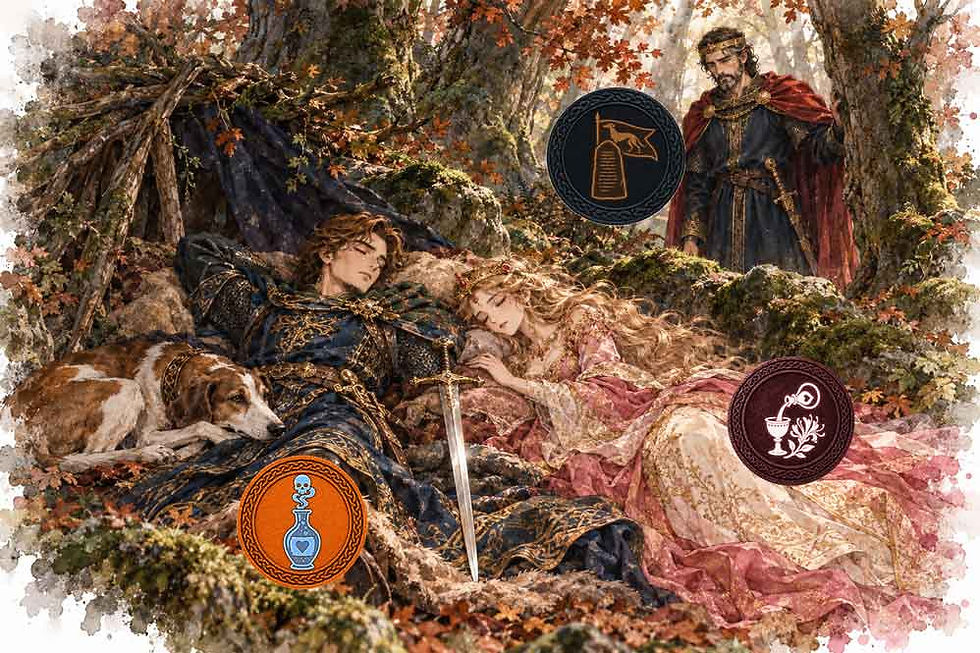
Tristan is a harper and a hunter as much as a knight. The dog, the forest, the harp at Mark’s court: those are Celtic hero marks, not French tournament marks. When the lovers hide in Morois, and he lays a sword between their bodies, that is theatre for Mark and for us. It says: we can still perform honour while breaking it. Whether you believe the sword is a nice touch, or a lie, is the whole moral problem of the romance.
Do not flatten Tristan and Isolde into “Lancelot and Guinevere, but Cornish.” Lancelot’s love is service, he climbs into the cart. Tristan’s love is accident first, then appetite, then loyalty to the accident. One story asks how far you will go for a sovereign lady; the other asks what you owe a cup you were never meant to drink, and an uncle you were meant to serve.

What Mythopouch wants you to notice about Tristan and Isolde
Myths here are not only battles. Tristan and Isolde survive because they make a human knot you cannot cut clean. Duty to the man who raised you. Desire that arrives as a mistake. A marriage that is legal and empty. A second woman with the same name. A signal at sea that one spoken lie can turn.
If you were playing after learning, the potion token is not “they cannot help it.” It is “now choose, and keep choosing, while the court still watches.” Nothing in that story is given clean. The cup is found. The rest is earned, and then paid for in two graves that will not stay apart.
French & English Source Notation
In the English tradition, he is usually Sir Tristram. Most readers first meet the story in Thomas Malory’s Le Morte d’Arthur, composed around 1469–70 and printed by Caxton in 1485. Malory drew on the earlier French Prose Tristan and shaped it into the long Book of Sir Tristram de Lyones. In that book the knight is Sir Tristram, nephew of King Mark of Cornwall. Older French and Welsh texts call him Tristan or Drystan; Malory’s English spelling and his decision to place the tale inside the Round Table cycle, are what later English readers inherited.
Mythopouch now holds both the historical source text and a modern retelling of Le Morte d’Arthur. The Sources pages give the older public-domain witnesses so you can check names, episodes and wording against the actual book. The Retellings are short form written in clear modern English for readers 15 and over, so the same stories can be followed without fighting fifteenth-century prose. Use the source when you want the original English form. Use the retelling if you want the narrative summarised and easier to read - in some cases, not all. The two sit side by side on the site so the myth can be learned, not only summarised.
Charter Source text: Thomas Malory’s Le Morte d’Arthur
📝 A Word Worth Learning
Charter (noun) |
A formal written document recording or granting rights, privileges or agreements. Historical charters can preserve valuable evidence about people and places. |
In this article: The historical discussion refers to a tenth-century charter, a document that can help researchers investigate people and places of the period. |
Mythopouch retelling: Le Morte d’Arthur retelling
See also the Mythopouch records:


#TristanAndIsolde #TristanOfLyonesse #ArthurianLegend #Isolde #KingMark #Lyonesse #Cornwall #LovePotion #Mythopouch #LearnEarnPlay #WelshMythology #Malory #Gottfried #Beroul
Sources
Béroul, Le Roman de Tristan (c. 1170)
Thomas of Britain, Tristan (c. 1170s)
Eilhart von Oberge, Tristrant
Gottfried von Strassburg, Tristan (c. 1210)
Prose Tristan (13th century)
Thomas Malory, Le Morte d’Arthur, Book of Sir Tristram de Lyones
Welsh Ystorya Trystan; Black Book of Carmarthen fragment; Welsh Triads; Culhwch and Olwen
Castle Dore stone (DRVSTANVS HIC IACIT CUNOMORI FILIVS); tenth-century charter for Isolde’s Ford
O. J. Padel on the Cornish background; Rachel Bromwich on the Welsh Tristan


Comments