Details
Region
Arthurian
Regional Information Additional (if applicable)

British / Celtic / Geoffrey of Monmouth's chronicle tradition
Category
Person
Historicity (actuality or factual truth of persons, events, and claims)
Legendary
Gender
Male
Time Period
Legendary pre-Roman Britain; literary tradition from c. 1136
Symbol
Sword & broken treaty
Tags
brennius, arthurian, person, belinus, dunvalo-molmutius, conwenna, allobroges, rome, geoffrey-of-monmouth
Introduction - Overview
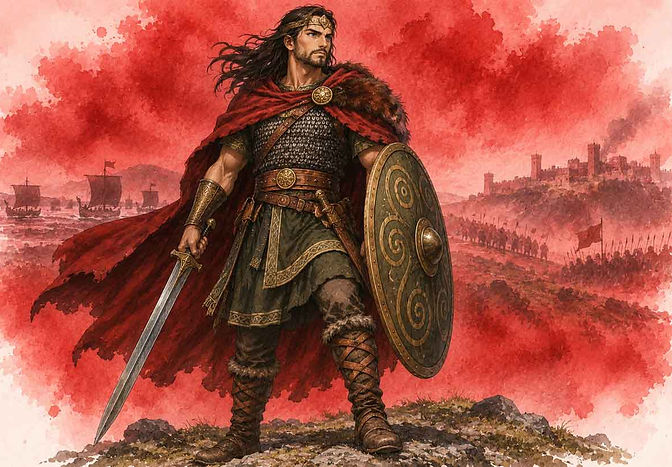
Brennius is the legendary British prince whose quarrel with his brother Belinus grows into a story of exile, reconciliation and the conquest of Rome. In Geoffrey of Monmouth's History of the Kings of Britain, he is the younger son of Dunvalo Molmutius and the ruler of the northern part of the island under his elder brother. Unwilling to remain subordinate, he seeks support abroad, loses a war at home and rebuilds his fortunes among the Allobroges in Gaul. His return threatens another civil war until their mother Conwenna persuades the brothers to make peace. United, they carry their armies onto the continent and into Geoffrey's imagined Roman campaign. Brennius then remains in Italy while Belinus returns to Britain. The tale belongs to medieval British legendary history, not a securely documented biography of a British conqueror. Its resemblance to accounts of the Gallic Brennus is important, but the two traditions must be distinguished rather than combined into one unquestioned life.
Gallery
Main Article - Who or What was...
Brennius
Geoffrey of Monmouth places Brennius in the legendary succession after Dunvalo Molmutius, whose name also appears as Dunwallo or Dunvallo. The king leaves two sons, Belinus the elder and Brennius the younger. Their followers initially negotiate a division: Belinus receives the crown and the greater part of Britain, while Brennius holds the northern lands under his brother. The younger brother does not simply reject the crown in favour of peaceful independence. His advisers encourage him to challenge his subordinate position, and a marriage alliance with Norway helps turn the dispute into war.
Belinus takes control of the northern territory while Brennius is abroad. Storms, rival rulers and the capture of Brennius's bride complicate his return before the brothers fight at Calaterium. Belinus wins, and Brennius escapes across the sea. In Gaul he finds protection with Segin, the duke of the Allobroges, whose favour eventually brings him marriage to the duke's daughter and succession to his lands. This continental connection transforms the defeated exile into a ruler capable of raising another army. Geoffrey's geography and institutions belong to a medieval reconstruction of antiquity, not a reliable political map of pre-Roman Europe.
Brennius returns to Britain intending to recover what he has lost. Before another battle begins, his mother Conwenna approaches him and appeals to their family bond. Geoffrey makes her intervention the turning point: Brennius listens, embraces Belinus and abandons the immediate struggle against him. The brothers become partners in a new campaign across the Channel. Their reconciliation ends one war but makes a much larger expedition possible, carrying the narrative from a family dispute into Geoffrey's imagined history of British conquest abroad.
The brothers advance through Gaul and towards Rome. Geoffrey names the Roman leaders Gabius and Porsenna and describes a settlement involving tribute and hostages. When the Romans later attack, Belinus ambushes them and joins Brennius in renewed warfare. The brothers besiege Rome, execute hostages before its walls and eventually take the city. Their stories then separate. Belinus returns to Britain and is remembered as a builder and lawgiver, while Brennius remains in Italy. Geoffrey characterises his subsequent rule as tyrannical, making the brothers' different endings part of the chronicler's moral contrast rather than an independently verified judgement about ancient rulers.
Brennius must be distinguished from the Gallic Brennus in Roman accounts of the sack of Rome. Livy's Book V tells the famous story of Brennus adding his sword to the ransom scales and declaring Vae victis, usually translated as woe to the conquered. That is an episode in Roman historical tradition, not evidence that Geoffrey's British prince personally uttered the words. Similarities between the names and conquest stories invite comparison, but they do not justify merging Brennius with every Brennus or with the Welsh Bran. His place in Mythopouch is as the legendary brother of Belinus, a figure in the British chronicle tradition whose story joins rivalry, exile, reconciliation and conquest.
Summary
Brennius is the younger brother of Belinus in Geoffrey of Monmouth's legendary history of Britain. Defeated in a struggle for power, he rebuilds his position in Gaul, returns with an army and is reconciled with his brother through their mother Conwenna. The brothers then undertake the conquest of Rome, after which Brennius remains in Italy. His story is related to the wider tradition surrounding Brennus and Rome, but Livy's sword-and-scales episode should not be treated as a verified incident in the life of Geoffrey's British prince. Brennius belongs to legend, not established ancient British history.
Now enter the Mythopouch World!
You’ve discovered:
Brennius
From Myth to Game
Join to access FREE real-world mythology "Learn Quests" and "Courses". Sign up to the newsletter for new releases, game updates, insider news, and more as Mythopouch brings real mythology to life. EARN the right to purchase an offline board game by completing FREE modules.


It's FREE to join as a MEMBER!
Not ready to join? Get the newsletter instead below


Looking for others?
Click into the field below to search, or click the icon to go to full page search function!

Looking for Mythology Insights?


Click below to view our mythology blog article insights, where we delve into the current Mythopouch Tier regions, and what we think you should know!
Sources & Retellings
Explore the original mythological Source texts (most from over 75 years ago, some as translated, possibly with mature content) and Mythopouch's source Retellings (a modern retelling also suitable for 15+) connected to this mythological entity. We are growing this resource and will link these in the future; for now, check the References below, then find the Sources or Retellings on those pages!


References
Validation References:
- Geoffrey of Monmouth, History of the Kings of Britain, Book III, c. 1136; Sebastian Evans translation - partition of Britain, the Norwegian alliance, Calaterium, Segin and the Allobroges, Conwenna's intervention and the Roman campaign.
- https://sacred-texts.com/neu/eng/gem/gem04.htm
- Livy, Ab Urbe Condita, Book V.48 - the Gallic Brennus, ransom weights, sword and Vae victis.
- https://www.thelatinlibrary.com/livy/liv.5.shtml
- Wace, Roman de Brut, c. 1155 - vernacular adaptation of Geoffrey's history.
- Layamon, Brut, late 12th or early 13th century - English adaptation.
- J. S. P. Tatlock, The Legendary History of Britain, 1950.
Cultural Context Notice
Mythology developed across different cultures, periods and traditions, and there is rarely one universally accepted version of a story. Mythopouch approaches these traditions with respect while remaining faithful to the complexity of the surviving material. Retellings and educational content may interpret or adapt historical sources, but are not presented as definitive accounts of any culture, religion or belief system.