Arthurian Mythology List


Welcome to the Mythopouch list of Arthurian Legend mythology entries! We also delve into the early history of Britain, Wales, and the Celtic and medieval traditions that shaped the Arthurian world. From kings, queens, knights and mages to castles, quests, monsters, artefacts, weapons, enchanted objects, creatures and more, this collection will continue to grow over time. Mythopouch provides real-world background and mythological information drawn from early chronicles, Welsh tales and medieval romances such as: the Welsh Triads, Culhwch and Olwen, the Historia Brittonum, the Annales Cambriae, Geoffrey of Monmouth, Chrétien de Troyes, the Lancelot-Grail or Vulgate Cycle, Sir Gawain and the Green Knight, and Thomas Malory’s Le Morte d’Arthur. Arthurian legend carries powerful ideas about courage, honour, loyalty, temptation, sacrifice, prophecy, betrayal and the dream of a better kingdom - messages passed from storyteller to storyteller for centuries, many of which still speak to modern life. Our unique imagery is meant to capture the imagination and ignite the Arthurian spark within us all. Our “token mark” coin symbol assigned to each record is a visual representation of the entity, for use in Mythopouch learning modules and games.
"Nothing is given, everything is earned" at Mythopouch!
Learn - Earn - Play
Arthurian Entity Quick Index
Our current list of ancient British mythology (Arthurian Legend) and ancient history entities are here - which are growing day by day!
Search by using the:
-
"Search Mythology Records" function to browse all mythology records and blog pages;
-
Browse the visual cards with overviews by clicking "Go to Visual A-Z";
-
Or just browse and click the A-Z entries below....
See more list entries
Read Arthurian Legend Insights
Click below to view our Arthurian Legend (ancient British) mythology blog article insights, where we delve into the current Mythopouch Tier regions and what we think you should know!


Arthurian Entity Card Index
See more card entries

Dinabuc
Dinabuc is the nameless giant given a name by Wace in his Roman de Brut, the Spanish monster who abducted Helena, the niece of Duke Hoel of Brittany, and carried her to the top of Mont-Saint-Michel, where he devoured knights and roasted captives on a spit until King Arthur cut him down. He is the fiend from Spain who emerged from the south to terrorise the coast of Normandy, a creature of such monstrous size that no single warrior dared face him, and whose cave on the sacred mount became a charnel house of half-eaten men and despairing women. He is the giant who killed the maiden Helena rather than let her be rescued, either by his own brutality or by her own hand to escape his lust, and who then turned his violence upon her aged nurse, defiling her in a display of grotesque excess that made him less a man than a devil in flesh. He is the adversary whom Arthur faced with only Sir Kay and Sir Bedivere at his side, the monster whose oak club and crocodile hide armour could not withstand the king's sword, and whose decapitated head was borne back to camp as proof that the land was free. And he is the giant whose death sanctified the mount, for Arthur ordered a church built upon the peak where Helena lay buried, the church that would become the abbey of Mont-Saint-Michel, one of the most famous pilgrimage sites in Christendom, a monument raised upon the grave of a monster's victim.

Dindrane
Dindrane is the Grail heroine of Arthurian legend, the sister of Sir Percival who joined the quest for the Holy Grail and whose voluntary sacrifice of her own blood became the truest expression of the Grail's meaning. She is the maiden who met Galahad at a hermitage and persuaded him to accompany her, providing a girdle for his sword fashioned from her own hair, a symbol of devotion and renunciation. She is the interpreter of relics who guided Percival, Galahad, and Bors through the mysteries of the Ship of Solomon, the Tree of Life, and the Sword of the Strange Belt, revealing the sacred history that the knights could not read for themselves. She is the pure maiden who, when told that only the blood of a virgin princess could cure a leprous lady, offered her own life without hesitation, dying so that another might live. And she is the only woman to sail the Ship of Solomon and reach the holy city of Sarras, where her body was laid to rest beside the very Grail she had helped to achieve, incorrupt and pure, a saint in all but name.

Diwrnach
Diwrnach is the Irish giant whose refusal to surrender his magic cauldron set in motion the first Arthurian expedition to Ireland, the steward whose defiance made him the first man to die by the blade of Caledfwlch, the sword later called Excalibur. He is the owner of the cauldron of discernment, a vessel that would boil meat placed within it only if intended for a brave man, and would remain cold if cowards sought to cook in it. He is the servant of King Odgar son of Aedd, the Irish king who commanded him to give up the cauldron to Arthur but found that his steward's pride was stronger than his own authority. He is the host who received Arthur at his table, fed him, and then denied him the one thing he had come for, a refusal that cost him his life and every man in his retinue. And he is the keeper of one of the Thirteen Treasures of Britain, whose cauldron would be remembered as a prototype of the Holy Grail and whose death proved Arthur's sword the deadliest weapon in the Isles.

Dolorous Stroke
The Dolorous Stroke is the disastrous blow by which Balin wounds King Pellam in Thomas Malory's Arthurian narrative. The weapon is a sacred spear associated with Christ's Passion, and its misuse brings the castle down and devastates the surrounding countries. The name describes the act and its consequences, not a separate object interchangeable with the Spear of Longinus. Behind the episode lies a wider body of Grail literature about wounded rulers, damaged lands and healing. Those stories differ in the identity of the king, the cause of his wound and the act that restores him. Balin's catastrophe should therefore not be combined indiscriminately with every Fisher King episode. In Malory, the immediate events grow out of his pursuit of the invisible murderer Garlon and a violent confrontation in Pellam's household. His desperate choice of a weapon changes a personal struggle into a disaster whose effects reach far beyond the two men in the room.

Dormarch
Dormarch is the hound of Gwyn ap Nudd, the named dog of the king of the Welsh Otherworld, and by his master's place the chief of the Cwn Annwn, the spectral pack that rides the night sky before death and war. He is the stallion of the door, if his strange name is read aright, the horse-named hound that stands at the threshold of Annwn. He is one of the earliest named dogs in British literature, called up in the great muster of Culhwch and Olwen when Arthur summoned all the marvels of the Island of Britain to his aid, and named by his master in the old verses of the Black Book of Carmarthen, where Gwyn speaks of his hound as a warrior speaks of his sword. He is the baying in the mountain wind, the white dog with the red ears at the head of the immortal hunt. And he is the reminder that even the king of the Otherworld keeps a faithful hound, and that the oldest stories of Wales knew a dog could be a legend in his own right.

Drudwyn
Drudwyn is the fiercest hunting hound in Welsh legend, the whelp of Greid son of Eri and the only dog in Britain capable of tracking the supernatural boar Twrch Trwyth across three kingdoms and two seas. He is the hound that no ordinary man could hold, a beast of such strength and ferocity that Ysbaddaden Chief Giant declared him indispensable for the hunt and Mabon ap Modron the only huntsman alive who could manage him. He is the dog who needed a leash fashioned by Cors Hundred Claws, a collar made by Canhastyr Hundred Hands, and a chain forged by Cilydd Hundred Holds, equipment so extraordinary that it took King Arthur himself to procure it. He is the tracker who followed Twrch Trwyth from Ireland to Wales to Cornwall, through rivers and across mountains, until the boar was finally driven into the sea. And he is the proof that in the oldest Arthurian tale, even a dog can be a hero, and even a hound can be the difference between a quest failed and a legend made.

Dumnonia
Dumnonia was an early medieval British realm associated with Devon and Cornwall, whose history became closely intertwined with the Arthurian traditions of the south-west. Its name preserves that of the Dumnonii, while its surviving evidence ranges from Gildas's denunciation of a ruler named Constantine to the imported pottery and substantial buildings at Tintagel. These remains reveal connections across the sea during the centuries after Roman government ended in Britain. Later Welsh genealogies and romances link the region with Geraint, Erbin and Cador, and Geoffrey of Monmouth makes a Constantine the successor to Arthur. Those literary relationships are not a securely established historical family tree. Nor was Dumnonia a kingdom with demonstrably unchanged borders and institutions throughout its existence. It is best understood through the changing communities, rulers and coastal connections of the peninsula. Its historical significance and its legendary associations enrich one another, but neither the trading settlements nor the royal names prove that Arthur ruled there.

Dunvalo Molmutius
Dunvalo Molmutius is the legendary king who forged a fractured island into a single realm and gave it laws that would echo down the centuries. He is the son of Cloten, the petty king of Cornwall, who rose from a minor kingdom to conquer the five warring realms of Britain and became the first monarch to wear a golden crown over all the island. He is the warrior who dressed six hundred of his men in the armour of the slain and led a charge that killed two enemy kings in a single day. He is the lawgiver whose Molmutine Laws granted sanctuary to the persecuted, protection to the ploughman, and the right of queens to rule. He is the builder of the Temple of Concord in Trinovantum, where he was buried after forty years of peace. And he is the father of Belinus and Brennius, whose rivalry for his throne would plunge Britain back into the very chaos he had spent his life ending.

Dyfed
Dyfed is the historical region and early medieval kingdom in south-west Wales that becomes the home of Pwyll, Rhiannon and Pryderi in the Four Branches of the Mabinogi. The tales describe seven cantrefs, or territorial divisions, and turn places such as Arberth and Glyn Cuch into meeting points between ordinary life and the Otherworld. Pwyll's exchange with Arawn, Rhiannon's elusive ride and the disappearance of their child belong to this literary landscape, not to a documented sequence of royal events. Dyfed's historical setting has a different kind of evidence: the name of the Demetae, early rulers mentioned in texts, inscriptions and traditions of contact with Ireland. Accounts of a Déisi ancestry preserve a migration story rather than a complete contemporary record of the kingdom's foundation. In the tenth century Dyfed became part of the larger realm associated with Hywel Dda. Its enduring identity joins real geography to stories of hospitality, marriage, grief and encounters with Annwn.

Dyfyr Golden-Hair
Dyfyr Golden-Hair is a woman of Welsh Arthurian tradition remembered among the Three Splendid Maidens of Arthur's court. Her companions in the grouping are Enid and Tegau Gold-Breast, while a fuller version associates Dyfyr herself with Glewlwyd Gafaelfawr, Arthur's formidable gatekeeper. Her Welsh epithet, Wallt Euraid, identifies her golden hair; it does not supply a complete story of her life. Unlike figures known through an extended surviving romance, Dyfyr reaches readers mainly through brief notices and the relationships recorded around her name. That scarcity makes her intriguing, but it also sets limits on what can responsibly be said. A water-goddess identity, a detailed love story and a particular home beside Arthur's gate are not established by those notices. Her place is nevertheless distinctive: she is an individual woman honoured within a group, not the group itself, and her connection with Glewlwyd gives her a relationship beyond a list of celebrated beauties.

Each Uisge
The Each Uisge is the most feared water spirit in Scottish folklore, a shape-shifting monster that haunts the sea lochs and freshwater lochs of the Highlands and Islands, luring riders to a death so terrible that only their livers survive to tell the tale. It is the creature that appears as a beautiful horse with an unnaturally fine coat and rich harness, mingling with mortal herds until some unsuspecting soul climbs upon its back, at which point its skin becomes adhesive and the horse gallops to the deepest part of the loch to drown and devour its prey. It is the handsome stranger who approaches young women on the shore, betrayed only by the sand and water-weeds tangled in his hair or the hooves that replace his feet when he thinks no one is looking. It is the monster that killed nine children at a single stroke in Argyll, leaving only one boy who cut off his own finger to escape, and the beast that the blacksmith of Raasay slew with red-hot hooks after it took his daughter. And it is the creature that dissolves by sunrise into a soft greyish jelly, leaving no corpse to prove it ever existed, the eternal reminder that the most beautiful things in the Highlands are often the most deadly.
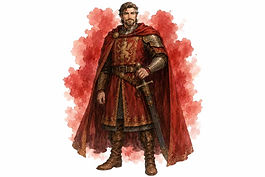
Ector (Sir)
Sir Ector is the foster father of King Arthur, the honest knight chosen by Merlin to raise the future king in secret as his own son. He is the man who took the newborn prince from the enchanter's hands on the night of his birth, brought him to his own wife's breast, and kept the secret of the boy's blood for fifteen years. He is the true father of Sir Kay, the sharp-tongued foster brother who would become seneschal of all England, and the head of the household where Arthur learned humility before he ever heard a crown. He is the knight standing in the snowy London churchyard when the forgotten sword of his son Kay sends young Arthur to the stone in the yard, and the boy comes back holding the blade that proves him king. He is the man who made his own son swear upon a Bible to tell the truth about that sword, and who then knelt to his foster child and asked only one reward: a place for Kay. And he is the proof that the greatest king in legend was raised not by a king, but by a good man.