
Details
Region
Greek
Regional Information Additional (if applicable)

Phaeacian / Homeric / Western geography
Category
Location
Historicity (actuality or factual truth of persons, events, and claims)
Mythological
Gender
N/A
Time Period
Heroic Age; first and most fully described in the Odyssey, composed in the 8th or 7th century BCE
Symbol
Palace garden and ship
Tags
greek, scheria, phaeacia, phaeacians, odysseus, alcinous, arete, nausicaa, odyssey
Introduction - Overview
Scheria is the mythological island kingdom of the Phaeacians, the remote and wealthy people who gave Odysseus his final passage home after ten years of wandering. It is the land the Phaeacians chose after fleeing the brutality of the Cyclopes, founded by Nausithous, son of Poseidon, and made famous by the palace of King Alcinous and Queen Arete. It is the setting for the meeting between the naked, salt-crusted Odysseus and the young Princess Nausicaa at the river where she washes her wedding clothes. It is the place where the hero enters a palace whose bronze walls shine like sun or moon, whose doors are flanked by golden and silver dogs made by Hephaestus and whose gardens produce fruit in every season. It is the court where Odysseus reveals his name and tells the four-book story of the Cyclops, Circe, the Sirens, the Underworld and Calypso. It is the homeland of magical ships that know the thoughts of their passengers, sail without rudders and cross the sea with the speed of a falcon. And it is the island punished by Poseidon for carrying the sea god's enemy, when the returning Phaeacian ship is turned to stone at the harbour mouth and its people lose their ancient privilege of conveying wanderers.
Gallery
Main Article - Who or What was...
Scheria
Scheria stands at the boundary between the strange world of Odysseus's wanderings and the human world of Ithaca. After leaving Troy, the hero passes through lands that grow increasingly unreal: the Lotus-Eaters who erase memory, the one-eyed Cyclops, the sorceress Circe, the Sirens, the monster-filled straits and Calypso's island of immortal temptation. Scheria follows these places, but it does not resemble them. Its people are mortals, they marry, work, eat and sleep, and yet their ships, gardens and intimacy with the gods make them unlike any community in the ordinary Greek world.
The Phaeacians had not always lived there. They once occupied broad Hypereia, near the land of the Cyclopes, arrogant giants who raided and oppressed them. Nausithous, son of Poseidon and Periboea, led the migration away from that danger. He ringed the new city with walls, divided the fields, built houses and temples and gave his people a settled order far from other mortals. When Nausithous died, Alcinous became king. The royal house remained close to the sea god: Alcinous married Arete, daughter of his brother Rhexenor, preserving the family's Poseidon-derived authority within its own bloodline.
Homer calls the land Scheria and its people Phaeacians. The latter name has often been connected with phaios, a Greek word meaning grey or dark, but the exact etymology remains uncertain. The Phaeacians' identity is more clearly expressed through their habits than through the colour of a word. They are seafarers, merchants, singers, dancers, feasters and artisans. Nausicaa tells Odysseus that the Phaeacians live far apart in the wash of the waves, at the furthermost edge of humankind, and have little traffic with other peoples. Their ships travel everywhere, but their city remains secluded.
Odysseus reaches the island after the most desperate passage of his return. He has spent seven years with Calypso, builds a raft at Zeus's command and sails for seventeen days. Poseidon sees him, raises a storm and shatters the raft. The sea goddess Ino, also called Leucothea, gives Odysseus her veil to keep him from drowning. Two days of swimming bring him to the coast of Scheria. He crawls beneath two olive bushes, heaps leaves over himself and falls into exhausted sleep.
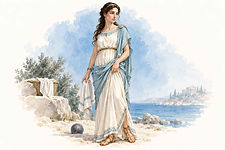
Athena guides the next event. She enters the palace at night, takes the form of a trusted friend and tells Nausicaa, daughter of Alcinous and Arete, to take the household laundry to the river because her marriage may be approaching. The next morning Nausicaa drives a mule-cart to the washing pools, spreads the clothes to dry and plays ball with her attendants. Their cries wake Odysseus. He emerges from the bushes covered only by leaves, and the young women flee in terror. Nausicaa stands her ground. The riverbank becomes the place where a naked castaway is restored to clothing, food, speech and social standing.
The city itself rises beyond the grove of Athena. Its walls and towers enclose a harbour suitable for ships, a market place beside the moorings and a sanctuary of Poseidon. The streets lead to the palace of Alcinous, which glows with a brilliance compared to the light of the sun or moon. Its walls are bronze, its doorposts are silver and its lintel is gold. Two immortal dogs, one silver and one gold, stand at the entrance as guardians. Hephaestus, the divine craftsman, made them to guard the house of Alcinous.
Inside, the palace displays the Phaeacians' skill in weaving and domestic order. Women grind grain, spin and weave beside the light of hearths. Golden youths, wrought by Hephaestus, hold torches in the halls. The woven fabrics show the scenes of heroic struggle that civilised households preserve in art rather than experience. Arete sits by the hearth spinning purple wool, and her judgement resolves disputes. Alcinous presides over the feast, but it is the queen whose recognition of Odysseus's clothing and whose favour determine whether the stranger will receive passage home.
Beyond the palace lies the garden that has made Scheria famous as a place of abundance without labour. Pears, apples, pomegranates, figs and olives grow together in an unbroken succession. One crop ripens while another is planted. Grapes dry into raisins or are pressed for wine. Vegetables grow in neat rows, and two springs water the whole garden, one flowing through the orchard and one beneath the palace. The west wind, Zephyrus, blows gently and keeps the fruit ripening. Homer presents the abundance as a gift from the gods rather than the reward of heroic effort.
The society of Scheria is distinguished by pleasure and courtesy, but not by heroic combat. Alcinous tells Odysseus that the Phaeacians do not care for archery, wrestling or running, except in festive games. They prefer ships, feasts, dancing, music and warm baths. When Odysseus throws the discus farther than any Phaeacian, he proves that he comes from a harder world. The island is not weak, but its strength lies in navigation, craftsmanship, wealth and hospitality rather than war.
Scheria also provides the stage for storytelling. Odysseus reaches the palace as an unnamed stranger, but Demodocus, the blind bard of the Phaeacians, sings about Troy. His first song describes a quarrel between Odysseus and Achilles. His second, the comic tale of Ares and Aphrodite, entertains the court. His third describes the wooden horse that ended the Trojan War. Odysseus weeps at the memory, and Alcinous finally asks who he is. Odysseus answers with the most famous line of the epic: I am Odysseus, son of Laertes.
The four central books of the Odyssey are then spoken in the hall of Scheria. Odysseus recounts the Cicones, the Lotus-Eaters, Polyphemus, Aeolus, the Laestrygonians, Circe, the descent to the dead, the Sirens, Scylla and Charybdis, the cattle of Helios and Calypso. The Phaeacians become the audience within the poem, mirroring the epic's external listeners. Alcinous repeatedly urges the story onward, asks questions and compares his own world with the dangers Odysseus has survived. Scheria becomes a place of reflection, the calm room in which the hero's sufferings can be transformed into narrative.
The island's greatest wonder is its ships. They possess no pilots in the ordinary sense and need no rudders. They know the thoughts of their passengers, understand every city and land and can cross the sea through mist and darkness without danger. Alcinous recalls carrying Rhadamanthys, the wise son of Zeus, as far as Euboea and returning on the same day. The ships are gifts from Poseidon, an inheritance of the Phaeacians' divine ancestry. They are technology made magical, vessels that remove the uncertainty from travel.
When the Phaeacians convey Odysseus home, they load him with bronze, gold, clothing and other treasures. The ship leaves Scheria at evening and crosses the sea so swiftly that the dark prow rises like a horse and a falcon cannot keep pace. Odysseus sleeps through the voyage. The Phaeacian crew lays him and his treasure beneath an olive tree on Ithaca and returns.
Poseidon waits for them at Scheria. Angry that the Phaeacians have carried his enemy safely home, he asks Zeus for permission to punish them. Zeus grants it. As the ship approaches the harbour, Poseidon strikes it with the flat of his hand and turns it into stone, rooting it beneath the water. An old prophecy is fulfilled: the Phaeacians once heard that Poseidon would one day strike one of their ships returning from a voyage and would raise a mountain around their city, cutting them off from the sea. The Odyssey ends the episode before revealing whether the second part occurs. The people offer sacrifice and prayer, but their privilege has ended.
Ancient writers could not leave Scheria floating without coordinates. Thucydides reports that the people of Corcyra, modern Corfu, boasted that their island had once been inhabited by the Phaeacians and that their maritime tradition reached back to those ancient sailors. The identification gave Corfu a Phaeacian heritage and supported a local tradition that the rock called Pontikonisi, Mouse Island, was the ship Poseidon turned to stone. Yet Homer never names Scheria as Corcyra. The island is far from Ithaca, but not so remote that its people should fail to recognise the king of the neighbouring Ionian islands. The contradiction belongs to the tension between myth and geography.
Other ancient geographers pushed Scheria much farther away. Strabo reports that Polybius criticised Homer's geography, while Strabo himself argues that passages about Ogygia, Oceanus and the Phaeacians point to locations in the Atlantic. The westward position of Scheria fits its position between Calypso's island and Ithaca, but the epic's distances and directions are not stable enough to create a modern map. Scheria moves with the interpretation of the Odyssey itself.
The island appears in the Argonautic tradition as the kingdom of Alcinous and Arete. Apollonius of Rhodes places the Phaeacian home at Drepane, the Sickle Isle, where the Argonauts seek refuge after taking the Golden Fleece from Colchis. The pursuing Colchians demand that Medea be surrendered. Alcinous agrees to give her up if she is still unmarried, but Arete secretly warns the couple and arranges a wedding on the island before her husband can act. The marriage of Jason and Medea therefore takes place in the Phaeacian sphere, joining the Argonautic cycle to the world of Scheria.
As a literary image, Scheria has often been called the first utopia. It possesses peace without war, abundance without destructive labour, maritime knowledge without ordinary danger and a royal household ruled by courtesy. Yet the paradise is imperfect. The Phaeacians can be insolent, as Euryalus shows when he mocks Odysseus during the games. Alcinous delays the stranger's departure and offers him Nausicaa as a bride, threatening the homecoming that the whole epic has pursued. Their intimacy with the gods ends in punishment. Scheria is not the final answer to suffering. It is the last gentle refuge before Odysseus returns to the disorder of Ithaca.
The island's modern legacy lies in the idea of the ideal society and in the real geography claimed by that idea. Corfu still presents itself as the ancient land of the Phaeacians, using the Homeric connection in guidebooks, local traditions and tourism. The petrified ship survives in the mythic interpretation of Pontikonisi. Literary utopias inherit the Scherian pattern of the traveller who enters an orderly land, studies its customs and returns to the imperfect world. Fantasy islands and hidden maritime societies continue the same structure.
Scheria endures because it contains the Odyssey in miniature. A storm brings the hero to its shore. A princess restores his clothing. A queen receives him. A bard sings of Troy. The hero speaks his own story. Games test his identity. Ships carry him home. Poseidon punishes the people who helped him. Every major theme of the epic, hospitality, storytelling, divine favour, memory, disguise and return, passes through the island.
Summary
Scheria endures as the Phaeacian island where Odysseus is washed ashore, received by Nausicaa and sent home aboard a ship that needs no helmsman. From the palace of Alcinous and Arete to the ever-bearing gardens, the self-steering vessels, the hero's four-book tale and Poseidon's stone ship, the island joins wealth, hospitality, song and punishment. Ancient writers identified it with Corcyra or placed it in the Atlantic, but Homer's Scheria remains a boundary between wonder and home. It is the final haven before Ithaca and the place where wandering becomes story.
Now enter the Mythopouch World!
You’ve discovered:
Scheria
From Myth to Game
Join to access FREE real-world mythology "Learn Quests" and "Courses". Sign up to the newsletter for new releases, game updates, insider news, and more as Mythopouch brings real mythology to life. EARN the right to purchase an offline board game by completing FREE modules.


It's FREE to join as a MEMBER!
Not ready to join? Get the newsletter instead below



Looking for others?
Click into the field below to search, or click the icon to go to full page search function!

Looking for Mythology Insights?


Click below to view our mythology blog article insights, where we delve into the current Mythopouch Tier regions, and what we think you should know!
Sources & Retellings
Explore the original mythological Source texts (most from over 75 years ago, some as translated, possibly with mature content) and Mythopouch's source Retellings (a modern retelling also suitable for 15+) connected to this mythological entity. We are growing this resource and will link these in the future; for now, check the References below, then find the Sources or Retellings on those pages!


References
Validation References:
- Homer, Odyssey 5.270-493 (c. 750 BCE) - Odysseus' departure from Calypso, Poseidon's storm and his arrival on the Scherian shore
- Homer, Odyssey 6.1-331 (c. 750 BCE) - Athena's dream, Nausicaa's laundry and the meeting beside the river
- Homer, Odyssey 7.1-347 (c. 750 BCE) - the history of the Phaeacians, the palace of Alcinous, the gardens, Arete's authority and the offer of marriage
- Homer, Odyssey 8.1-586 (c. 750 BCE) - the Phaeacian games, the songs of Demodocus and Odysseus' revelation of his identity
- Homer, Odyssey 9.1-12.453 (c. 750 BCE) - Odysseus' first-person account of his wanderings, framed by the court of Scheria
- Homer, Odyssey 13.1-187 (c. 750 BCE) - the magical voyage to Ithaca, Odysseus' sleep and Poseidon's transformation of the returning ship
- Apollonius of Rhodes, Argonautica 4.982-1236 (c. 270-245 BCE) - Drepane, Alcinous, Arete, the Colchians and the marriage of Jason and Medea
- Thucydides, History of the Peloponnesian War 1.25.4 (c. 430 BCE) - the Corcyraean claim that their island had once been inhabited by the Phaeacians
- Strabo, Geography 1.1.7 and 1.2.37 (early 1st century CE) - ancient criticism of the Odyssey's geography and arguments for an Atlantic location
- Fraser, A.D., "Scheria and the Phaeacians", Transactions of the American Philological Association 60 (1929), pp. 155-178 - classic study of the island, its people and ancient geographical identifications
- Shewan, A., "The Scheria of the Odyssey", Classical Philology 14 (1919) - early analysis of Scheria as a utopian and imaginary land
- Heubeck, Alfred, Stephanie West and J. Bryan Hainsworth, A Commentary on Homer's Odyssey, Volume 1 (Oxford University Press, 1988), Books 6-7 - commentary on the Phaeacian setting, palace and social world
- de Jong, Irene J.F., A Narratological Commentary on the Odyssey (Cambridge University Press, 2001), Books 6-13 - the Scheria frame and Odysseus' embedded narrative
- Cook, Erwin F., The Odyssey in Athens: Myths of Cultural Origins (Cornell University Press, 1995), Chapter 3 - the Phaeacian court, hospitality and epic performance
- Segal, Charles, Singers, Heroes, and Gods in the Odyssey (Cornell University Press, 1994), Chapter 5 - Demodocus, song and the role of Scheria as audience
- Dougherty, Carol, The Raft of Odysseus: The Ethnographic Imagination of Homer's Odyssey (Oxford University Press, 2001), Chapter 4 - travel, cultural encounter and the Phaeacian reception
Cultural Context Notice
Mythology developed across different cultures, periods and traditions, and there is rarely one universally accepted version of a story. Mythopouch approaches these traditions with respect while remaining faithful to the complexity of the surviving material. Retellings and educational content may interpret or adapt historical sources, but are not presented as definitive accounts of any culture, religion or belief system.