
Details
Region
Greek
Regional Information Additional (if applicable)

Phaeacian / Homeric / Argonautic
Category
Person
Historicity (actuality or factual truth of persons, events, and claims)
Legendary
Gender
Female
Time Period
Heroic Age; first attested in the Odyssey, composed in the 8th or 7th century BCE, and retained in the Argonautic tradition by Apollonius of Rhodes
Symbol
Wool
Tags
greek, arete, phaeacians, scheria, alcinous, nausicaa, odysseus, medea, hospitality
Introduction - Overview
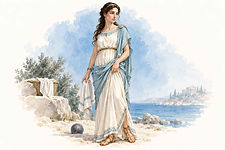
Arete is the queen of the Phaeacians whose favour Athena tells Odysseus to win before he dares ask the king of Scheria for passage home. She is the daughter of Rhexenor and the niece of her husband Alcinous, joining two branches of the Phaeacian royal family. She is the mother of Nausicaa and the royal children of Alcinous, honoured by her children, her husband and the people like a goddess. She is the woman who walks through the city settling the quarrels of men and women, giving her judgement the force of public order. She is the first person in the palace to recognise Odysseus's clothing as the work she and her maids had made, transforming a domestic detail into a question that opens the hero's identity and his tale. She is the listener beside Alcinous during the Odyssey's four-book narration of Odysseus's wanderings. She is the queen of Drepane who receives Medea's plea, protects her when the Colchians demand her surrender and gives her twelve attendants as a wedding gift. And she is the figure whose name, arete, means excellence or virtue, a name Homer lets her earn through her wisdom, honour and social authority.
Gallery
Main Article - Who or What was...
Arete
Arete belonged to the oldest line of the Phaeacians. Her father was Rhexenor, son of Nausithous and grandson of Poseidon. Rhexenor married but fathered no son. Apollo of the silver bow struck him down in his own hall, leaving only Arete as his heir. Her father's brother, Alcinous, married her. The union kept the royal house within the same family and joined the descendants of Poseidon even more tightly. In the palace, their children included five sons and the celebrated daughter Nausicaa. Alcinous honoured Arete as no husband on earth was said to honour his wife.
Her name already carried its meaning. Arete meant excellence, virtue, moral worth or the ability to fulfil a social role to the highest degree. When Athena describes her to Odysseus, the goddess says her name is Arete and that she earns it. The word is the same used for the excellence of heroes, cities and gods, but in the queen it becomes the excellence of judgement, household authority, generosity and persuasion. Arete's power is not based upon a spear or throne room alone. It rests upon her ability to settle conflict before it becomes violence.
Athena's speech gives the fullest portrait. The goddess tells Odysseus to pass the king and approach the queen first. Arete comes from the same family as Alcinous and shares the lineage of Nausithous, founder of Scheria and son of Poseidon. She is honoured by her children, by Alcinous and by the people, who greet her as if she were a goddess. She walks through the city with more public authority than any woman in the Odyssey. If she becomes friendly towards someone, that person has hope of reaching home and family.
Arete's role was judicial as well as domestic. The people brought disputes to her, and she ended quarrels even between men. In a society where the queen normally appears behind the household, Arete walks outside the palace and resolves the conflicts of the city. Her influence reaches men and women alike. Odysseus is told that her goodwill is the key to his passage, a remarkable instruction in an epic world where a suppliant normally approaches a male ruler.
Her palace household formed part of that power. Phaeacian women worked at the loom, ground grain and prepared clothing. Arete herself made garments with her maids, and Odysseus wears one of them when he enters the palace. Her work is not merely decorative. The purple cloth she spins places royal labour beside judgement and hospitality. When the queen recognises her own work on the stranger's body, she recognises the route by which help has reached him.
Nausicaa becomes the first Phaeacian to receive Odysseus, but she immediately sends him to her mother. Athena and Nausicaa both give the same advice. The princess tells Odysseus to go past Alcinous, embrace Arete's knees and ask for passage. Her reason is precise: if the queen's thoughts are friendly, there is hope that the stranger may see his own people again. Nausicaa understands the hidden centre of her own court. Her father rules in public, but her mother determines what the household will do.
Athena meets Odysseus outside the city and gives the same instruction with a full account of Arete's ancestry and authority. The goddess also protects Odysseus in mist and brings him to the palace. Arete therefore becomes the first person Odysseus sees when the mist dissolves. He does not approach the king, the assembly or the elders. He walks straight to the queen, clasps her knees and begs for mercy.
Odysseus's plea is crafted for Arete's household and her family's history. He calls her daughter of Rhexenor and asks her, Alcinous and the assembled guests to send him home. He has suffered, he says, and spent too long away from his friends. Then he sits in the ashes by the hearth. The pose is humble, but the choice of queen is calculated. He has been told that Arete, not Alcinous, is the person whose favour decides the voyage.
Echeneus, the eldest Phaeacian, breaks the silence. He tells Alcinous that the stranger should not be left to sit in ashes and that he must be raised to a seat, given wine and fed. Alcinous responds at once. He takes Odysseus by the hand, seats him beside Laodamas and orders food and drink. Arete has not yet spoken, but the supplication at her knees has already activated the ritual of hospitality.
The stranger eats and answers questions about his origins. When he says that he is mortal and longs for home, the Phaeacians agree to send him. Then Arete speaks. She notices the cloak and tunic Odysseus wears and recognises them as clothing she and her women made. Her question is simple: who gave him those garments, and how did he reach Scheria from the sea? The question moves the whole epic forward. Until that moment, Odysseus has hidden his identity. Arete's domestic recognition demands an explanation, and Odysseus answers with the story of Calypso, the raft, the storm, Ino's veil and his arrival on the shore.
His answer praises Nausicaa. He describes how the princess fed him, had him washed and gave him clothing. Odysseus says Nausicaa told him to follow her maids to the palace, but he refused out of shame and fear, thinking Alcinous might be angered by the sight. The tale is diplomatic. Odysseus defends Nausicaa from the suggestion that she acted improperly. Arete's question has revealed not only the stranger's route but also her daughter's role in saving him.
Alcinous wonders aloud whether Nausicaa fell short by not leading Odysseus to the palace. Odysseus answers that the princess is blameless. His praise completes the defence of Nausicaa's honour, which Arete's clothing had made vulnerable. The queen's observation and the hero's answer join private work to public reputation. A woven tunic becomes evidence, a question becomes a judgement and Odysseus's reply protects the daughter whose first act of hospitality had saved him.
Arete's household then becomes the centre of the longest storytelling sequence in the Odyssey. The stranger is bathed, given a bed and entertained with food, games and song. Demodocus sings of Troy and makes Odysseus weep. Alcinous asks the hero's name, and Odysseus identifies himself as Odysseus, son of Laertes. From Book Nine through Book Twelve he tells Arete, Alcinous and the assembled Phaeacians the stories of the Cyclops, the Lotus-Eaters, Aeolus, Circe, the Underworld, the Sirens, Scylla and Charybdis, the cattle of the Sun and Calypso.
Arete is present through this narration as the queen whose approval secured it. The Homeric narrator does not give her individual replies, yet the royal couple forms the audience together. When the wanderings end, Alcinous gives Odysseus gifts and orders the crew to prepare the ship. Nausicaa says farewell and asks Odysseus to remember that he owes his life to her. Odysseus promises to honour her like a goddess if he reaches home. Arete's role remains quieter, but the voyage begins because the queen first recognised the clothing and asked the question that led to the stranger's story.
The queen's domestic judgement thus becomes the mechanism of recognition. In Odysseus's own household, Penelope will later test the stranger by mentioning the immovable bed he built. In Alcinous's household, Arete recognises the clothing she made. Both queens use intimate knowledge to test a hidden man. Arete's question is less dangerous than Penelope's, but it performs the same function: the household possesses evidence that no disguise can erase.
In the Argonautic tradition, Arete appears again as queen of Drepane, the Phaeacian island where Jason and Medea seek refuge after fleeing Colchis. The pursuing Colchians demand Medea's surrender. Alcinous tells his wife that if Medea is still a virgin he will return her to her father Aeetes, but if she is Jason's wife she will remain with her husband. The king's answer creates a race between law and marriage.
Medea understands where protection must begin. She touches Arete's knees, as Odysseus had done, and begs the queen not to hand her over. She says that fear and haste drove her to leave Colchis and swears that she has left her father's house with virginity intact. Medea asks Arete to take pity on her and persuade her husband, wishing the queen a full life, children and an unconquered city. Her plea echoes the supplication of Odysseus and reaches the same judicial centre of the household.
Arete reports the king's decision to the Argonauts and sends a message warning them to arrange the marriage before daylight. Jason and Medea are wed in the sacred cave of Macris, with Orpheus singing and the Golden Fleece spread across the bridal bed. When Alcinous walks down in the morning, the marriage is complete and his legal condition is fulfilled. Medea cannot be surrendered because she is already Jason's wife.
The Colchians abandon their pursuit and settle among the Phaeacians. Arete gives Medea twelve attendants as part of the gifts that send the Argonauts onward. Her intervention has changed the future of the Argonautic myth. Without the queen's warning and message, Medea could have been returned to Colchis. The marriage that later brings Medea to Corinth, Iolcus and tragedy begins in the sphere of Arete's protection.
Arete's two appearances therefore share the same structure. In Scheria she receives Odysseus's supplication and helps determine his return. In Drepane she receives Medea's plea and helps determine Jason's escape. In both cases a royal husband holds formal authority, but the queen acts as the effective guardian of hospitality. The knees of Arete become a doorway through which fugitives pass from danger to safety.
Her power resembles the authority of Penelope, who governs Ithaca by weaving and delaying the suitors while Telemachus and Odysseus are absent. It resembles too the public honour given to Helen before the Trojan War and to Andromache within Troy, yet Arete is less tragic than either. She does not wait for a husband's return or lose a city. Her excellence appears in peace, abundance and stable kingship.
Homer's portrait of the queen is also a portrait of Phaeacia itself. The island is wealthy, orderly and close to the gods. Its people sail with magical ease, its gardens bear fruit in every season and its palace shines with bronze, gold and silver. Arete sits at the centre of that order. She spins purple cloth, settles disputes, judges strangers and receives suppliants. The Phaeacian ideal of civilisation is embodied not only by Alcinous's ships but by Arete's social intelligence.
Later tradition could identify Scheria with Corcyra, modern Corfu, because the island's ancient naval power and maritime geography seemed to fit the Homeric portrait. The identification also gave Corcyra a royal ancestress whose authority matched its historical importance. Arete's name entered Greek language permanently. Arete became the ordinary word for excellence and, in later philosophy, a central term for virtue, human fulfilment and civic excellence. The word's meanings cannot be reduced to the queen, but Homer makes her an image of what excellence looks like when embodied by a woman in power.
Ancient art, commentary and later scholarship have returned to Arete less often than to Nausicaa or Alcinous, partly because Homer grants her no long speech. Yet her role is structural. Nausicaa acts at the river; Arete acts in the palace. Athena instructs Odysseus to seek her; Odysseus does so; she asks the question that begins the narration; the king follows her lead. The Odyssey's civilised centre is not only a male king's hall. It is a household governed jointly by husband and wife, in which the queen's approval can save a stranger.
Arete's story ends in silence. Homer does not tell her age at the time of Odysseus's visit, her reaction to his departure, her feelings about Alcinous's offer of Nausicaa or her later life. The queen receives no lament, no prophecy and no separate fate. Her power lies in the moment of recognition, when a woven garment identifies a man and a question opens a story. After that, she remains where she began: beside the hearth, surrounded by the household whose excellence she embodies.
Summary
Arete endures as the Phaeacian queen whose authority in Scheria makes her the true key to Odysseus's rescue and whose compassion in Drepane protects Medea from the Colchians. Daughter of Rhexenor, niece-wife of Alcinous and mother of Nausicaa, she walks through her city settling disputes and receives strangers at her knees. Her recognition of Odysseus's clothing opens the hero's tale, while her warning to Jason completes Medea's marriage and saves the Argonauts. Named for the Greek excellence she embodies, Arete remains the queen at the hearth whose judgement turns hospitality into salvation.
Now enter the Mythopouch World!
You’ve discovered:
Arete
From Myth to Game
Join to access FREE real-world mythology "Learn Quests" and "Courses". Sign up to the newsletter for new releases, game updates, insider news, and more as Mythopouch brings real mythology to life. EARN the right to purchase an offline board game by completing FREE modules.


It's FREE to join as a MEMBER!
Not ready to join? Get the newsletter instead below




Looking for others?
Click into the field below to search, or click the icon to go to full page search function!

Looking for Mythology Insights?


Click below to view our mythology blog article insights, where we delve into the current Mythopouch Tier regions, and what we think you should know!
Sources & Retellings
Explore the original mythological Source texts (most from over 75 years ago, some as translated, possibly with mature content) and Mythopouch's source Retellings (a modern retelling also suitable for 15+) connected to this mythological entity. We are growing this resource and will link these in the future; for now, check the References below, then find the Sources or Retellings on those pages!


References
Validation References:
- Homer, Odyssey 6.303-315 (c. 750 BCE) - Nausicaa's instruction to Odysseus to approach Arete and clasp her knees
- Homer, Odyssey 7.54-91 (c. 750 BCE) - Athena's account of Arete's ancestry, public honour and power to settle disputes
- Homer, Odyssey 7.133-181 (c. 750 BCE) - Odysseus' supplication at Arete's knees and the beginning of Phaeacian hospitality
- Homer, Odyssey 7.232-347 (c. 750 BCE) - Arete's recognition of Odysseus's clothing and her question about Nausicaa
- Homer, Odyssey 8.1-586 and 9.1-12.453 (c. 750 BCE) - the games, songs and Odysseus's wanderings narrated before Alcinous and Arete
- Homer, Odyssey 13.1-187 (c. 750 BCE) - the royal household's gifts and the departure that fulfills the hope Arete's favour secured
- Apollonius of Rhodes, Argonautica 4.982-1236 (c. 270-245 BCE) - Drepane, Medea's plea to Arete, the queen's warning, the marriage and the gifts to Medea
- Thucydides, History of the Peloponnesian War 1.25.4 (c. 430 BCE) - the Corcyraean claim to Phaeacian ancestry and maritime identity
- Apollodorus, Bibliotheca, Epitome 7.25-36 (1st or 2nd century CE) - the Phaeacian return of Odysseus and the royal household's role
- Heubeck, Alfred, Stephanie West and J. Bryan Hainsworth, A Commentary on Homer's Odyssey, Volume 1 (Oxford University Press, 1988), Book 7 - commentary on Arete's genealogy, status, supplication and household
- Pomeroy, Sarah B., Goddesses, Whores, Wives, and Slaves: Women in Classical Antiquity (Schocken Books, 1975), "Homeric Society" - women, household labour and the public position of Arete
- Murnaghan, Sheila, Disguise and Recognition in the Odyssey (Princeton University Press, 1987), Chapter 5 - recognition, household knowledge and Odysseus's return to identity
- Reece, Steve, The Stranger's Welcome: Oral Theory and the Aesthetics of the Homeric Hospitality Scene (University of Michigan Press, 1993), "The Phaeacian Hospitality Scene" - the ritual structure of Odysseus's reception by Arete and Alcinous
- Schein, Seth L., "Female Representations and Interpreting the Odyssey", in Beth Cohen (ed.), The Distaff Side: Representing the Female in Homer's Odyssey (Oxford University Press, 1995), pp. 17-27 - female figures and the interpretation of the Odyssey's women
- Cook, Erwin F., The Odyssey in Athens: Myths of Cultural Origins (Cornell University Press, 1995), Chapter 3 - the Phaeacian court and the ideal of civilised hospitality
Cultural Context Notice
Mythology developed across different cultures, periods and traditions, and there is rarely one universally accepted version of a story. Mythopouch approaches these traditions with respect while remaining faithful to the complexity of the surviving material. Retellings and educational content may interpret or adapt historical sources, but are not presented as definitive accounts of any culture, religion or belief system.