
Details
Region
Greek
Regional Information Additional (if applicable)

Phaeacian / Homeric / Argonautic
Category
Person
Historicity (actuality or factual truth of persons, events, and claims)
Legendary
Gender
Male
Time Period
Heroic Age; first attested in the Odyssey, composed in the 8th or 7th century BCE, and retained in the Argonautic tradition by Apollonius of Rhodes
Symbol
Self-steering ship
Tags
greek, alcinous, phaeacians, scheria, arete, nausicaa, odysseus, demodocus, hospitality
Introduction - Overview
Alcinous is the king of the Phaeacians whose hospitality ends the wanderings of Odysseus and gives the hero the last ship that carries him home to Ithaca. He is the son of Nausithous, founder of Scheria and grandson of Poseidon, inheriting a kingdom whose people have mastered the sea beyond ordinary mortals. He is the husband of Arete, whom he honours more than any other husband honours a wife and whose judgement settles disputes among Phaeacians and strangers alike. He is the ruler of a palace whose bronze walls shine like sun or moon, whose gardens bear fruit in every season and whose doors are guarded by immortal dogs fashioned by Hephaestus. He is the host who bathes, feeds, clothes, entertains and finally transports Odysseus, offering not only gifts but his daughter Nausicaa in marriage. He is the attentive listener whose questions transform Odysseus's sufferings into the story of the Cyclops, Circe, the Sirens, the Underworld and Calypso. He is the judge of Drepane in the Argonautic tradition, whose ruling about Jason and Medea determines the fate of the Golden Fleece's fugitives. And he is the king punished by Poseidon, because the magical ship that carries Odysseus home returns as stone and marks the end of his people's freedom of the sea.
Gallery
Main Article - Who or What was...
Alcinous
Alcinous inherited his kingship through Poseidon. His grandmother was Periboea, daughter of Eurymedon, the overweening king of the Giants whose race brought destruction upon itself. Poseidon lay with Periboea and fathered Nausithous, who later led the Phaeacians away from Hypereia, where the lawless Cyclopes had oppressed them, and founded the city of Scheria. Nausithous married Periboea, daughter of Eurymedon, and fathered two sons, Rhexenor and Alcinous. Rhexenor died before producing a son. Apollo of the silver bow struck him down in his hall, either before his marriage was complete or while he was newly married. His daughter Arete survived him, and Alcinous married his brother's child.
The marriage made Arete both Alcinous's wife and niece, preserving the authority of the royal house within the same lineage. Their household was extraordinary for its concord. Homer says that no husband on earth honours his wife as Alcinous honours Arete. Her children, her husband and the people treat her as a goddess. She walks through the city receiving greetings, settles the quarrels of men and women, and grants favours to those who win her goodwill. Athena tells Odysseus that approaching Arete is the safest path to his return home. The queen's authority makes Scheria a kingdom in which female judgement is as important as royal command.
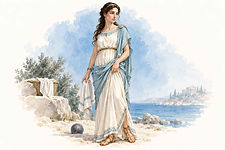
Their children included five sons and one celebrated daughter, Nausicaa. Among the sons Homer names Laodamas, Halius and Clytoneus. Laodamas later becomes the most prominent, leading the Phaeacian games and receiving Odysseus as a guest. Nausicaa is the daughter whose dream from Athena brings her to the river where Odysseus lies hidden. Through his children, Alcinous's household embodies both the future succession of Scheria and the royal family's care for travellers.
His palace at Scheria turns kingship into a visible work of art. The walls are bronze, the doors golden and the doorposts silver. A frieze of blue enamel runs along the walls. Two dogs, one of silver and one of gold, stand at the entrance as immortal guardians made by Hephaestus. Inside, golden youths hold torches through the night. Woven fabrics cover the seats, and the halls open onto gardens where pears, apples, pomegranates, figs, olives and grapes grow in an unbroken succession. Springs water the orchard, the west wind ripens the fruit and the whole estate breathes divine craftsmanship. The palace is not merely a house. It is a vision of perfect order, comfort and abundance.
Alcinous rules with twelve great Phaeacians in counsel. He is first among the kings, but not a solitary tyrant. His people live far from bread-eating mortals, in a land closer to the gods than to the cities of Greece. They value ships, dancing, music and feasting more than war. The king does not lead armies. He leads banquets, games and the council that receives strangers.
His people possess the most extraordinary ships in Greek myth. They have no rudders and no ordinary pilots. They know the thoughts of their passengers, understand every city and land, and can carry a traveller anywhere without danger. Alcinous recalls carrying Rhadamanthys, son of Zeus, to Euboea and returning on the same day. The journey, measured in human terms, would have taken a ship far beyond normal reach. His ships compress distance, making Scheria the bridge between the ends of the world.
Odysseus reaches Scheria after leaving Calypso's island and surviving the storm Poseidon sends against his raft. He crawls beneath an olive thicket and falls asleep. Athena brings Nausicaa to the river, where her cries during a ball game wake the hero. Nausicaa stands before the naked stranger, gives him food, oil and clothing, and sends him towards the palace. Athena, disguised as a young woman, guides Odysseus through the city and tells him to approach Arete. Alcinous has not yet seen the stranger when the encounter begins.
Odysseus enters the hall and clasps Arete's knees. The elder Echeneus urges Alcinous to raise the guest from the ground, because leaving a suppliant kneeling dishonours the house. Alcinous takes Odysseus by the hand, seats him beside Laodamas and orders food and drink. When the stranger says he is only a mortal longing for home, the Phaeacians applaud. Arete later recognises the clothing Odysseus wears and asks how he came by it. Odysseus explains Nausicaa's help, praises her modesty and places the responsibility for his arrival at the palace on his own choice. Alcinous responds by offering the hero a house, wealth and Nausicaa as a bride if he will remain in Scheria. If he insists on returning, the king promises a ship no matter how far away his homeland lies.
The offer is more than generosity. It threatens the entire direction of the Odyssey. Odysseus has rejected immortality with Calypso because he wants Penelope and Ithaca. Now Alcinous offers him youth, beauty, royal marriage, endless abundance and the most advanced ships in the world. The king's hospitality gives Odysseus a genuine alternative to homecoming. The hero refuses. He prays to Zeus to fulfil Alcinous's promise but asks for his own land, wife and house.
The next day Alcinous summons the people to the assembly ground. Twelve great Phaeacians join him. He orders fifty-two servants to prepare a feast and asks the herald Pontonous to mix wine. The crews prepare a ship. The Phaeacians gather, and games begin. Odysseus first sits apart, wrapped in sorrow, watching the races, wrestling, jumping, discus and boxing. Only when Laodamas invites him to compete and Euryalus taunts him does Odysseus rise. He throws the discus farther than any Phaeacian, proving that he comes from a world of hardship and war even if he accepts their feast. Euryalus apologises and gives him a sword.
After the games, Alcinous orders the houses to be prepared for a banquet and commands Demodocus, the blind bard, to sing. The singer performs the tale of Ares and Aphrodite caught in Hephaestus's invisible net, then the capture of Troy through the wooden horse. Odysseus weeps when he hears his own history. Alcinous notices and asks the stranger why his heart groans. He suggests that the guest may be a hero who lost companions at Troy or lost a kinsman. The question opens the way for Odysseus to reveal his name and begin the four-book account of his wanderings.
Alcinous becomes the ideal audience inside the poem. He listens, asks questions and draws the story forward. When Odysseus describes Scylla and Charybdis, the king asks why the hero did not simply row past. When Odysseus reaches Calypso and the loss of his companions, Alcinous understands the grief that has made him hide his name. The palace of Scheria becomes the room in which suffering becomes narrative. Without Alcinous's attentiveness, the Odyssey would never receive the long central account that makes Odysseus more than a name.
When the story ends, Alcinous gives Odysseus gifts: clothing, gold, tripods, cauldrons and treasures that will make him wealthy when he returns to Ithaca. He commands the ship to be made ready and orders the crew to place a rug and linen in the stern so that the hero can sleep. Nausicaa says farewell and asks Odysseus to remember that he owes his life to her. Alcinous's final act as host is to return his guest to the world from which the sea had taken him.
The ship leaves Scheria in the evening. It is so swift that the dark prow rises like a horse and a falcon cannot match its speed. The crew lays the sleeping Odysseus beneath an olive tree on Ithaca and places his treasure beside him. On its return, the ship meets Poseidon. The god has watched Odysseus reach home and asks Zeus for permission to punish the Phaeacians. Zeus grants it. Poseidon strikes the ship with his hand and roots it beneath the harbour as stone.
The Phaeacians had heard an old prophecy. A man had foretold that Poseidon would one day strike one of their returning ships and raise a mountain around their city, cutting them off from the sea. The people now offer sacrifice and pray to Poseidon, but the prophecy remains suspended. The king who ruled the sea through inherited power has brought Poseidon's anger upon his people by using that power against the god's wishes.
In the Argonautic tradition, Alcinous appears again as king of Drepane, a Phaeacian island at the entrance to the Ionian Sea. Jason and Medea reach him while fleeing Colchis with the Golden Fleece, pursued by Colchians demanding Medea's return. Apollonius makes Alcinous a just and cautious judge. He tells Arete privately that if Medea is still a virgin, he will surrender her to the Colchians; if she is married to Jason, she must remain with her husband. Arete reveals the plan to the lovers. Jason and Medea are married in the cave of Macris, with the Golden Fleece spread upon their bridal bed. When the Colchians come the next day, Alcinous declares that he will not separate husband and wife. The fugitives are protected, and the Colchians settle among the Phaeacians rather than return home in failure.
The Drepane episode shows the same Alcinous as the king of Scheria: attentive to law, influenced by Arete and balanced between fairness and political caution. His verdict in the Argonautic story makes him the guardian of marriage, while his reception of Odysseus makes him the guardian of hospitality. Both roles require the same skill. He listens before judging, honours divine law and protects the vulnerable party who reaches his island.
Ancient writers later placed him in real geography. Thucydides records that the people of Corcyra, modern Corfu, claimed descent from the Phaeacians and said that their naval tradition began with Alcinous and his people. The identification linked a powerful historical naval city to the Homeric king. Other traditions connected Alcinous's Drepane with Corcyra, while Strabo and later geographers debated whether Homer's Phaeacia belonged in the known Ionian Sea or in the Atlantic beyond the known world.
Alcinous's name has been interpreted as meaning something like Strong of Mind or Powerful in Understanding. The interpretation suits the portrait Homer gives him. He is not a warrior king like Agamemnon or Achilles. His power lies in counsel, ceremony, judgement, wealth and the ability to receive another person's story. He creates the conditions under which a naked castaway can become again a hero with a name. His strength is the strength of civilised order.
His legacy survives wherever hospitality is treated as a test of character. In the Odyssey, the contrast is sharp. Polyphemus eats his guests. The suitors consume Odysseus's household while pretending to be guests. Calypso keeps Odysseus as her prisoner. Alcinous feeds, bathes, clothes, listens, gives and sends the stranger home. He is the ideal host because he understands that hospitality must restore the guest to himself.
His punishment adds complexity. The same ships that make his kingdom perfect also make it dependent upon divine favour. When Alcinous uses them to oppose Poseidon, the miracle becomes a monument. The self-steering ship is frozen into stone. The king who could send anyone home can no longer send his own people across the sea.
Alcinous therefore stands at the centre of the Odyssey's greatest contrast. He is both the culmination of Phaeacian civilisation and the cause of its punishment. He embodies peace, abundance, storytelling and generosity, yet his final act brings Poseidon's vengeance. The homecoming of Odysseus begins with Alcinous's hospitality and ends with the stone ship in the harbour. The king's gift and his punishment arrive together.
Summary
Alcinous endures as the ideal Homeric king whose palace, ships and hospitality transform Odysseus from a naked castaway into a named hero and send him home to Ithaca. Through his marriage to Arete, his reception of Nausicaa's stranger, the games and songs of Scheria, his attentive listening to the wanderings and his role as judge of Jason and Medea, he embodies civilised judgement at the edge of the world. Poseidon's petrification of his returning ship shows that the same power can bring both blessing and ruin. Alcinous remains the king whose house turns suffering into story.
Now enter the Mythopouch World!
You’ve discovered:
Alcinous
From Myth to Game
Join to access FREE real-world mythology "Learn Quests" and "Courses". Sign up to the newsletter for new releases, game updates, insider news, and more as Mythopouch brings real mythology to life. EARN the right to purchase an offline board game by completing FREE modules.


It's FREE to join as a MEMBER!
Not ready to join? Get the newsletter instead below



Looking for others?
Click into the field below to search, or click the icon to go to full page search function!

Looking for Mythology Insights?


Click below to view our mythology blog article insights, where we delve into the current Mythopouch Tier regions, and what we think you should know!
Sources & Retellings
Explore the original mythological Source texts (most from over 75 years ago, some as translated, possibly with mature content) and Mythopouch's source Retellings (a modern retelling also suitable for 15+) connected to this mythological entity. We are growing this resource and will link these in the future; for now, check the References below, then find the Sources or Retellings on those pages!


References
Validation References:
- Homer, Odyssey 6.2-13 and 6.54-65 (c. 750 BCE) - Nausithous as founder and Alcinous as the wise king of the Phaeacians
- Homer, Odyssey 7.54-91, 7.179-193 and 7.320-347 (c. 750 BCE) - Alcinous' genealogy, marriage to Arete, palace, gardens, offer of Nausicaa and promise of a ship
- Homer, Odyssey 8.1-586 (c. 750 BCE) - Alcinous' assembly, games, feast, commands to Demodocus and questions that draw out Odysseus' identity
- Homer, Odyssey 9.1-12.453 (c. 750 BCE) - Odysseus' wanderings narrated as the story of Alcinous's court
- Homer, Odyssey 13.1-187 (c. 750 BCE) - the Phaeacian gifts, the magical voyage, Odysseus' return and Poseidon's punishment of the ship
- Apollonius of Rhodes, Argonautica 4.982-1236 (c. 270-245 BCE) - Alcinous at Drepane, the Colchian demand, Arete's intervention and the marriage of Jason and Medea
- Thucydides, History of the Peloponnesian War 1.25.4 (c. 430 BCE) - the Corcyraean claim to Phaeacian ancestry and naval tradition
- Apollodorus, Bibliotheca, Epitome 7.25-36 (1st or 2nd century CE) - the Phaeacian return of Odysseus and the punishment of their ship
- Heubeck, Alfred, Stephanie West and J. Bryan Hainsworth, A Commentary on Homer's Odyssey, Volume 1 (Oxford University Press, 1988), Books 7-8 - commentary on the palace, hospitality, games and court of Alcinous
- Cook, Erwin F., The Odyssey in Athens: Myths of Cultural Origins (Cornell University Press, 1995), Chapter 3 - the Phaeacian king as audience and model of civilised order
- Segal, Charles, Singers, Heroes, and Gods in the Odyssey (Cornell University Press, 1994), Chapter 5 - Demodocus, song and the narrative setting of Alcinous's court
- Dougherty, Carol, The Raft of Odysseus: The Ethnographic Imagination of Homer's Odyssey (Oxford University Press, 2001), Chapter 4 - the Phaeacian reception and the transformation of the wanderer into a storyteller
- Hunter, Richard, The Argonautica of Apollonius: Literary Studies (Cambridge University Press, 1993), Chapter 4 - Alcinous, Arete and the Homeric model of the Argonautic court
- Frame, Douglas, "New Light on the Homeric Question: The Phaeacians Unmasked", Harvard Center for Hellenic Studies (2023) - the genealogy and kingship of Alcinous within the Phaeacian tradition
Cultural Context Notice
Mythology developed across different cultures, periods and traditions, and there is rarely one universally accepted version of a story. Mythopouch approaches these traditions with respect while remaining faithful to the complexity of the surviving material. Retellings and educational content may interpret or adapt historical sources, but are not presented as definitive accounts of any culture, religion or belief system.