
Details
Region
Greek
Regional Information Additional (if applicable)

Phaeacian / Homeric / Argonautic
Category
Group
Historicity (actuality or factual truth of persons, events, and claims)
Legendary
Gender
Both
Time Period
Heroic Age; introduced as a people in the Odyssey, composed in the 8th or 7th century BCE, and retained in the later Argonautic tradition
Symbol
Ship & Large Sail
Tags
greek, phaeacians, phaeacia, scheria, odysseus, alcinous, arete, nausicaa, self-steering-ships
Introduction - Overview
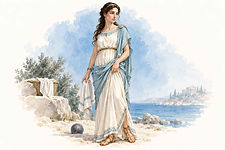
The Phaeacians are the extraordinary seafaring people of Scheria whose hospitality and magical ships carry Odysseus home from the edge of the world. They are the descendants of Poseidon, shaped from their origin by the sea god's protection and destined to receive his punishment when they defy his hatred of Odysseus. They are the people who once lived beside the brutal Cyclopes before Nausithous led them to a safer island far from ordinary mortals. They are the community ruled by King Alcinous and Queen Arete, where twelve kings share counsel, women spin royal purple and a stranger may win safety by clasping the queen's knees. They are the inventors of vessels that need no pilots, rudders or sails, because the ships themselves understand their passengers' thoughts and know every land and city. They are the dancers, athletes, singers and feasters who prefer pleasure, craftsmanship and song to war. They are the listeners who hear Odysseus tell the Cyclops, Circe, the Sirens, the Underworld and Calypso. They are the people punished for helping him, when Poseidon turns their returning ship to stone at the harbour mouth. And they are the model of the mythic utopia, a society close to the gods where abundance, beauty, hospitality and technology remove the normal hardships of human life.
Gallery
Main Article - Who or What was...
Phaeacians
The Phaeacians began in hardship. They once dwelt in spacious Hypereia, a land within reach of the Cyclopes, those one-eyed giants who live without laws, assemblies, agriculture or civic order. The Cyclopes were stronger than the Phaeacians and plundered them continually. Nausithous, the divine-minded founder of the people, ended the oppression by leading them away. He carried them across the sea to Scheria, walled the city, built houses and temples, apportioned the fields and established a settled way of life. His people would remain the furthermost of mortals, separated from other human communities but joined to the gods through Poseidon, father of Nausithous.
That origin defines them. The Cyclopes represent nature without culture: caves instead of cities, violence instead of law, raw abundance without craft. The Phaeacians represent culture perfected. They have walls, harbours, market places, assembly, courts, weaving, feasting, games, music and sea-going skill. They escaped barbarism and built the opposite of it. Their distance from ordinary mortals does not make them wild. It makes them civilised to a degree beyond other peoples.
Their royal house descended from Poseidon through Nausithous. Nausithous married Periboea and fathered Alcinous and Rhexenor. Rhexenor was killed by Apollo while still a bridegroom, leaving a daughter, Arete. Alcinous married his brother's daughter, joining the two lines of the family. Their children included five sons and the famous daughter Nausicaa. Homer gives their household a harmony rare in Greek myth. Arete has the power of judgement within the city, and Alcinous honours her as no other husband honours his wife. Strangers who win her favour can expect passage, gifts and protection.
The Phaeacians were not ruled by a single unchecked monarch. Alcinous was first among the kings, and twelve great men shared in the government of the community. Their society was aristocratic, wealthy and orderly. The people themselves lived apart from the bread-eating mortals of the ordinary world, separated by sea and custom. They had little contact with other peoples, yet their ships could travel anywhere. Scheria was an island of seclusion powered by the knowledge of the entire world.
Their women appear in the Odyssey as active agents of civilisation. Nausicaa drives the household laundry to the river, confronts Odysseus and saves him without waiting for male permission. Arete receives suppliants, questions Odysseus and judges his request. Fifty maids grind grain, spin and weave in the palace. Women carry water, prepare baths, serve food and manage the household spaces through which Odysseus passes. The Phaeacian ideal of order depends upon female labour, judgement and courage as much as upon kings and sailors.
Their greatest marvel was the ship. Alcinous describes vessels that have no pilots and no rudders. The ships understand the thoughts of their passengers, know every city and country in the world and can traverse mist, darkness and storm without danger. They are faster than a falcon and steadier than thought. Poseidon gave the Phaeacians this power because they were near to the gods and belonged to his lineage. Their ships join divine gift to human craft: they are technology imagined at the point where mechanism becomes miracle.
Alcinous recalls that the Phaeacians once carried Rhadamanthys, son of Zeus, to Euboea and returned on the same day. The claim places them within the geography of the blessed, since Rhadamanthys belonged to the heroic world beyond ordinary time. When the Phaeacians later carry Odysseus home, the journey takes one night. Odysseus sleeps while the ship runs, and wakes beneath an olive tree on Ithaca with his treasure arranged around him. The people who live at the furthermost edge of the world possess the power to cross that edge at will.
Their reception of Odysseus is the fullest portrait of Greek hospitality in the epic. After Poseidon destroys the hero's raft, Athena brings him to the river where Nausicaa and her maids are washing clothes. The girls flee when the naked stranger appears, but Nausicaa stands firm, reminds them that strangers and beggars come from Zeus, and gives Odysseus food, oil and clothing. She sends him to Arete. Athena hides him in mist and guides him to the palace. Odysseus passes the golden and silver dogs made by Hephaestus, ignores the king's first approach and clasps Arete's knees. The Phaeacians listen, question, feed, wash, clothe, entertain and finally send him home.
Their courtly life revolves around pleasure, performance and reciprocity. Alcinous provides a bath and a feast. Demodocus, the blind bard, sings the quarrel of Odysseus and Achilles, the adultery of Ares and Aphrodite and the fall of Troy. The Phaeacians dance in a circle, their feet moving so lightly that the earth seems to beat time beneath them. They hold games and challenge Odysseus to prove himself. Their society is not militaristic. Alcinous says that the Phaeacians care nothing for archery, wrestling or running, except as festive sport. Their excellence lies in ships, dancing, music and the pleasures of civilisation.
The palace materialises that ideal. Bronze walls rise around it, silver doorposts support golden lintels and the radiance resembles sun or moon. Hephaestus made two immortal dogs, one gold and one silver, to guard the entrance. Golden youths hold lighted torches within. The household contains weaving women, polished tables, abundant food and drink. Outside, the gardens bear pears, apples, pomegranates, figs, grapes and olives without interruption. One crop ripens as another is planted. Springs water the garden, and the west wind blows gently to keep every fruit sweet. The Phaeacians possess the classical image of effortless abundance.
Their arts are not separate from their social order. Dancing follows song, song follows feast and games follow storytelling. When Demodocus sings, the Phaeacian audience becomes the model for every later audience of epic. Odysseus weeps at the tale of Troy, and Alcinous notices the stranger's tears. The king asks who he is, and Odysseus answers with the name and story that occupy the central books of the Odyssey. The Phaeacians are not merely helpers. They are the listeners who make the hero's suffering into narrative.
In Apollonius of Rhodes, the people appear in the Argonautic tradition at Drepane, their kingdom in the Ceraunian Sea. Jason and Medea arrive after taking the Golden Fleece, pursued by the Colchians. Alcinous must decide whether to surrender Medea to her father Aeetes' envoys. His law says that a woman already married belongs to her husband, but Arete acts first. She secretly arranges for Jason and Medea to be wed on the island, so that Alcinous cannot return the bride. The Phaeacians therefore become the witnesses and protectors of one of myth's most consequential marriages.
This Argonautic role links them to another age of heroic travel. They receive the Argo, protect fugitives, mediate between rival powers and provide a safe harbour before the Argonauts continue westward. Their function in both the Odyssey and the Argonautica is the same: they stand at the boundary between danger and homecoming, between the unknown sea and the familiar shore. Any hero who reaches them may receive the final passage.
Their punishment comes because they use that power against Poseidon. Odysseus has blinded Polyphemus, Poseidon's son, and the sea god has sworn to make his return bitter. When the Phaeacians carry Odysseus home in defiance of that anger, Poseidon asks Zeus for leave to punish them. Zeus grants it. As the returning ship approaches Scheria, Poseidon strikes it with his hand and roots it in the harbour as stone.
The people remember an older prophecy. A Phaeacian once heard that Poseidon would one day strike one of their ships on its return and raise a mountain around their city, shutting them off from the sea. Homer ends the episode with sacrifices and prayers, leaving unresolved whether the mountain prophecy will be fulfilled. The punishment matters because the Phaeacians knew the risk and helped Odysseus anyway. Their ships were their gift; using that gift for hospitality brings the gift to an end.
Ancient geography tried to give the Phaeacians a homeland. Thucydides says the people of Corcyra, modern Corfu, boasted that their island had once been inhabited by the Phaeacians and that its naval tradition descended from them. The identification gave Corcyra prestige and created a local tradition in which the rock Pontikonisi, Mouse Island, was the petrified ship. Other geographers, following Polybius' criticism of Homer's geography or Strabo's own arguments, placed Phaeacia in the Atlantic beyond the known world. The Homeric description resists both solutions. It is near enough to Ithaca for a one-night voyage, yet far enough to remain the furthermost of peoples.
The name Phaeacian itself remains uncertain. It has been connected with phaios, grey, dark or dusky, but no ancient explanation has survived with certainty. Their names often relate to ships and the sea: Nausithous, Nausicaa, Laodamas, Clytoneus and others. Poseidon appears in their ancestry, and the ocean dominates their identity. Whether their name meant the grey ones, the sea people or something older, their character is unmistakable.
In modern interpretation, the Phaeacians stand beside Plato's Atlantis and the Isles of the Blessed. They descend from Poseidon, inhabit a remote land of abundance, master the sea and possess wealth beyond ordinary cities. Like Atlantis, their perfection carries the seed of catastrophe. Their ships fail; Poseidon punishes them; their separation from humankind ends. Unlike Atlantis, they are not destroyed by their own imperial pride. They are punished for generosity.
They have also become the earliest literary model of the utopia. Every imagined society that removes hunger, labour, violence and travel hardship owes something to Scheria. Every science-fiction culture whose technology erases distance, whose citizens live in abundance and whose visitors receive perfect hospitality inherits the Phaeacian pattern. Their thought-steering ships anticipate modern dreams of intelligent transport. Their gardens anticipate controlled abundance. Their court anticipates the ideal audience.
Yet the Phaeacians are not flawless. They can be arrogant, as Euryalus shows when he mocks Odysseus during the games. Alcinous delays the stranger's return and offers Nausicaa in marriage, threatening the homecoming for which the entire epic has struggled. Their isolation produces a society that is beautiful but vulnerable to divine punishment. Their abundance depends upon gifts they cannot defend once Poseidon withdraws his favour. The utopia is real, but it is temporary.
Their final image is the petrified ship. The vessel that crossed the sea in a night becomes stone at the harbour mouth. The miracle freezes into a monument. The people who carried wanderers home can no longer carry anyone. Their punishment preserves their greatest gift in its most useless form.
The Phaeacians endure because they unite every form of Greek excellence that does not depend on war. They sail, dance, sing, weave, judge, feast, receive strangers, love their families and honour the gods. They are close enough to mortals to live and die, yet close enough to the gods to possess ships that think. They make Odysseus's wanderings possible to tell, carry him home and receive the consequences. The furthermost people become the centre of the Odyssey's meaning: civilisation is valuable because it answers suffering with shelter.
Summary
The Phaeacians endure as the mythic people of Scheria whose divine ancestry, magical ships, gardens, music and hospitality create Greek literature's first great portrait of utopia. From their flight from the Cyclopes to Alcinous and Arete's court, their rescue of Odysseus, their role in Jason and Medea's escape and Poseidon's petrification of their ship, they combine abundance with vulnerability. Ancient Corcyra claimed them as ancestors and later traditions moved their island to the Atlantic. The Phaeacians remain the people who turn the sea into a road and the wanderer's last hope into a voyage home.
Now enter the Mythopouch World!
You’ve discovered:
Phaeacians
From Myth to Game
Join to access FREE real-world mythology "Learn Quests" and "Courses". Sign up to the newsletter for new releases, game updates, insider news, and more as Mythopouch brings real mythology to life. EARN the right to purchase an offline board game by completing FREE modules.


It's FREE to join as a MEMBER!
Not ready to join? Get the newsletter instead below



Looking for others?
Click into the field below to search, or click the icon to go to full page search function!

Looking for Mythology Insights?


Click below to view our mythology blog article insights, where we delve into the current Mythopouch Tier regions, and what we think you should know!
Sources & Retellings
Explore the original mythological Source texts (most from over 75 years ago, some as translated, possibly with mature content) and Mythopouch's source Retellings (a modern retelling also suitable for 15+) connected to this mythological entity. We are growing this resource and will link these in the future; for now, check the References below, then find the Sources or Retellings on those pages!


References
Validation References:
- Homer, Odyssey 6.1-331 (c. 750 BCE) - the Phaeacians' migration from Hypereia, Nausicaa's dream and the rescue of Odysseus
- Homer, Odyssey 7.1-347 (c. 750 BCE) - the palace, gardens, social order, Arete's authority and Alcinous' description of the ships
- Homer, Odyssey 8.1-586 (c. 750 BCE) - the games, songs of Demodocus, Phaeacian dance and Odysseus' revelation of identity
- Homer, Odyssey 13.1-187 (c. 750 BCE) - the overnight voyage to Ithaca and Poseidon's transformation of the returning ship
- Apollonius of Rhodes, Argonautica 4.982-1236 (c. 270-245 BCE) - Drepane, Alcinous, Arete, the Colchians and the marriage of Jason and Medea
- Thucydides, History of the Peloponnesian War 1.25.4 (c. 430 BCE) - the Corcyraean claim to Phaeacian ancestry and naval tradition
- Strabo, Geography 1.1.7 and 1.2.37 (early 1st century CE) - ancient debate about the geography of Scheria and the Atlantic interpretation
- Apollodorus, Bibliotheca, Epitome 7.25-36 (1st or 2nd century CE) - the Phaeacians in the Odyssey's return narrative
- Fraser, A.D., "Scheria and the Phaeacians", Transactions of the American Philological Association 60 (1929), pp. 155-178 - classic study of the people, their island and ancient geographical identifications
- Heubeck, Alfred, Stephanie West and J. Bryan Hainsworth, A Commentary on Homer's Odyssey, Volume 1 (Oxford University Press, 1988), Books 6-8 - commentary on the Phaeacian society, palace, ships and hospitality
- Cook, Erwin F., The Odyssey in Athens: Myths of Cultural Origins (Cornell University Press, 1995), Chapter 3 - the Phaeacian court as audience and model of epic performance
- Segal, Charles, Singers, Heroes, and Gods in the Odyssey (Cornell University Press, 1994), Chapter 5 - Demodocus, song and the social world of Scheria
- Dougherty, Carol, The Raft of Odysseus: The Ethnographic Imagination of Homer's Odyssey (Oxford University Press, 2001), Chapter 4 - travel, cultural encounter and the Phaeacian reception
- Frame, Douglas, "New Light on the Homeric Question: The Phaeacians Unmasked", Harvard Center for Hellenic Studies (2023) - the Phaeacians, their genealogy and their place in the epic tradition
- de Brasi, Diego, "The Shape of Early Greek Utopia", Classical Quarterly 71 (2021) - Scheria, the Phaeacians and the ancient utopian imagination
Cultural Context Notice
Mythology developed across different cultures, periods and traditions, and there is rarely one universally accepted version of a story. Mythopouch approaches these traditions with respect while remaining faithful to the complexity of the surviving material. Retellings and educational content may interpret or adapt historical sources, but are not presented as definitive accounts of any culture, religion or belief system.