Greek Mythology List


Welcome to the Mythopouch list of Greek mythology entries! We also delve into the ancient history of Greece and the surrounding areas. From heroes to goddesses, places, monsters, artifacts, weapons, creatures and more - which will only grow over time. Mythopouch provides real-world information extracted from the original source material such as that from: Homer, Hesiod, Apollodorus, Ovid, Pausanias, Pindar, Aeschylus, Sophocles, Euripides, Hyginus, Diodorus Siculus and Apollonius of Rhodes. Words and stories carry powerful messages that were passed down from one generation to the next, many of which are still very applicable to modern times. Our unique imagery is meant to capture the imagination and ignite the magic mythology spark within us all. Our "token mark" coin symbol that is assigned to each record is a visual representation of the entity, for use in Mythopouch learning modules and games.
Learn - Earn - Play
Greek Entity Quick Index
Our current list of ancient Greek mythology and ancient history entities are here - which are growing day by day!
Search by using the:
-
"Search Mythology Records" function to browse all mythology records and blog pages;
-
Browse the visual cards with overviews by clicking "Go to Visual A-Z";
-
Or just browse and click the A-Z entries below....
See more list entries
Read Ancient Greek Insights
Click below to view our ancient Greek mythology blog article insights, where we delve into the current Mythopouch Tier regions and what we think you should know!


Greek Entity Card Index
See more card entries

Amalthea
Amalthea is the she-goat who nursed the infant Zeus in a dark cave on the island of Crete while the fate of the cosmos hung upon her udder. She is the foster-mother of the king of the gods, the animal whose milk sustained the child who would one day overthrow his father Cronus and establish the reign of the Olympians. She is the source of the cornucopia, the horn of plenty, for when one of her horns broke off - whether by the infant's rough play or by catching on a tree - Zeus transformed it into a vessel that would supply whatever food or drink its bearer desired. She is the creature whose hide became the aegis, the storm-shield of Zeus that would later pass to his daughter Athena, a goatskin that struck terror into the hearts of men and gods alike. And she is the star that still shines in the northern sky, placed among the constellations as Capra, the goat on the arm of Auriga the Charioteer, her two kids beside her, an immortal reward for the humble animal who saved a god.
Amphion
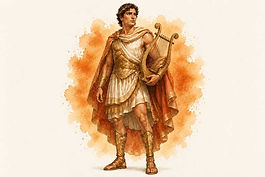
Amphion is the king of Thebes who built the walls of his city with the music of his lyre, charming the stones into place while his twin brother Zethus wrestled them into position by strength. He is the son of Zeus, the king of the gods who ruled from Olympus, and Antiope, the princess of Thebes who was seduced by the god in the disguise of a satyr. He is the musician whose art was so powerful that the very rocks obeyed his song, and whose city became one of the greatest in Greece because of his gift. He is the husband of Niobe, the daughter of Tantalus, the king who was condemned to eternal hunger in Tartarus, the deepest pit of the Underworld, and the father of the fourteen Niobids whose slaughter by Apollo and Artemis destroyed his house. He is the king who threw himself upon his sword or was struck by a thunderbolt when he saw his children dead, a man who built a city with music and lost it to grief. And he is the founder whose walls stood for centuries, the proof that art could accomplish what force alone could not. Every wall built by song, every city founded on harmony, and every father who dies of a broken heart carries his shadow.

Amphitrite
Amphitrite is the queen of the sea, the eldest of the fifty Nereids, the sea nymphs who danced on the waves and guided sailors through storms, and the wife of Poseidon, the god of earthquakes and the ocean. She is the goddess who fled from her suitor to the farthest reaches of the world and was brought back by a dolphin who talked her into marriage. She is the mother of Triton, the fish-tailed herald who blew his conch shell to raise or calm the waves, and of Rhode, the goddess who gave her name to the island of Rhodes. She is the sea-goddess who welcomed the hero Theseus into her husband's underwater palace and gave him a purple cloak and a crown of gems to prove his divine parentage. And she is the personification of the Mediterranean itself, the "loud-moaning" mother of seals, dolphins, and fish, whose name Homer used as a synonym for the sea and whose presence at the birth of Apollo on Delos marked her as one of the great goddesses of Olympus.

Amphitryon
Amphitryon is the prince of Tiryns whose accidental killing of Electryon drove him into exile and bound his marriage to a campaign of vengeance. He is the son of Alcaeus and a member of the family descended from Perseus, linked to Alcmene through a closely interwoven royal genealogy. He is the man purified by Creon at Thebes, then required to confront an uncatchable fox before he could obtain help against the island enemies who had killed Alcmene's brothers. He is the commander whose victory depended on Comaetho removing the golden hair that protected her father Pterelaus. He is the husband who returned from war to discover that Zeus had already visited Alcmene in his own shape. And he is the father of Iphicles and foster father of Heracles, raising two boys whose different fathers gave them different places in heroic tradition. His story moves between accident and responsibility, divine deception and human duty, ending either in battle or in the troubled old age imagined by Greek tragedy.

Amyclae
Amyclae is the ancient Laconian settlement south of Sparta where the worship of Apollo and the memory of Hyacinthus met in one remarkable sanctuary. It is a real place known through archaeology and ancient descriptions, but its foundation by King Amyclas belongs to Greek legend. It is the home associated with his son Hyacinthus, the beloved youth whose death by a discus became a story of grief, flowers and divine remembrance. It is the city incorporated into the Spartan state, and the centre of the Hyacinthia, a festival which brought mourning, music, processions and communal celebration together. It is the sanctuary where a colossal, pillar-like image of Apollo stood above what worshippers regarded as Hyacinthus's tomb, surrounded by the elaborate structure called the Throne of Apollo. And it is a place where surviving stone fragments and ancient narratives must be read alongside one another, without mistaking a legendary founder for an archaeological fact or a modern reconstruction for a fully preserved monument.

Anchises
Anchises is the Trojan prince who became the father of Aeneas through a night with the goddess Aphrodite, and who was carried from the burning ruins of Troy on his son's shoulders, the sacred images of the household gods pressed to his chest. He is the handsome herdsman of Mount Ida whom Zeus, the king of the gods, chose as the instrument of Aphrodite's humiliation, filling her heart with desire for a mortal man so that she might know the shame she had inflicted on others. He is the boastful lover who could not keep the secret of his divine bedfellow and was struck by Zeus's thunderbolt, crippled for life but spared from death. He is the aged patriarch who refused to leave Troy until the gods themselves sent a sign, and who then became the living bridge between the fallen city and the future empire of Rome. And he is the ghost who met his son in the underworld near Cumae and showed him the long parade of Roman heroes yet to be born, from Romulus to Augustus Caesar, a vision that made the cost of exile bearable.

Androgeus
Androgeus is the prince of Crete whose death in Athens set in motion the most terrible tribute in Greek myth, the sacrifice of fourteen young people to the Minotaur every nine years. He is the son of King Minos, the lawgiver whose judgements were so just that he became a judge of the dead, and Pasiphae, the sorceress queen cursed by Poseidon, the god of the sea and earthquakes, to bear the Minotaur. He is the athlete who travelled to Athens and won every contest at the Panathenaic games, the festival held in honour of Athena, the goddess of wisdom and craft who was patron of the city, only to be killed by jealousy or by a monster sent by a fearful king. He is the brother of Ariadne, the princess who gave Theseus the thread that led him through the Labyrinth, and Phaedra, who would later marry the same hero and die by her own hand. His death made him the catalyst for the entire Minotaur saga, the single life whose loss condemned a generation of Athenian youths to the jaws of a beast. And he is the prince whose murder turned a kingdom's pride into a kingdom's curse, a story that begins with victory and ends with vengeance.

Andromache
Andromache is the princess of Cilician Thebe who lost her father, her seven brothers, and her mother to Achilles before she ever set foot in Troy, and who would go on to lose her husband and her son to the same war. She is the wife of Hector, the greatest warrior the Trojans ever fielded, the man who was father, mother, brother, and husband to her all in one. She is the woman who begged Hector not to return to battle, who pointed to the wild fig tree where the wall was weakest and the Greeks pressed hardest, and who watched him walk away knowing she would never see him again. She is the mother of Astyanax, the little boy whom the Trojans called "lord of the city" because his father was its only defence, and whom the Greeks threw from the walls of Troy after the city fell. She is the slave who became a queen twice over, first as the concubine of Neoptolemus, the son of Achilles, and then as the wife of Helenus, Hector's own brother, in a "little Troy" built on the shores of Epirus. And she is the survivor whose descendants ruled Molossia for generations, a Trojan princess whose bloodline outlasted the empire that destroyed her city.

Andromeda
Andromeda is the Ethiopian princess chained naked to a rock by the sea and left as a sacrifice to a monster, the most famous damsel in distress in all of Greek mythology and the ancestor from whom every Persian king claimed descent. She is the daughter of King Cepheus and Queen Cassiopeia of Aethiopia, a kingdom the Greeks placed at the edge of the known world, and the victim of her mother's fatal boast that she was more beautiful than the Nereids, the fifty sea-nymph daughters of the old sea god Nereus. She is the maiden who waited in chains while the sea monster Cetus rose from the deep, its jaws wide enough to swallow a ship, and who was saved at the last moment by Perseus, the hero who had just slain the Gorgon Medusa, a creature so terrible that one look at her face turned living things to stone. She is the bride whose wedding was interrupted by her uncle Phineus, who claimed she had been promised to him first, and who watched Perseus turn her would-be groom and his men to stone with the same severed head that had killed the monster. And she is the queen of Mycenae, the mother of nine children including Perses, the legendary founder of Persia, and the constellation that still bears her name in the northern sky, placed there by Athena, the goddess of wisdom and war, as an eternal monument to the heroism of the man who saved her.

Anticlea
Anticlea is the queen of Ithaca whose longing for her son killed her, the mother who was still alive when Odysseus left for Troy and who met him again only as a shade in the house of Hades. She is the daughter of Autolycus, the notorious thief whose family was linked with Hermes, the messenger god and divine trickster. She is the wife of Laertes, the king who withdrew into rural hardship while waiting for his son's return, and the mother of Odysseus and his sister Ctimene. She is the woman whose son's parentage became disputed in later traditions, some of which made Sisyphus rather than Laertes his father. And she is the ghost who stood before her living son, told him that Penelope still waited and that his father still grieved, and slipped beyond his reach when he tried to hold her. Their reunion gives the Odyssey one of its most painful images: a son who has crossed the sea to question the dead but cannot embrace his own mother.

Antilochus
Antilochus is a young Greek hero at Troy whose story joins the skill of a charioteer with the loyalty of a son and friend. He is the prince of Pylos, son of Nestor, the aged king whose counsel guides the Greek commanders. He is the messenger who brings Achilles the news that Patroclus has died, and the companion whom the Odyssey says Achilles honoured above the others after Patroclus. He is the driver who takes second place at the funeral games by forcing Menelaus to check his horses on a narrow track, then repairs the quarrel by yielding rather than swearing a false oath. He is the warrior who, in Pindar's account, stands against Memnon to save his endangered father and dies in his place. And he is the hero remembered beside Achilles and Patroclus after death, though his remains are not mingled with theirs. His story moves from the competitive urgency of youth to a final act of loyalty on the Trojan plain.

Antinoopolis
Antinoopolis is the city that imperial remembrance built beside the Nile, a Greek civic foundation in Roman Egypt named for a young man whose death became the centre of a new cult. Hadrian founded it on 30 October 130 CE after Antinous of Bithynia, his companion, drowned during the imperial journey through Egypt. The city stood on the east bank of the river near Hermopolis, where an older Egyptian temple of Ramesses II already marked the landscape. Its streets, colonnades and public buildings gave Greek urban institutions a new home in the Nile valley, while the worship of Antinous linked the dead youth with Osiris and with other divine figures across the empire. Antinoopolis was more than a memorial: it became a community of settlers, festivals, commerce and administration, followed by Christian religious life. Its later ruins suffered extensive dismantling, but the site did not vanish. Archaeology continues to recover the overlapping Egyptian, Greek, Roman and Christian histories behind a city remembered for love and loss.