
Details
Region
Greek
Regional Information Additional (if applicable)

Phoenician / Punic / Roman
Category
Location
Historicity (actuality or factual truth of persons, events, and claims)
Historical
Gender
N/A
Time Period
Carthage founded in the ninth century BCE; traditional foundation date c. 814-813 BCE; Punic and Roman phases
Symbol
Oxhide strip
Tags
greek, byrsa, carthage, dido, oxhide, phoenician, elissa, iarbas, citadel
Introduction - Overview
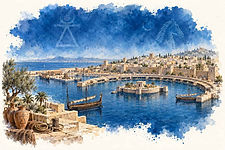
Byrsa is the historical citadel hill of Carthage, overlooking the Gulf of Tunis and closely associated with the foundation legend of Dido, also called Elissa. It is the place whose Greek name became linked with an oxhide bargain: the refugee queen is said to have cut a hide into thin strips so that a seemingly small grant of land could enclose the beginning of a settlement. It is part of the landscape in which a Phoenician foundation developed into Punic Carthage and was later transformed under Roman rule. The story of the bargain explains the place through ingenuity, negotiation and the precarious position of newcomers, but it does not prove that the settlement was established exactly as the legend describes. Ancient writers also differ over Dido's husband, her journey and the circumstances of her death. Byrsa therefore joins two kinds of memory. Its archaeology belongs to the history of an actual city, while the queen and the oxhide belong to the Greek and Roman literary traditions through which that city's beginnings were retold.
Gallery
Main Article - Who or What was...
Byrsa
Byrsa stands within the ancient site of Carthage, near Tunis on the North African coast. The historical city originated as a Phoenician foundation in the ninth century BCE, while literary chronologies commonly placed its beginnings around 814 or 813 BCE. The hill became its citadel and later formed part of the monumental centre of Roman Carthage. Those broad phases are supported by historical and archaeological evidence. The detailed account of a refugee queen securing the hill with an oxhide belongs to a different category: a foundation legend preserved in ancient literature. Its importance does not depend on assuming that every exchange and gesture can be reconstructed as an actual event.
Dido's flight begins at Tyre, but the surviving accounts should not be combined without identifying their differences. In Virgil's Aeneid, her husband is Sychaeus, murdered by her brother Pygmalion for his wealth. The dead husband appears in a dream, reveals the crime and directs her towards hidden treasure that will enable her escape. In Justin's epitome of Pompeius Trogus, the murdered husband is called Acerbas, and the account gives the journey a different set of details. The king is Pygmalion of Tyre, not the Cypriot sculptor of another famous myth. Dido gathers companions and resources and leaves a household in which royal kinship has become a source of danger.
Justin describes a stop in Cyprus before the fugitives reach Africa. His account includes a priest and his family joining the expedition, as well as young women taken aboard by Dido's followers. These details belong to Justin's account of the voyage, while Virgil places more emphasis on the revelation of the murder and the treasure that enables escape. In both broad traditions, however, Dido reaches a foreign shore with a following that needs land and protection. The beginning of the city is presented as a problem of obtaining a foothold rather than arriving with an already established kingdom.
The oxhide bargain provides the memorable solution. In Justin, Dido obtains permission to occupy as much ground as an oxhide can encompass. She has the hide cut into extremely narrow strips, creating a long boundary from an object that first appears to offer very little space. The resulting enclosure secures room for the newcomers. The account does not identify Iarbas as the individual who personally makes this bargain, and it need not be embellished with an invented speech or a claim that the offer was deliberately insulting. Justin later describes tribute owed to the local population. The tradition concerns a negotiated settlement, not an uncomplicated grant of permanent independence.
The name Byrsa was explained through the Greek word for a hide, linking the hill with Dido's ingenuity. That explanation should be presented as the literary connection preserved in the story, not as a securely demonstrated account of the place-name's earliest origin. Justin also describes foundation omens: an ox's head suggests wealth accompanied by subjection, while a horse's head points towards a more powerful future. These discoveries are interpreted within the narrative as signs about the city to come. They are not reports of modern archaeological finds proving that Dido chose the hill through such omens.
The growing settlement eventually faces another demand. In Justin, Iarbas seeks Dido's hand in marriage and threatens war if his request is refused. The conflict places the city's security against her commitment to her dead husband. She asks for time and prepares a pyre under the appearance of a ritual, then takes her own life. The story presents a tragic refusal under coercion, not an event that can be treated as an established historical biography. It also differs from the account most familiar through Roman epic. Its central pressure is the demanded marriage to Iarbas, not abandonment by a Trojan lover.
Virgil's Aeneid reshapes Dido's fate around Aeneas, who comes to Carthage after the fall of Troy. Their relationship ends when he leaves to pursue his destined settlement in Italy. Dido's death and curse then create a literary connection between the Trojan ancestors of Rome and the future hostility of Rome and Carthage. The poem was written in the first century BCE; it is not simply an account composed a thousand years after an earlier written biography of Dido. Its chronology, divine interventions and foreshadowing belong to epic. The curse anticipates the Punic Wars within the poem, but is not a historical explanation of why those wars occurred.
Byrsa's later history is part of the actual transformation of Carthage. The Punic city expanded into a major Mediterranean centre before its destruction by Rome in 146 BCE. Roman refoundation brought a different arrangement of public space, and the area of the hill became associated with monumental civic and religious buildings. Later occupation, construction and excavation changed what could be seen of earlier phases. The layers of the site therefore record rebuilding as well as loss. Its classification as Historical applies to Byrsa as a real place, not to every action attributed to its legendary founder. The oxhide remains a way of remembering the beginning, while archaeology investigates the settlement through surviving material evidence.
Summary
Byrsa is the real citadel hill of Carthage whose foundation legend turns a single oxhide into the boundary of a new settlement. Dido's flight from Tyre, the bargain and the later demand of Iarbas survive in literary accounts that differ from Virgil's story of her relationship with Aeneas. The hill's Punic and Roman remains provide another form of evidence: the history of a place repeatedly built upon and transformed. Byrsa's significance lies in holding those strands together without confusing them, preserving both the city's material past and the enduring story of its resourceful founder.
Now enter the Mythopouch World!
You’ve discovered:
Byrsa
From Myth to Game
Join to access FREE real-world mythology "Learn Quests" and "Courses". Sign up to the newsletter for new releases, game updates, insider news, and more as Mythopouch brings real mythology to life. EARN the right to purchase an offline board game by completing FREE modules.


It's FREE to join as a MEMBER!
Not ready to join? Get the newsletter instead below



Looking for others?
Click into the field below to search, or click the icon to go to full page search function!

Looking for Mythology Insights?


Click below to view our mythology blog article insights, where we delve into the current Mythopouch Tier regions, and what we think you should know!
Sources & Retellings
Explore the original mythological Source texts (most from over 75 years ago, some as translated, possibly with mature content) and Mythopouch's source Retellings (a modern retelling also suitable for 15+) connected to this mythological entity. We are growing this resource and will link these in the future; for now, check the References below, then find the Sources or Retellings on those pages!


References
Validation References:
- Justin, Epitome of Pompeius Trogus 18.4-6: Acerbas, the Cypriot stage, the oxhide bargain, tribute, omens and Iarbas
- https://www.attalus.org/translate/justin2.html
- Virgil, Aeneid 1: Sychaeus, Pygmalion, the flight from Tyre and Byrsa
- https://classics.mit.edu/Virgil/aeneid.1.i.html
- Virgil, Aeneid 4: Aeneas, Dido's death and the poem's anticipation of hostility between the peoples
- https://classics.mit.edu/Virgil/aeneid.4.iv.html
- UNESCO, Archaeological Site of Carthage: ninth-century BCE foundation, Byrsa, destruction in 146 BCE and Roman refoundation
- https://whc.unesco.org/en/list/37/
Cultural Context Notice
Mythology developed across different cultures, periods and traditions, and there is rarely one universally accepted version of a story. Mythopouch approaches these traditions with respect while remaining faithful to the complexity of the surviving material. Retellings and educational content may interpret or adapt historical sources, but are not presented as definitive accounts of any culture, religion or belief system.