Details
Region
Greek
Regional Information Additional (if applicable)

Prometheus cycle / Caucasian heroic geography / Heracles tradition
Category
Creature/Monster/Animal
Historicity (actuality or factual truth of persons, events, and claims)
Mythological
Gender
Male
Time Period
Archaic Greek tradition; Prometheus's eagle appears in Hesiod around 700 BCE and is elaborated by tragedy and later mythography
Symbol
Eagle & prisoner chain
Tags
caucasian-eagle, prometheus, zeus, heracles, caucasus, echidna, typhon, eagle, greek-mythology
Introduction - Overview
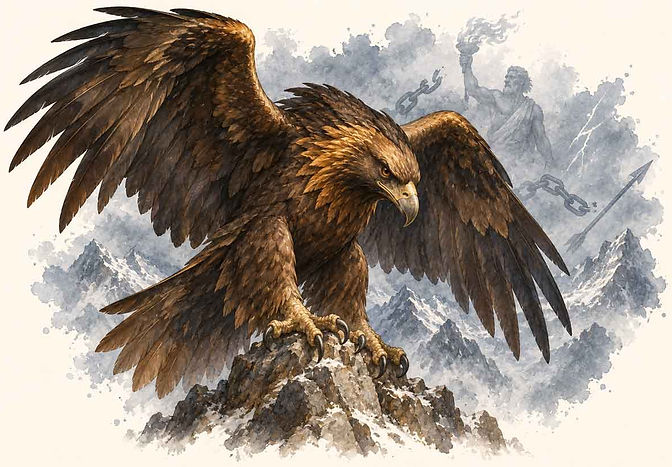
The Caucasian Eagle is the great bird sent to consume the liver of the chained Prometheus. Hesiod gives the core punishment: Zeus binds Prometheus, sets a long-winged eagle upon him, the bird eats his immortal liver by day and the organ grows back at night until Heracles kills the eagle with Zeus's consent. Aeschylus later calls the tormentor the winged hound of Zeus. Its parentage is a later and variable addition. Pseudo-Apollodorus makes the eagle a child of Typhon and Echidna, while Hyginus preserves other origins from Earth and Tartarus or from a creature fashioned by Hephaestus. The bird's myth therefore centres less on genealogy than on its function as the living instrument of Prometheus's endlessly renewed punishment.
Gallery
Main Article - Who or What was...
Caucasian Eagle
Prometheus's punishment grows out of his conflict with Zeus over sacrifice and fire. Hesiod tells how Prometheus deceives Zeus over the division of an ox and later steals fire for humankind. Zeus responds by binding the Titan with inescapable bonds and setting a great eagle to feed upon his liver.
The punishment depends upon Prometheus's immortality. The eagle eats the liver during the day, but at night the organ grows back, restoring the same wound for the next attack. Aeschylus intensifies the image by calling the bird the winged hound of Zeus, making the eagle less a natural predator than a hunting animal permanently assigned to divine vengeance.
Early sources do not require the eagle to have monstrous parents. Later mythographers expand its genealogy. Pseudo-Apollodorus calls it the offspring of Typhon and Echidna, while Hyginus preserves competing traditions in which it comes from Earth and Tartarus or is made by Hephaestus and given life. These later genealogies are alternatives, not a single family history.
Apollonius of Rhodes brings the eagle into the Argonautic landscape. As the Argo travels near the Caucasus, the heroes see the enormous bird flying above them and feel the force of its wings. Soon afterwards Prometheus's cries carry across the air as the eagle tears at him. The scene makes the punishment part of the geography Jason and Medea inhabit without allowing the Argonauts to intervene.
The torment also becomes connected with Medea's magic. Apollonius says a powerful plant grows where Prometheus's divine ichor falls upon the Caucasian earth. Medea gathers the plant and uses its juice in the charm that protects Jason during Aeetes's trials. The eagle therefore contributes indirectly to the Golden Fleece story through the wound it continually reopens.
Heracles finally ends the punishment. Hesiod says the hero kills the bird and releases Prometheus, explicitly adding that this occurs with the will of Zeus so that Heracles's glory may increase. Later stories connect Prometheus's freedom with Chiron and with advice for Heracles's Hesperides labour, but the essential act remains the same: the eagle dies beneath Heracles's arrow.
Summary
The Caucasian Eagle endures as Zeus's living instrument of punishment against Prometheus. Hesiod describes the daily feeding and nightly renewal of the Titan's liver and makes Heracles the hero who kills the bird with Zeus's consent. Later sources give the eagle several competing parentages, including Typhon and Echidna. Apollonius brings the torment into the Argonautic story when the crew sees the eagle near the Caucasus and Medea gathers a plant grown from Prometheus's ichor. Its defining image remains the dark bird above the chained Titan until Heracles's arrow finally ends the cycle.
Now enter the Mythopouch World!
You’ve discovered:
Caucasian Eagle
From Myth to Game
Join to access FREE real-world mythology "Learn Quests" and "Courses". Sign up to the newsletter for new releases, game updates, insider news, and more as Mythopouch brings real mythology to life. EARN the right to purchase an offline board game by completing FREE modules.


It's FREE to join as a MEMBER!
Not ready to join? Get the newsletter instead below


Looking for others?
Click into the field below to search, or click the icon to go to full page search function!

Looking for Mythology Insights?


Click below to view our mythology blog article insights, where we delve into the current Mythopouch Tier regions, and what we think you should know!
Sources & Retellings
Explore the original mythological Source texts (most from over 75 years ago, some as translated, possibly with mature content) and Mythopouch's source Retellings (a modern retelling also suitable for 15+) connected to this mythological entity. We are growing this resource and will link these in the future; for now, check the References below, then find the Sources or Retellings on those pages!


References
Validation References:
- Hesiod, Theogony 507-534 - the eagle, daily feeding, liver renewal and Heracles's rescue.
https://www.theoi.com/Text/HesiodTheogony.html
- Aeschylus, Prometheus Bound 1021-1025 - the winged hound of Zeus.
- Pseudo-Apollodorus, Bibliotheca 2.5.11 - Typhon-Echidna parentage and Heracles killing the eagle.
https://www.theoi.com/Text/Apollodorus2.html
- Apollonius of Rhodes, Argonautica 2.1242-1260 and 3.843-866 - Argonauts see the eagle and Medea gathers the plant from Prometheus's ichor.
- Diodorus Siculus, Library of History 4.15.2 - Heracles kills the eagle with an arrow.
- Hyginus, Astronomica 2.15 - competing later origins for the eagle.
Cultural Context Notice
Mythology developed across different cultures, periods and traditions, and there is rarely one universally accepted version of a story. Mythopouch approaches these traditions with respect while remaining faithful to the complexity of the surviving material. Retellings and educational content may interpret or adapt historical sources, but are not presented as definitive accounts of any culture, religion or belief system.