Greek Mythology List


Welcome to the Mythopouch list of Greek mythology entries! We also delve into the ancient history of Greece and the surrounding areas. From heroes to goddesses, places, monsters, artifacts, weapons, creatures and more - which will only grow over time. Mythopouch provides real-world information extracted from the original source material such as that from: Homer, Hesiod, Apollodorus, Ovid, Pausanias, Pindar, Aeschylus, Sophocles, Euripides, Hyginus, Diodorus Siculus and Apollonius of Rhodes. Words and stories carry powerful messages that were passed down from one generation to the next, many of which are still very applicable to modern times. Our unique imagery is meant to capture the imagination and ignite the magic mythology spark within us all. Our "token mark" coin symbol that is assigned to each record is a visual representation of the entity, for use in Mythopouch learning modules and games.
Learn - Earn - Play
Greek Entity Quick Index
Our current list of ancient Greek mythology and ancient history entities are here - which are growing day by day!
Search by using the:
-
"Search Mythology Records" function to browse all mythology records and blog pages;
-
Browse the visual cards with overviews by clicking "Go to Visual A-Z";
-
Or just browse and click the A-Z entries below....
See more list entries
Read Ancient Greek Insights
Click below to view our ancient Greek mythology blog article insights, where we delve into the current Mythopouch Tier regions and what we think you should know!


Greek Entity Card Index
See more card entries
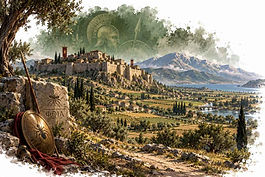
Phthia
Phthia is the Thessalian homeland of Achilles, the promised return that dominates his speeches in the Iliad and becomes impossible after the death of Patroclus. It is the land of the Myrmidons, the fifty ships and the people whom Achilles leads against Troy. It is the deep-soiled and fertile country that Homer calls Achilles' home, although the epic never takes its audience inside Phthia's palace or gives the place a full dramatic scene. It is the kingdom ruled by Peleus, where Thetis bore Achilles and where the old king waits for a son who will never return. It is the destination Achilles threatens to reach on the third day when he rejects Agamemnon's embassy, saying that a favourable wind could carry him back to fertile Phthia. It is the home from which Phoenix was sent to guide the young Achilles and to which Phoenix appeals when he begs the hero to rejoin the Greeks. It is the country whose name later poets and philosophers heard as an echo of phthisis, decline, consumption and death. It is the land through which the River Spercheios runs, where Peleus had vowed to dedicate a lock of Achilles' hair if his son returned safely. It is the later setting of Euripides' Andromache, where Neoptolemus rules after the Trojan War and Andromache suffers under Hermione. It is a place whose exact location has been debated since antiquity, whether in the Spercheios valley or near Pharsalus, but whose mythic function is certain: Phthia is the life Achilles loses when he chooses glory at Troy. And it is the location that must be distinguished from the several mythological women also named Phthia, including nymphs, daughters and concubines in unrelated genealogies.

Pierides
The Pierides are nine mortal sisters who challenge the nine Muses to a musical contest and are transformed into birds after defeat. Their story survives in more than one ancient form. Ovid makes them daughters of wealthy Pierus of Pella and Euippe of Paeonia, has one sister sing a deliberately hostile version of the war of the gods, and turns all nine into magpies after they insult the victorious Muses. Antoninus Liberalis, preserving a version attributed to Nicander, instead calls Pierus an earth-born king of Emathia and turns each sister into a different bird after the contest on Helicon. Pausanias records another tradition in which Pierus has nine daughters bearing the same names as the Muses. Because Pierides was also an epithet for the Muses themselves, the mortal challengers must be distinguished from the divine Pierian sisters.

Pindar
Pindar is the greatest surviving lyric poet of ancient Greece and the master of the choral victory ode. He is the Boeotian poet born near Thebes who celebrated the winners of the Olympic, Pythian, Nemean and Isthmian games and turned their triumphs into songs of gods, heroes, cities, mortality and eternal fame. He is the aristocratic composer whose patrons included the tyrants Hieron of Syracuse, Theron of Acragas and Arcesilaus of Cyrene, as well as athletes and families from Aegina, Rhodes, Cyrene, Sicily and mainland Greece. He is the poet of Pythian 10, written in 498 BCE for a Thessalian victor, and Pythian 8, written in 446 BCE, the last dated poem in the surviving corpus. He is the composer whose ancient reputation rested on seventeen books of hymns, paeans, dithyrambs, processionals, maiden songs, dance songs, encomia, laments and victory odes, of which only the four epinician books survive in complete form. He is the architect of the triadic lyric ode, with its strophe, antistrophic response and epode, and the creator of a language so dense in metaphor, myth and moral reflection that ancient critics called him magnificent and later writers described his movements as Pindaric flights. He is the poet whose music and choreography are lost but whose verses preserved the Greek world's highest ideals of achievement, divine favour, civic pride and restrained praise. And he is the figure whose ancient biographies are full of stories, many late and unreliable, but whose poems themselves place him at the centre of the Panhellenic world.

Pirithous
Pirithous is the king of the Lapiths whose wedding feast became the most notorious in Greek mythology, the occasion on which his own kin, the centaurs, drank too much wine and tried to carry off the women, sparking a battle so brutal that it defined the boundary between civilised man and beast forever. He is the son of Zeus, the king of the gods, who descended upon his mother Dia in the form of a stallion, a divine parentage that gave him strength and daring beyond that of ordinary men. He is the sworn friend of Theseus, the hero who slew the Minotaur in the labyrinth of Crete, a friendship so absolute that the two heroes swore an oath to help each other in any adventure, no matter how dangerous or impious. He is the fool who convinced Theseus to descend into the underworld with him to abduct Persephone, the queen of the dead and wife of Hades, the god who ruled the realm of shadows, a plan so reckless that it cost him his freedom and very nearly his life. And he is the prisoner who sat for eternity in a chair of forgetfulness in the house of Hades, or who was freed by Heracles during his twelfth labour, depending on which poet you believe, a hero whose ambition outran his luck but whose friendship with Theseus became the model for every tale of brotherly loyalty in the ancient world.

Pittheus
Pittheus is the wise king of Troezen whose cunning placed a sword beneath a rock and a princess in a bedchamber, and who became the grandfather of the greatest hero of Athens. He is the son of Pelops, the Phrygian prince whose name gave the Peloponnese to the Greeks, and Hippodamia, the princess whose chariot wedding had killed her father and cursed the next four generations. He is the brother of Atreus and Thyestes, the brothers whose feud of adultery, cannibalism, and revenge produced Agamemnon and Menelaus and the Trojan War itself. He is the father of Aethra, the most beautiful woman in the Argolid, and the man who tricked Aegeus, the king of Athens, into sleeping with her by filling him with wine and placing him in her bed. And he is the grandfather who raised Theseus in secret, who taught the boy the arts of war and statecraft, and who placed his father's sword beneath a rock so that the child could prove his identity when he was old enough to lift it.

Plato
Plato is the Athenian philosopher whose dialogues made Socrates immortal and whose Academy became the ancestor of the university and the word academic. He is the son of Ariston and Perictione, born into one of Athens' oldest and most distinguished families during the city's wars with Sparta. He is the young aristocrat who watched the democracy of Athens execute Socrates in 399 BCE and transformed grief into a literary and philosophical project. He is the writer who invented the philosophic dialogue as a dramatic form, using conversation, irony, myth, humour, characterization and deliberate aporia to test ideas rather than merely state doctrines. He is the author of the Apology, Crito and Phaedo, works that preserve the trial, imprisonment and death of Socrates and make them foundations of Western moral philosophy. He is the creator of the Republic, whose arguments about justice, education, the divided line, the cave and the philosopher-king continue to shape political thought. He is the poet-philosopher of the Symposium and Phaedrus, dialogues in which love becomes a ladder from bodily beauty to the eternal Forms. He is the metaphysician of the Phaedo, Parmenides, Sophist, Statesman, Timaeus, Philebus and Laws, whose ideas about Forms, being, knowledge, change, pleasure, cosmology and law changed the course of philosophy. He is the founder of the Academy, where philosophers and mathematicians gathered for research and teaching for more than two centuries after his death. He is the teacher of Aristotle for twenty years and the thinker whom Aristotle criticised as often as he followed him. He is the author whose ancient canon contains thirty-five dialogues and thirteen letters, though several transmitted works are spurious and the authenticity of others remains debated. He is the philosopher whose works, unlike Aristotle's treatises, survived almost entire and became the most influential body of philosophical writing in the Western tradition.

Pleiades
The Pleiades are the seven star-sisters who shine from the shoulder of Taurus, the celestial Bull, transformed into fire to escape a hunter's lust. They are the daughters of Atlas, the Titan condemned to hold up the heavens, and Pleione, one of the three thousand Oceanid nymphs who were daughters of the Titan Oceanus and the goddess Tethys. They are the mothers of gods and kings, including Hermes, the messenger god born to Maia in a cave on Mount Cyllene, and Dardanus, the founder of Troy born to Electra. They are the maidens who fled from Orion, the giant hunter whose stride measured the earth, until Zeus, the king of the gods who rules from the high throne, took pity and set them among the stars. They are the six bright lights and one dim spark, for Merope hides her face in shame at having married a mortal man while her sisters married gods. And they are the cluster that sailors watch to mark the seasons, that farmers follow to plough and to reap, and that still bears the name of seven ancient sisters in every language under the sun.

Plutarch
Plutarch is the Greek philosopher, priest, teacher, essayist and biographer whose works joined the intellectual world of Greece to the political memory of Rome. He is the citizen of Chaeronea born around 46 CE into a family rooted in Boeotian civic and religious life. He is the student of Ammonius in Athens and the Platonist who wrote dialogues, essays, moral treatises and religious investigations from Chaeronea and Delphi. He is the traveller who visited Rome, lectured to Roman audiences, became a Roman citizen under the name Lucius Mestrius Plutarchus and counted senators and imperial officials among his friends. He is the priest of Apollo at Delphi, the sacred city where many of his dialogues take place. He is the author of the Parallel Lives, in which famous Greeks and Romans appear in comparative pairs so that character, fortune, virtue and vice can be examined across the two cultures. He is the writer of the Moralia, the vast collection of essays, speeches, dialogues and inquiries now grouped under a modern title. He is the biographer who declared that he wrote not histories but lives, and who believed that a jest, a phrase or a small action could reveal character more clearly than a battle. He is the chronicler of Alexander and Caesar, Cicero and Demosthenes, Brutus and Antony, Solon and Publicola, Theseus and Romulus. He is the author whose lives of Galba and Otho are the only survivors from a lost series on the Roman emperors from Augustus to Vitellius. He is the essayist who wrote on anger, talkativeness, superstition, friendship, marriage, exile, fate, music, the Delphic oracle, the moon and the eating of meat. He is the ancient author whose works, in the words of the so-called Lamprias catalogue, reached two hundred and twenty-seven titles, even though the catalogue is incomplete, mutilated and not wholly reliable. And he is the writer whose Lives and Moralia became models for the essay, the biography and the study of human character from antiquity through Montaigne, Shakespeare, Dryden, Rousseau, Emerson and beyond.

Polydeuces
Polydeuces is the divine half of the Dioscuri, the immortal twin whose greatest deed was not winning a boxing match but refusing immortality unless his mortal brother Castor could share it. He is the son of Leda, queen of Sparta, and in the dominant tradition the son of Zeus, while Castor is the son of Leda's husband Tyndareus. He is the boxer of the two brothers, matched with Castor the tamer of horses and rider without rival. He is the Argonaut who defeated the brutal king Amycus in a boxing match and thereby broke the custom by which every stranger who landed on the Bebrycian coast had to fight for his life. He is the brother who helped rescue Helen when Theseus carried her away from Sparta and hid her far beyond the Eurotas. He is the bridegroom who carried off Hilaeira with Castor and Phoebe, triggering the feud in which Castor was killed by Lynceus and Polydeuces killed his enemy in return. He is the son of Zeus who rejected the comfort of Olympus when Castor lay among the dead and asked his father to divide the gift of immortality so that the brothers might share death and heaven in turn. He is the god who became one of the bright stars of Gemini and the helper who appears to sailors as St Elmo's fire, to horsemen as a divine rider and to travellers as a guardian of the road. He is the Greek Polydeuces whom the Romans called Pollux and honoured in the Forum as a heavenly twin. And he is the figure through whom Greek mythology joined the strength of the athlete, the loyalty of the brother and the promise that love can divide even death.

Polyhymnia
Polyhymnia is one of the nine Muses, daughters of Zeus and Mnemosyne, and later tradition assigns her sacred hymns and solemn eloquence. Hesiod lists her seventh among the nine named Muses, between Erato and Urania, but does not yet divide the sisters into separate artistic domains. Her later iconography is unusually quiet: Greco-Roman art often shows her veiled or pensive rather than actively performing. The familiar idea of Polyhymnia as the contemplative Muse therefore belongs chiefly to the later differentiation of the Muses, not to a detailed personal myth in early epic.

Polyphemus
Polyphemus is the one-eyed giant who devoured Odysseus's men in his cave on Sicily, a Cyclops so massive that he blocked the entrance with a stone no twenty men could shift. He is the son of Poseidon, the god of the earthquake and the grey sea, and the sea-nymph Thoosa, born with a single orb blazing in the centre of his forehead where other men have two. He is the shepherd who kept his flocks of sheep and goats in a cavern on the slopes of Mount Etna, milking them into wicker pails and living without law or council, for the Cyclopes trust in the immortal gods and have no assemblies where men gather to judge one another. He is the monster who asked Odysseus his name and received the answer "Nobody," a trick that cost him his sight and earned the hero a curse that would hound him across the wine-dark sea. And he is the spurned lover of the sea-nymph Galatea, who crushed the handsome Acis beneath a boulder in a fit of jealousy that turned the youth into a river.

Poseidon
Poseidon is the god of the sea, the second most powerful deity on Olympus, the sacred mountain where the twelve great Olympian gods made their eternal home, and the only god whose anger could shake the earth and raise waves tall enough to swallow fleets. He is the brother of Zeus, the king of the gods and wielder of the thunderbolt, and Hades, the god of the dead who ruled from the darkness beneath the earth, the three sons of the Titan Cronus who overthrew their father and divided the cosmos between them, with Zeus taking the sky, Hades the underworld, and Poseidon the sea. He is the earth-shaker whose trident, forged by the Cyclopes, the one-eyed giants who were the first smiths of the gods, could split mountains and summon earthquakes that toppled cities. He is the creator of the horse, the beast that he shaped from the foam of the sea in a contest with Athena, the goddess of wisdom born fully armed from the head of her father Zeus, for the patronage of Athens, a contest he lost when the people chose Athena's olive tree over his salt spring. He is the pursuer of mortals, the god who flooded the plains of Attica when King Cecrops chose Athena, who cursed the hero Odysseus with ten years of wandering for blinding his son Polyphemus, the one-eyed giant, and who demanded the sacrifice of virgins to his sea-monsters when cities failed to honor him. And he is the father of heroes and monsters, the sire of Theseus, the Athenian hero who slew the Minotaur, and of the Cyclops Polyphemus, of the winged horse Pegasus born from Medusa's blood, and of countless other beings who shaped the Greek world between wonder and terror.