Details
Region
Greek
Regional Information Additional (if applicable)

Spartan / Dioscuri / Heroic
Category
Person
Historicity (actuality or factual truth of persons, events, and claims)
Legendary
Gender
Male
Time Period
Heroic Age; attested from Homer and the Hesiodic tradition, with the mixed-paternity version first surviving complete in Pindar's Nemean Ode 10
Symbol
Boxing fists & horeshoe
Tags
greek, polydeuces, pollux, castor, dioscuri, gemini, argonauts, sparta, twin-gods
Introduction - Overview
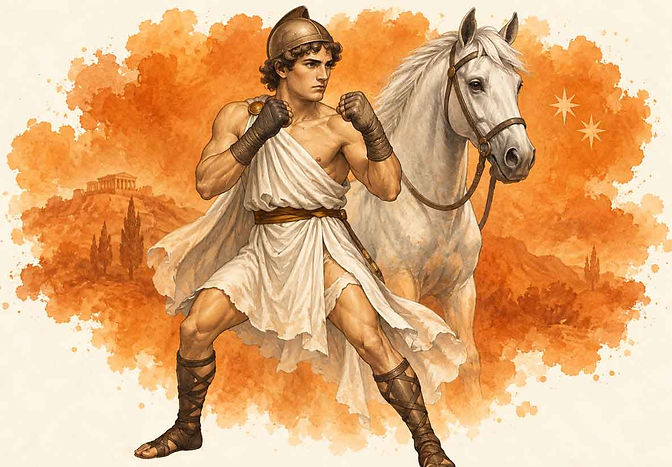
Polydeuces is the divine half of the Dioscuri, the immortal twin whose greatest deed was not winning a boxing match but refusing immortality unless his mortal brother Castor could share it. He is the son of Leda, queen of Sparta, and in the dominant tradition the son of Zeus, while Castor is the son of Leda's husband Tyndareus. He is the boxer of the two brothers, matched with Castor the tamer of horses and rider without rival. He is the Argonaut who defeated the brutal king Amycus in a boxing match and thereby broke the custom by which every stranger who landed on the Bebrycian coast had to fight for his life. He is the brother who helped rescue Helen when Theseus carried her away from Sparta and hid her far beyond the Eurotas. He is the bridegroom who carried off Hilaeira with Castor and Phoebe, triggering the feud in which Castor was killed by Lynceus and Polydeuces killed his enemy in return. He is the son of Zeus who rejected the comfort of Olympus when Castor lay among the dead and asked his father to divide the gift of immortality so that the brothers might share death and heaven in turn. He is the god who became one of the bright stars of Gemini and the helper who appears to sailors as St Elmo's fire, to horsemen as a divine rider and to travellers as a guardian of the road. He is the Greek Polydeuces whom the Romans called Pollux and honoured in the Forum as a heavenly twin. And he is the figure through whom Greek mythology joined the strength of the athlete, the loyalty of the brother and the promise that love can divide even death.
Gallery
Main Article - Who or What was...
Polydeuces
The birth of Polydeuces belongs to a family crowded by divine desire. Leda, wife of King Tyndareus of Sparta, was loved by Zeus. In the familiar later version Zeus came to her in the form of a swan, and on the same night Leda lay with her husband. From this double union came two sets of twins. Castor and Clytemnestra were the children of Tyndareus, while Polydeuces and Helen were the children of Zeus. The four were sometimes born from eggs, and ancient Spartans were said to preserve an egg of Leda in a temple.
Homer gives a different account. In the Iliad, Helen stands on the walls of Troy and looks among the Greek host for Castor and Polydeuces, whom she calls her brothers, but they are absent because the grain-giving earth already holds them. The Odyssey then presents them as honoured like gods and living on alternate days because Zeus has granted them a special fate. The Hesiodic Catalogue and the Homeric Hymns make them both sons of Zeus. Pindar's Tenth Nemean Ode supplies the mixed parentage that later became standard: Polydeuces is Zeus's son, while Tyndareus sows the mortal seed from which Castor is born.
This double paternity explains the central paradox of Polydeuces' life. He is both one of a pair and different from his twin. Castor belongs to the earth, the house of Tyndareus and the realm of mortals. Polydeuces belongs to Zeus, Olympus and the stars. Yet the brothers are inseparable. Their stories repeatedly test whether divine birth can overcome the bond of brotherhood.
Polydeuces' own sphere is boxing. Where Castor masters horses and rides with extraordinary skill, Polydeuces fights with his hands. Homer already calls him the boxer when Helen searches for him on the Trojan plain. Later poets expanded that skill into his most famous victory. During the voyage of the Argonauts the ship stopped on the coast of the Bebryces, where King Amycus enforced a savage law: no stranger could depart without facing him in a boxing match. Amycus was enormous, violent and accustomed to victory.
The Argonauts accepted the challenge only after Amycus insulted them. Polydeuces stepped forward as the natural champion. Their fight became the archetypal contest between brute force and trained skill. Amycus rushed at the Greek twin, but Polydeuces dodged, struck and broke through his opponent's defence. In Apollonius of Rhodes the fight is dangerous and technical. In other versions Polydeuces kills Amycus outright. The victory freed the coast from a predatory custom and made the boxer of the Dioscuri a saviour of travellers before he became a god of the sea.
The Dioscuri also joined the Calydonian Boar Hunt and shared in several expeditions of the heroic generation. Their myth wanders between generations because they are simultaneously the brothers of Helen, whose abduction caused the Trojan War, and companions of Jason, whose voyage belongs to an earlier age. Ancient artists and poets could imagine them as older brothers of Helen or as young men barely past adolescence when they sailed with the Argo. The tension became part of their identity: they stand between one heroic age and another, between Sparta and the wider Greek world.
One of their earliest family adventures was the recovery of Helen. Theseus and his friend Pirithous decided to marry daughters of Zeus. Theseus seized the young Helen and placed her with his mother Aethra at Aphidnae while her brothers were away. When Castor and Polydeuces returned, they led a Spartan army into Attica, defeated Theseus' supporters and recovered their sister. Some traditions say they also captured Aethra and made her Helen's slave. Others give the brothers a more active role in humiliating Athens. Herodotus already remembers the episode as the cause of an old enmity between Athenians and Spartans.
The Dioscuri's best-known marital adventure brought them into conflict with another pair of twins. Phoebe and Hilaeira, the daughters of Leucippus, were priestesses of Athena and Artemis and were betrothed to their cousins Idas and Lynceus, the sons of Aphareus. Castor and Polydeuces desired the sisters and carried them away in a scene later called the rape of the Leucippides. The abduction joined marriage, kinship and insult in a single act.
The feud could not end peacefully. Idas and Lynceus pursued the Dioscuri, either to recover their brides, punish the theft or answer the theft of their cattle. Lynceus possessed sight so keen that he could see through walls or beneath the earth. In the usual version he spotted Castor hiding inside a hollow oak and Idas killed him. Polydeuces then killed Lynceus and pursued Idas until Zeus struck Idas with a thunderbolt or Polydeuces defeated him under divine protection.
The death of Castor became the turning point of Polydeuces' mythology. Zeus offered his immortal son a choice. He could remain forever among the gods on Olympus, radiant, deathless and separate from his brother, or he could share his immortality with Castor. Polydeuces chose division. The brothers would alternate realms, one living among the gods while the other lay beneath the earth. The Odyssey gives the classic formula: the grain-giving earth covers them, yet they are alive and have honour equal to that of the gods, living one day and dead the next.
Later writers varied the structure. Some had the brothers alternate between Olympus and Hades; others placed them beneath the earth at Therapne or made them dwell together in the sky. In every version Polydeuces refuses the selfish use of divine birth. His immortality becomes a shared possession rather than a privilege. The myth transforms paternity into love. Zeus gives him life; Castor gives it meaning.
The Dioscuri were also placed among the stars. The constellation Gemini holds Castor and Polydeuces as its two principal lights, Castor the mortal star and Pollux the brighter divine one. Ancient astronomers and mythographers joined their celestial appearance to their earthly function. They rose as seasonal signs, guarded sailors and marked the twinship that made them one being divided into two bodies.
As gods, Polydeuces and Castor became the Dioscuri, the sons of Zeus, and the Anakes, the lords. They were the great saviours of Greek religion. Sailors in danger called upon them and watched for the twin lights of St Elmo's fire dancing upon mast or yardarm. The light was a sign that the brothers had come, stilling the storm and promising deliverance. Horsemen honoured them as riders and patrons of the cavalry. Travellers, guests and fugitives appealed to them as protectors of the road and helpers of the oppressed.
Their cult was especially powerful in Sparta. Castor and Polydeuces were the native heroic sons of the city, tied to its kings, its cavalry and its rites of initiation. Young Spartan warriors saw them as models of disciplined brotherhood and martial service. At Olympia and other Panhellenic sanctuaries they received honours as patrons of competition. Poets invoked them as guardians of friendship and as deities who valued justice and loyalty.
Their statues shaped the visual language of twinhood. The Dioscuri appear as two youthful horsemen in short cloaks and egg-shaped felt caps, often with stars above them. Castor may hold a horse while Polydeuces raises a spear or assumes the pose of a boxer. Votive reliefs place them side by side with linked symbols: twin amphorae, paired shields, crossed timbers or snakes. Their images joined aristocratic riding, athletic beauty and the promise of rescue.
The Romans received the twins as Castor and Pollux. Latin shortened Polydeuces to Pollux, but the brotherly structure remained. At the Battle of Lake Regillus, legend said, two young horsemen appeared on the Roman side, brought victory and were seen at the fountain of Juturna announcing the result. In gratitude the Romans dedicated a temple to Castor in the Forum. The twins became patrons of cavalry and of the equestrian order. Roman coins, civic rituals and everyday oaths carried their names.
Polydeuces' afterlife continues in the word Gemini and in the image of twin stars. Astronomers still call the brighter star of Gemini Pollux, preserving the Roman form of his Greek name. Mythographers compare the Dioscuri with other Indo-European divine twins, especially the Vedic Ashvins, who likewise appear as youthful horsemen and healers. The Greek pair gave Western culture one of its strongest symbols of brotherhood: two different fates joined by choice.
Their appeal rests on the division they overcome. Castor is mortal and Polydeuces immortal, yet neither accepts separation. One is rider, one boxer; one is tied to Sparta, one to Zeus; one belongs to earth, one to heaven. The myth joins them in alternating light. Their shared immortality makes death a place visited in turn rather than an absolute ending.
Polydeuces remains the twin whose greatest victory came after his most famous fight. He defeated Amycus, rescued Helen and avenged Castor, but his decisive act was spoken to Zeus in grief. He refused heaven without his brother. The request transformed him from a heroic son into a god of shared life, and the twins became the saviours who still ride through storm, starlight and the imagination of Greece.
Summary
Polydeuces endures as the immortal Dioscuri twin, son of Zeus and Leda, brother of Helen and Castor and champion of the boxing ring. His defeat of Amycus freed the Bebrycian coast, while his recovery of Helen and his feud with Idas and Lynceus placed him at the centre of heroic legend. When Castor died, Polydeuces refused Olympus and divided his immortality so that the brothers could alternate between the world above and the world below. As a god he became Pollux to the Romans, one of the twin stars of Gemini and a saviour of sailors, riders and travellers. Polydeuces remains the boxer whose greatest strength was brotherly love.
Now enter the Mythopouch World!
You’ve discovered:
Polydeuces
From Myth to Game
Join to access FREE real-world mythology "Learn Quests" and "Courses". Sign up to the newsletter for new releases, game updates, insider news, and more as Mythopouch brings real mythology to life. EARN the right to purchase an offline board game by completing FREE modules.


It's FREE to join as a MEMBER!
Not ready to join? Get the newsletter instead below


Looking for others?
Click into the field below to search, or click the icon to go to full page search function!

Looking for Mythology Insights?


Click below to view our mythology blog article insights, where we delve into the current Mythopouch Tier regions, and what we think you should know!
Sources & Retellings
Explore the original mythological Source texts (most from over 75 years ago, some as translated, possibly with mature content) and Mythopouch's source Retellings (a modern retelling also suitable for 15+) connected to this mythological entity. We are growing this resource and will link these in the future; for now, check the References below, then find the Sources or Retellings on those pages!


References
Validation References:
- Homer, Iliad 3.237-244 (c. 750 BCE) - Helen seeks Castor and Polydeuces on the Trojan plain, where they are absent among the dead
- Homer, Odyssey 11.298-304 (c. 750 BCE) - the brothers honoured like gods and living on alternate days beneath the earth and among the immortals
- Hesiod, Catalogue of Women, fragment 66 (8th or 7th century BCE) - the tradition that Castor and Polydeuces were both sons of Zeus
- Alcman, fragment 2 (7th century BCE) - Castor the tamer of horses and glorious Polydeuces dwelling beneath the earth
- Homeric Hymn 32 to the Dioscuri (7th-6th century BCE) - the twins as saviours of sailors, appearing with tawny wings to still the storm
- Pindar, Nemean Ode 10.55-90 (c. 444 BCE) - Zeus declares Polydeuces his son, explains Castor's mortal paternity and grants the brothers alternating life
- Apollonius of Rhodes, Argonautica 2.1-97 (c. 270-245 BCE) - Polydeuces' boxing match with Amycus
- Theocritus, Idyll 22.27-223 (c. 270-250 BCE) - the Dioscuri as horsemen, boxers and gods
- Apollodorus, Bibliotheca 1.9.16 and 3.10.7 (1st or 2nd century CE) - the mixed parentage, the Leucippides and the death of Castor
- Diodorus Siculus, Library of History 4.43-48 (c. 60-30 BCE) - Greek and Roman traditions of the twins' deeds and honours
- Hyginus, Fabulae 14, 77, 80 and 92; Astronomica 2.22 (1st or 2nd century CE) - parentage, feud, shared immortality, Gemini and Poseidon's gift of horses
- Ovid, Fasti 5.697-720 and Heroides 16.327-350 (c. 8 CE) - the Latin account of the Leucippides and Pollux's division of immortality
- Propertius, Elegies 2.26A (c. 25 BCE) - the stars helping the storm-tossed ship and the twins as protectors of sailors
- Burkert, Walter, Greek Religion (Harvard University Press, 1985), pp. 212-213 - cult and religious significance of the Dioscuri
- Kerényi, Karl, The Heroes of the Greeks (Thames & Hudson, 1959), pp. 105-112 - mythic biography and Greek hero traditions
- Gantz, Timothy, Early Greek Myth: A Guide to Literary and Artistic Sources (Johns Hopkins University Press, 1993), Volume 2, "The Dioscuri" - source history and variant traditions
- Hard, Robin, The Routledge Handbook of Greek Mythology (Routledge, 2004), "The Dioscuri" - synthesis of the myths, cults and genealogies
- Walker, Henry John, The Twin Horse Gods: The Dioskouroi in Mythologies of the Ancient World (I.B. Tauris, 2015) - comparative study of divine twins
- West, M.L., Indo-European Poetry and Myth (Oxford University Press, 2007), pp. 187-190 and 377-380 - the Dioscuri among the Indo-European horse twins
- Larson, Jennifer, Ancient Greek Cults: A Guide (Routledge, 2007), "Dioskouroi" - sanctuaries, rituals and local cults
- Kearns, Emily, The Heroes of Attica (Institute of Classical Studies, 1989), pp. 175-180 - Attic cult traditions of the Dioscuri
Cultural Context Notice
Mythology developed across different cultures, periods and traditions, and there is rarely one universally accepted version of a story. Mythopouch approaches these traditions with respect while remaining faithful to the complexity of the surviving material. Retellings and educational content may interpret or adapt historical sources, but are not presented as definitive accounts of any culture, religion or belief system.