
Details
Region
Greek
Regional Information Additional (if applicable)

Boeotian / Classical Greek Lyric / Epinician Poetry
Category
Person
Historicity (actuality or factual truth of persons, events, and claims)
Historical
Gender
Male
Time Period
c. 518-c. 438 BCE; the first securely dated surviving victory ode was composed in 498 BCE and the last in 446 BCE
Symbol
Victor's wreath
Tags
greek, pindar, greek-lyric, epinician-odes, olympian-games, pythian-games, nemean-games, isthmian-games, thebes
Introduction - Overview
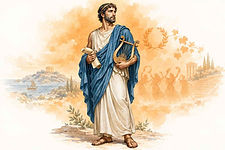
Pindar is the greatest surviving lyric poet of ancient Greece and the master of the choral victory ode. He is the Boeotian poet born near Thebes who celebrated the winners of the Olympic, Pythian, Nemean and Isthmian games and turned their triumphs into songs of gods, heroes, cities, mortality and eternal fame. He is the aristocratic composer whose patrons included the tyrants Hieron of Syracuse, Theron of Acragas and Arcesilaus of Cyrene, as well as athletes and families from Aegina, Rhodes, Cyrene, Sicily and mainland Greece. He is the poet of Pythian 10, written in 498 BCE for a Thessalian victor, and Pythian 8, written in 446 BCE, the last dated poem in the surviving corpus. He is the composer whose ancient reputation rested on seventeen books of hymns, paeans, dithyrambs, processionals, maiden songs, dance songs, encomia, laments and victory odes, of which only the four epinician books survive in complete form. He is the architect of the triadic lyric ode, with its strophe, antistrophic response and epode, and the creator of a language so dense in metaphor, myth and moral reflection that ancient critics called him magnificent and later writers described his movements as Pindaric flights. He is the poet whose music and choreography are lost but whose verses preserved the Greek world's highest ideals of achievement, divine favour, civic pride and restrained praise. And he is the figure whose ancient biographies are full of stories, many late and unreliable, but whose poems themselves place him at the centre of the Panhellenic world.
Gallery
Main Article - Who or What was...
Pindar
Pindar was born around 518 BCE at Cynoscephalae, a small place near Thebes in Boeotia. Ancient biographies disagree about his father's name, offering Daiphantus, Pagondas and Scopelinus, and call his mother Cleodice. The family belonged to the Theban aristocracy, and later tradition connected Pindar with the Aegeidai, a clan with claims to Spartan connections. The precise genealogy cannot be verified, but the poems repeatedly express pride in noble ancestry, inherited excellence, guest-friendship and the obligations of aristocratic society. Pindar's social world is visible in his poetry even when his biography remains uncertain.
Ancient tradition says that he studied at Athens under Lasus of Hermione and was criticised by the Boeotian poet Corinna for failing to make his songs local enough. Another story says that bees placed honey in his mouth in childhood, marking him as a poet. Both anecdotes are late, but they preserve the ancient image of Pindar as a divinely gifted musician trained in the greatest lyric centres of Greece. The secure evidence is his first datable ode, Pythian 10, composed in 498 BCE for Hippocleas of Pelinna, who won the double race at the Pythian games. Pindar was about twenty when the poem was commissioned, and it already displays the mastery that would define his career.
His life spans the central decades of the 5th century BCE. He was old enough to remember the Persian Wars and composed poems that reflect the changed Greek world after Salamis, Plataea and the rise of Sicilian tyranny. Thebes, his native city, did not join the Greek resistance at Thermopylae or Plataea, and Pindar's relationship to Theban politics remains debated. His poems praise Theban heroes, Theban cults and Theban myth, but they also celebrate Aeginetan, Athenian, Argive, Sicilian, Rhodian and Cyrenean victors. He moved in the Panhellenic world even when he remained rooted in Boeotia.
Ancient sources place his death at Argos around 438 BCE, at approximately eighty years of age. His last securely dated poem, Pythian 8, celebrates a victory by Aristomenes of Aegina and closes with one of his most memorable statements on human life: Creatures of a day. What is a man? What is he not? A shadow in a dream is man. He is crowned with gold, and his radiance surpasses all other things. The poem belongs to the final period of his work and turns athletic praise into a meditation on mortality.
Pindar's surviving works fall into a large ancient corpus whose complete books have almost entirely vanished. Alexandrian scholars collected his poetry in seventeen books organised by genre: one book of hymns, one of paeans, two of dithyrambs, two of processionals, three of maiden songs, two of dance songs, one of encomia, one of laments and four of victory odes. Only the four epinician books survive complete in medieval manuscripts. The other thirteen survive in quotations, ancient scholia and papyrus fragments recovered from Egypt.
The lost book of hymns contained songs of praise for gods. Surviving fragments invoke Zeus Ammon, Persephone, Fortune, the gods of Thebes and other divine powers. The paeans honoured Apollo and related gods and were sung at Delos, Delphi, Thebes, Abdera and other sanctuaries. Paeans 1-14 are known in varying degrees from papyri and quotations. Some celebrate Delos and Apollo's birth; others narrate Delphic foundation myths, the death of Neoptolemus or the mythical origin of the paean itself.
Pindar's two books of dithyrambs celebrated Dionysus. Fragments show a range of myths, including the birth of Dionysus, Heracles' descent to the Underworld, the introduction of the Eleusinian Mysteries to Thebes and stories of Perseus. One famous fragment for Athens summons Dionysus to the city during spring and describes the god returning from the sea with bulls, panthers and satyrs. The dithyrambs are among his most exuberant works and reveal the religious energy of Dionysiac performance.
The processionals were choral songs performed while worshippers approached a sanctuary. Pindar wrote processionals for Delians and Aeginetans. The maiden songs were performed by choruses of girls and often joined ritual, myth and the social education of young women. One fragment speaks in a maiden voice and declares, I must think maidenly thoughts and utter them with my tongue. Another invokes Pan as lord of Arcadia and attendant of the Great Mother. The dance songs accompanied lively movement and were closely tied to the worship of Apollo and Dionysus. A fragment connected with the eclipse of the sun in 463 BCE may have been performed in propitiatory rites.
The encomia praised mortal men rather than gods. Pindar composed encomia for Theron of Acragas and Alexander I of Macedon, among others. The laments mourned the dead and offered consolation. Fragments of the threnoi preserve Pindar's views on the afterlife, including the Isle of the Blessed, the punishment of those who lived unjustly and the possibility that the dead return to light after payment to Persephone. These ideas also appear in Olympian 2, one of the most important surviving statements of early Greek eschatology.
The complete surviving epinician corpus consists of forty-five numbered odes. These are divided into fourteen Olympian odes, twelve Pythian odes, eleven Nemean odes and eight Isthmian odes. Some older accounts give forty-four poems because Isthmian 3 and Isthmian 4 share metre and have sometimes been treated as parts of a single composition, while the current standard numbering separates them. The conventional forty-five-poem corpus remains the usual scholarly count.
The Olympian Odes celebrate victories at Olympia and are divided into fourteen poems. Olympian 1, composed for Hieron of Syracuse, opens with the famous priamel: Water is best, and gold, like a blazing fire in the night, stands out supreme of all lordly wealth. It praises the Olympic games above all contests and narrates the race of Pelops against Oenomaus. Olympian 2 for Theron of Acragas gives Pindar's eschatological vision of judgment after death. Olympian 6 traces the line of Iamus and the founding of Olympia's prophetic cult. Olympian 7 for Diagoras of Rhodes recounts the birth of Athena from Zeus's head, Tlepolemus' founding of Rhodes and the island's Olympic glory. Olympian 13 celebrates Corinth and Xenophon's remarkable victories in both running and pentathlon. Olympian 14, a very short closing poem, invokes the Graces and has been questioned as an authentic epinician by some critics.
The Pythian Odes number twelve and celebrate victories at Delphi. Pythian 1 for Hieron compares the tyrant's rule to music and praises divine order. Pythian 2 criticises slander and warns against Ixion's deceit. Pythian 3 consoles Hieron in illness and recounts the punishment of Asclepius. Pythian 4, at 299 lines the longest surviving Pindaric poem, narrates the Argonauts' expedition and Medea's prophecy to glorify Arcesilaus of Cyrene. Pythian 5 continues the Cyrenean praise. Pythian 6 celebrates a chariot victory and tells how Antilochus died for his father Nestor. Pythian 8 for Aristomenes of Aegina is Pindar's last dated poem and contains his most direct statement on human transience. Pythian 12 celebrates Midas of Acragas as a flute player and tells how Athena imitated the Gorgons' cry.
The Nemean Odes number eleven, but not all celebrate Nemean victories. Ancient editors placed three poems that did not fit neatly into their category at the end of the Nemean book. Nemean 9 celebrates a victory at Sicyon, Nemean 10 a victory at Argos, and Nemean 11 is an encomium for Aristagoras of Tenedos on entering the prytany rather than an athletic victory. The Nemean odes frequently celebrate Aeginetan victors and draw on the mythology of the Aiakidai, the family of Aeacus, Peleus, Telamon, Achilles, Ajax and Neoptolemus.
The Isthmian Odes number eight in the surviving book, although the ancient collection likely contained more. The ending of the Isthmian book was lost in transmission. Isthmian 1 celebrates Herodotus of Thebes, who drove his own chariot to victory. Isthmian 3 and 4 honour Phylacides and Pytheas of Aegina. Isthmian 4 praises Melissus of Thebes with a vivid image of the athlete who was small in body but courageous as a lion and clever as a fox. Isthmian 7 addresses the victor Strepsiades and turns from praise to a meditation on living peacefully toward old age. Isthmian 8, perhaps the finest closing poem in the corpus, recalls Ajax's defeat by the false judgement of the Achaeans and asks the Muse to heal grief with song.
The odes celebrate many kinds of contest: four-horse chariot racing, two-mule wagon racing, single-horse racing, boxing, wrestling, the pankration, the stadion, diaulos and long-distance races, the race in armour, the pentathlon and musical competition. The greatest patrons often won chariot victories, in which the owner hired a charioteer and horses; Pindar praises both the owner's expenditure and the risk of competition. The odes for Sicilian rulers frequently present chariot victory as an image of political power, while the Aeginetan odes emphasise local heroism, family achievement and the island's Aiakid heritage.
Pindar's epinician structure is recognisable across the corpus. The poem opens with an invocation to the Muse or a deity and a priamel, a series of statements that establish a hierarchy before reaching the victor. The announcement identifies the contest, the victor, his city, his event and his patron. A transition leads into myth, the central narrative that connects the victor's family or city to heroic history. The poet often interrupts himself with break-off formulas such as My mouth must not tell the story. A gnomic passage reflects on envy, divine favour, wealth, mortality or the limits of praise. The poem returns to the victor, mentions earlier victories and closes with a prayer, proverb or personal seal called the sphragis.
The myths of the epinicia are not decorative. Each one constructs a genealogy between present victory and heroic past. The Pelops myth in Olympian 1 connects Hieron to the founding hero of the Olympic games. The Argonautic narrative in Pythian 4 links Arcesilaus to the colonisation of Cyrene. The Aiakidai in the Aeginetan odes connect local wrestlers and boxers to Achilles, Ajax and Neoptolemus. The Ajax myth in Isthmian 8 addresses the pain of unjust judgement and asks poetry to compensate for what competition denied. The myths give athletic achievement a place in sacred history.
Pindar's style is famous for abrupt movement among image, proverb and narrative. Ancient critics called these transitions Pindaric flights. A single ode may move from water to gold, from Pelops to Poseidon, from athletic victory to the Isles of the Blessed and back to the victor's father. The poems are densely metaphorical: the ode itself is an arrow, a chariot, honey, medicine, water, a crown or a building. Praise must avoid excess because envy, phthonos, follows greatness. The poet therefore balances glory with warnings about mortality, divine limits and the danger of hubris.
The metre of the odes is choral and triadic. A triad consists of a strophe, an antistrophe with the same metrical pattern and an epode with a different pattern. The poems were sung by a chorus accompanied by lyre, flute or both and were choreographed as dance. No musical notation survives, and the rhythms cannot be recovered exactly in modern performance. Pindar uses a wide range of metres, including dactylo-epitrite, logaoedic and paeonic forms. No two surviving odes have exactly the same metrical design, except the problematically related Isthmian 3 and 4.
His language combines the literary dialect of choral lyric with Doric colouring and Ionic epic forms. The grammar and syntax are compressed, and words may carry multiple meanings according to metre and context. Pindar repeats key themes through ring composition, echoes between strophe and epode and thematic returns at the end. His vocabulary is rich in compounds, rare words and metaphor. For centuries readers found the odes difficult because the poems were stripped of their musical and choreographic context; the discovery of Bacchylides in 1896 helped place many Pindaric peculiarities within the conventions of archaic choral lyric rather than within personal eccentricity alone.
The ancient reception of Pindar was immediate and enduring. Aristophanes jokes about the Pindaric praise of Hieron in the Birds and mocks the poet's ornate style in the Clouds. Plato quotes Pindar, Aristotle cites his aphorisms, and Athenaeus preserves fragments. Dionysius of Halicarnassus praises his austere harmony, while Longinus describes his sublime power. Horace calls him a swan and declares that imitation of Pindar is impossible: the stream rushes down from the mountains, deep and fierce, bursting its banks. Quintilian ranks him first among the nine canonical lyric poets because of his inspired magnificence, beauty of thought, exuberance of language and rolling flood of eloquence.
In the Roman period, Pindar became a model for lyric and a school author. Alexandrian scholars produced editions, biographies and scholia. Medieval Byzantium copied the epinician books, and the surviving scholia preserve ancient commentary on metres, historical settings and mythology. Modern scholarship was transformed by the recovery of Bacchylides, the publication of papyrus fragments and the development of literary analysis. August Böckh's edition, Friedrich Gottlieb Welcker's early work and Ulrich von Wilamowitz's Pindaros established the scientific study of the poet. Elroy Bundy's Studia Pindarica redirected attention from biography to the rhetorical and generic conventions of praise.
Modern debates continue over the social meaning of the odes. Earlier scholarship often treated Pindar as a paid poet flattering aristocratic patrons. Later work has examined the odes as instruments of civic identity, religious memory and political negotiation. Leslie Kurke interpreted victory odes within an economy of prestige and guest-friendship. Bruno Currie explored their relation to hero cult. Simon Hornblower placed Pindar alongside Thucydides in the political imagination of the 5th century. Recent studies have questioned how much we can reconstruct about commissions and performance from scholiastic biographies, reminding readers that the poems are not straightforward records of transactions.
Pindar's influence on later European literature is immense. The Pindaric ode became a genre of irregular stanzas and lofty praise in English and European poetry. Abraham Cowley adapted Pindar in the 17th century, and Dryden, Gray, Schiller and later poets continued the tradition. The modern Pindaric ode influenced public poetry, ceremonial verse and translations of Olympic achievement. Modern composers have set the odes to music, and contemporary athletes and institutions still quote his lines about glory, effort and the shadow of mortality.
The most accurate account of Pindar's works must distinguish between what survives complete and what survives only in fragments. The epinicia are complete and securely central to his reputation. The hymns, paeans, dithyrambs, processionals, maiden songs, dance songs, encomia and laments survive in varying fragments and reveal a poet far broader than the victory-ode tradition alone. No work outside the epinician corpus survives complete. Ancient biographical stories, even when entertaining, cannot be treated as secure evidence without support from the poems.
Pindar's central achievement is to make praise a serious form of thought. His odes honour the victor without pretending that victory is simple. They remind the audience that wealth can be dangerous, that envy follows glory, that divine favour is unpredictable and that even the greatest athlete will die. The poem does not remove these limits. It gives the victor a song that will outlast the body. Bronze-armoured heroes sleep in their graves, but the Muse gives Pindar's words wings beyond the reach of forgetfulness.
Summary
Pindar endures as the greatest surviving lyric poet of ancient Greece, the master of choral epinician odes and the best-preserved poet among the canonical nine. Born near Thebes around 518 BCE and active until at least 446, he wrote hymns, paeans, dithyrambs, processionals, maiden songs, dance songs, encomia, laments and victory odes for patrons across the Greek world. Only the four epinician books survive complete, containing forty-five numbered Olympian, Pythian, Nemean and Isthmian odes. His complex triadic metres, dense metaphors, heroic myths, moral reflections and Pindaric flights made him the model of lofty praise. Pindar remains the poet who joins athletic victory, divine favour and human mortality in a single song.
Now enter the Mythopouch World!
You’ve discovered:
Pindar
From Myth to Game
Join to access FREE real-world mythology "Learn Quests" and "Courses". Sign up to the newsletter for new releases, game updates, insider news, and more as Mythopouch brings real mythology to life. EARN the right to purchase an offline board game by completing FREE modules.


It's FREE to join as a MEMBER!
Not ready to join? Get the newsletter instead below




Looking for others?
Click into the field below to search, or click the icon to go to full page search function!

Looking for Mythology Insights?


Click below to view our mythology blog article insights, where we delve into the current Mythopouch Tier regions, and what we think you should know!
Sources & Retellings
Explore the original mythological Source texts (most from over 75 years ago, some as translated, possibly with mature content) and Mythopouch's source Retellings (a modern retelling also suitable for 15+) connected to this mythological entity. We are growing this resource and will link these in the future; for now, check the References below, then find the Sources or Retellings on those pages!


References
Validation References:
- Pindar, Pythian Odes 10 (498 BCE) - the earliest securely dated epinician, for Hippocleas of Pelinna
- Pindar, Olympian Ode 1 (476 BCE) - the priamel on water and gold, the praise of Hieron and the myth of Pelops
- Pindar, Pythian Ode 1 (470 BCE) - Hieron's rule, the lyre and the harmony of divine order
- Pindar, Pythian Ode 4 (c. 462 BCE) - the 299-line Argonautic narrative for Arcesilaus of Cyrene
- Pindar, Olympian Ode 2 (476 BCE) - the eschatological myth of judgment and the Isle of the Blessed for Theron
- Pindar, Nemean Ode 7 (c. 483 BCE) - Neoptolemus, Aegina and Pindar's protest against slander
- Pindar, Isthmian Ode 8 (c. 478 BCE) - Ajax, unjust judgement and the power of song to heal grief
- Pindar, Pythian Ode 8 (446 BCE) - the last dated poem and the meditation on man as the dream of a shadow
- Pindar, fragments of the paeans, dithyrambs, partheneia, hyporchemata, encomia and threnoi (5th century BCE) - the lost choral genres surviving in quotations and papyri
- Aristophanes, Birds 927-951 and Clouds 1353-1378 (414 and 423 BCE) - comic reception of Pindar and his style
- Plato, Meno 76d-e and Phaedrus 227b (early 4th century BCE) - quotations and adaptation of Pindaric lines
- Dionysius of Halicarnassus, On Literary Composition 22-23 (1st century BCE) - Pindar as an example of austere harmony
- Horace, Odes 4.2 (13 BCE) - the impossible task of imitating Pindar and the image of the rushing river
- Quintilian, Institutio Oratoria 10.1.61 (late 1st century CE) - Pindar ranked first among the nine lyric poets
- Vita Ambrosiana and P.Oxy. 2438 (Hellenistic and Roman periods) - ancient lists of Pindar's seventeen books of hymns, paeans, dithyrambs, processionals, partheneia, hyporchemata, encomia, threnoi and epinikia
- Wilamowitz-Moellendorff, Ulrich von, Pindaros (Weidmann, 1922) - the foundational modern study of Pindar's life, works and historical context
- Bowra, C.M., Pindar (Oxford University Press, 1964) - a major synthesis of biography, poetry and interpretation
- Bundy, Elroy L., Studia Pindarica (University of California Press, 1962; reprinted 1986) - the revolutionary study of epinician rhetoric and generic convention
- Kirkwood, Gordon Macdonald, Selections from Pindar (American Philological Association, 1982) - commentary on major odes with analysis of metre and myth
- Race, William H., Pindar, Volumes I-II (Loeb Classical Library 56 and 485, Harvard University Press, 1997) - Greek text, translation, fragments and introduction
- Kurke, Leslie, The Traffic in Praise: Pindar and the Poetics of Social Economy (Cornell University Press, 1991) - praise, wealth, gift exchange and aristocratic ideology
- Rutherford, Ian, Pindar's Paeans: A Reading of the Fragments with a Survey of the Genre (Oxford University Press, 2001) - scholarly edition and interpretation of the fragmentary paeans
- Lavecchia, Salvatore, Pindari Dithyramborum Fragmenta (Edizioni dell'Ateneo, 2000) - edition of the fragmentary dithyrambs
- Currie, Bruno, Pindar and the Cult of Heroes (Oxford University Press, 2005) - hero cult, myth and epinician poetry
- Hornblower, Simon, Thucydides and Pindar: Historical Narrative and the World of Epinikian Poetry (Oxford University Press, 2004) - Pindar in the political and historical world of the 5th century
- Itsumi, Kiichiro, Pindaric Metre: The Other Half (Oxford University Press, 2009) - metrical structure and the technical construction of the odes
- Morgan, Kathryn A., Pindar and the Construction of Syracusan Monarchy (Oxford University Press, 2015) - Pindar, Hieron and the politics of Sicilian praise
Cultural Context Notice
Mythology developed across different cultures, periods and traditions, and there is rarely one universally accepted version of a story. Mythopouch approaches these traditions with respect while remaining faithful to the complexity of the surviving material. Retellings and educational content may interpret or adapt historical sources, but are not presented as definitive accounts of any culture, religion or belief system.