Greek Mythology List


Welcome to the Mythopouch list of Greek mythology entries! We also delve into the ancient history of Greece and the surrounding areas. From heroes to goddesses, places, monsters, artifacts, weapons, creatures and more - which will only grow over time. Mythopouch provides real-world information extracted from the original source material such as that from: Homer, Hesiod, Apollodorus, Ovid, Pausanias, Pindar, Aeschylus, Sophocles, Euripides, Hyginus, Diodorus Siculus and Apollonius of Rhodes. Words and stories carry powerful messages that were passed down from one generation to the next, many of which are still very applicable to modern times. Our unique imagery is meant to capture the imagination and ignite the magic mythology spark within us all. Our "token mark" coin symbol that is assigned to each record is a visual representation of the entity, for use in Mythopouch learning modules and games.
Learn - Earn - Play
Greek Entity Quick Index
Our current list of ancient Greek mythology and ancient history entities are here - which are growing day by day!
Search by using the:
-
"Search Mythology Records" function to browse all mythology records and blog pages;
-
Browse the visual cards with overviews by clicking "Go to Visual A-Z";
-
Or just browse and click the A-Z entries below....
See more list entries
Read Ancient Greek Insights
Click below to view our ancient Greek mythology blog article insights, where we delve into the current Mythopouch Tier regions and what we think you should know!


Greek Entity Card Index
See more card entries

Demodocus
Demodocus is the blind bard of the Phaeacian court whose three songs dominate Book Eight of the Odyssey and transform the island of Scheria into a stage for poetry itself. He is the singer whom the Muse loved above all others, a man who received both good and evil in her gift: she destroyed his sight and granted him the power of sweet song. He is the performer who sings of a quarrel between Odysseus and Achilles before he knows that Odysseus is present among his listeners. He is the singer whose tale of Ares and Aphrodite enmeshed in Hephaestus's invisible net brings laughter into the heroic world and joins the Phaeacian dance to the laughter of the gods. He is the bard whom Odysseus praises as one who sings as though he had been present at Troy or heard the tale from one who was. He is the singer of the Wooden Horse whose song makes Odysseus weep and leads Alcinous to ask the stranger who he is. He is the figure through whom Homer displays the power of epic storytelling: the blind bard who cannot see the world becomes the voice through which the world sees itself. And he is the ancient image of the artist whose suffering and inspiration are joined in a single gift.
Demophilus of Thespiae
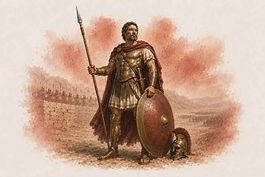
Demophilus is the otherwise unknown Thespian commander who led seven hundred of his countrymen to Thermopylae and chose to remain with Leonidas and the three hundred Spartans when the pass was surrounded. He is the son of Diadromes, named only once by Herodotus in the list of Greek forces gathered against Xerxes. He is the commander of the second largest Greek contingent to fight through the last stand at Thermopylae, overshadowed in later memory by the three hundred Spartans but indispensable to the ancient account. He is the man who rejected dismissal from the battlefield and stayed to fight in a position from which retreat had become almost impossible. He is the leader of the Thespians who, in Herodotus' words, remained very willingly because they refused to abandon Leonidas and his men. He is the forgotten officer honoured in the collective inscription of the Thespians, not by a personal epitaph but by the memory of seven hundred dead. He is the Boeotian patriot whose city was destroyed by the Persians as they advanced and whose countrymen later returned to fight in their thousands at Plataea. And he is the figure whose presence at Thermopylae transforms the famous last stand from a purely Spartan sacrifice into a shared Greek act of resistance.

Demophon
Demophon is the son of Theseus who fought at Troy, rescued his grandmother from slavery, and broke the heart of a Thracian princess whose love for him turned her into an almond tree. He is the prince of Athens who grew up in exile on Euboea after his father lost the throne to Menestheus, and who returned from the Trojan War as one of the heroes hidden inside the Wooden Horse. He is the king who gave refuge to the children of Heracles when they were persecuted by Eurystheus, establishing Athens's reputation as the protector of the oppressed. He is the bridegroom who married Phyllis, the daughter of the Thracian king Sithon, promised to return after settling his affairs in Athens, and then failed to come back, leaving her to die of grief on the shore where she had watched for his ship nine times. And he is the ruler who wrested the Palladium from Diomedes, founded the court of the Ephetae, and presided over Athens during the years when Orestes wandered in madness, a legacy that made him one of the most important kings in Athenian mythic history.

Derceto
Derceto is the fish-tailed goddess of the eastern Mediterranean, a Syrian deity who entered the Greek world as a mermaid with the head of a woman and the body of a fish, worshipped from the coast of Philistia to the temples of northern Syria. She is the consort of Hadad, the storm god whom the Greeks identified with Zeus, enthroned between lions and wearing a mural crown that marks her as sovereign of the ancient world. She is the mother of Semiramis, the legendary queen of Assyria who was raised by doves in the wilderness and grew to rule an empire. She is the goddess who fell in love with a beautiful youth, bore a child in shame, and threw herself into a lake where Aphrodite transformed her into a fish. She is the deity whose temple at Hierapolis Bambyce drew pilgrims from across the Hellenistic world, where fish were sacred and doves were divine. And she is the ancestor of every mermaid story ever told, from medieval bestiaries to modern folklore, the fish-tailed goddess who guards the boundary between the human world and the depths.

Dido
Dido is Elissa, the Phoenician princess who fled the murderous court of Tyre and founded Carthage on the coast of North Africa, building a city so powerful that Rome would spend three centuries trying to destroy it. She is the daughter of King Mutto and the sister of Pygmalion, the boy-king who had her husband killed for his gold and drove her into exile with a fleet of treasure ships and a band of loyal nobles. She is the cunning negotiator who tricked a Libyan chieftain into giving her as much land as a bull's hide could cover, then cut that hide into strips so fine that they enclosed a hill large enough for a fortress. She is the queen who built Carthage from nothing, who refused to marry a neighbouring king and chose death by fire rather than betray her dead husband's memory. And she is the woman whom Virgil, the Roman poet, transformed into the tragic lover of Aeneas, the Trojan refugee who abandoned her to found Rome, a literary invention so powerful that it eclipsed the real queen for two thousand years.

Diodorus Siculus
Diodorus Siculus is the Greek historian from Agyrium in Sicily who composed the Bibliotheca Historica, a universal history in forty books that attempted to preserve the history of the known world from the age of myth to the rise of Julius Caesar. He is the traveller who visited Egypt in 60-57 BCE, spent years in Rome and claimed to have travelled through Asia and Europe in search of historical knowledge. He is the author of the only surviving large-scale Greek universal history of the late Hellenistic period. He is the compiler whose complete Books One through Five describe the gods, heroes, lands and customs of Egypt, the Near East, Africa, India, Arabia and the Greek world. He is the annalist whose complete Books Eleven through Twenty provide a continuous account of Greek, Persian, Sicilian, Macedonian and Italian history from 480 BCE to the years after Alexander's death. He is the author who used and thereby preserved portions of Hecataeus, Ctesias, Agatharchides, Ephorus, Theopompus, Timaeus, Philistus, Hieronymus of Cardia, Duris of Samos, Polybius, Posidonius and many other historians whose works are now lost. He is the writer whose remaining books survive only in fragments gathered by Photius, the Byzantine excerptors and later anthologies. And he is the historian whose work, once dismissed as mechanical compilation, now stands as the most extensively preserved account of ancient Mediterranean history by a Greek author. The accurate record of his works is simple: Diodorus wrote the Bibliotheca Historica, and no other work can be securely attributed to him.

Diomedes
Diomedes is the king of Argos who did what no mortal had ever done before: he wounded two gods on the battlefield of Troy and lived to tell of it. He is the son of Tydeus, one of the Seven Against Thebes who was denied immortality by Athena because he ate the brains of a dying enemy, and of Deipyle, the daughter of Adrastus, the king of Argos. He is the warrior whom Athena, the grey-eyed goddess of wisdom and war, loved above all other Greeks at Troy, granting him the strength to drive his spear into the belly of Ares, the god of war himself, and through the delicate hand of Aphrodite, the goddess of love. He is the hero who exchanged his bronze armour for the golden armour of Glaucus, the Lycian prince, a trade so unequal that Homer called it the exchange of gold for bronze. He is the night-raider who crept into the Thracian camp with Odysseus, the cunning king of Ithaca, and slew King Rhesus in his sleep before his white horses could ever smell the grass of Troy. And he is the only Greek hero to return from Troy without divine punishment, sailing on to found the city of Arpi in Italy and, in some traditions, receiving immortality from Athena herself, a legacy that made him the most fortunate of all the Achaeans.

Dionysus
Dionysus is the god of wine, ecstasy, and the wild forces of nature that break every boundary between mortal and divine. He is the twice-born god, first torn apart by Titans as the infant Zagreus and then stitched into the thigh of Zeus to be born again from his mortal mother Semele's ashes. He is the wanderer who traveled from India to Greece in a chariot drawn by panthers, teaching mortals to cultivate the vine and casting madness upon those who refused to worship him. He is the liberator whose frenzied rites, the Bacchanalia, drew women into the mountains to tear living animals apart with their bare hands, a power that terrified kings and transformed civilizations. He is the husband of Ariadne, the princess of Crete whom he rescued from abandonment on the island of Naxos and made immortal. And he is the founder of the greatest drama festival in Athens, where tragedies and comedies were performed in his honor, a legacy that shaped Western theater for two and a half thousand years.
Dirce
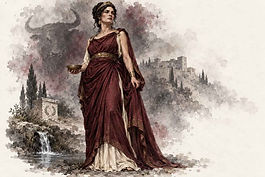
Dirce is the queen of Thebes whose cruelty to her stepchildren earned her one of the most gruesome deaths in Greek mythology, a woman tied to a wild bull and dragged across the rocks until her body was torn apart. She is the second wife of Lycus, the king of Thebes who had abandoned his first wife Antiope, and she is the stepmother of Amphion and Zethus, the twin brothers who would one day build the walls of Thebes with music and muscle. She is the woman who imprisoned Antiope in her own house, treated her like a slave, and mocked her for the children she had borne in secret on Mount Cithaeron. She is the victim of a vengeance so terrible that even the gods did not intervene when the twins returned to claim their birthright, tied her to the horns of a bull, and let the beast drag her until she died. And she is the namesake of the most famous spring in Boeotia, the fountain of Dirce that flowed through the city of Thebes and became sacred to Dionysus, a legacy that turned a cruel stepmother into a nymph whose waters were worshipped for a thousand years.

Domitian
Domitian is the last Flavian emperor of Rome, the younger son who waited in the shadow of his father and brother before claiming the throne for himself. He is the ruler who rebuilt a fire-scarred city, raised a palace on the Palatine that swallowed the hilltop, and filled Rome with games so extravagant that chariots, poets, gladiators and even women raced for his pleasure. He is the administrator who raised the value of Rome's silver coinage, paid the army more generously, repaired roads and temples, and left a treasury surplus after years of building. He is the autocrat who made himself censor for life, policed the morals of senators and Vestal Virgins, the celibate priestesses of Rome's hearth goddess, expelled philosophers and filled the prisons with men accused of treason. He is the emperor whose armies fought wars in Britain, Germany and Dacia, claimed triumphs that his enemies called hollow, and returned from the Danube with the settlement unresolved. And he is the man murdered in his own bedroom on 18 September 96 CE, his name chiselled from monuments by the Roman Senate, the empire's aristocratic council, while the soldiers who loved him demanded revenge. His body vanished into a humble grave, but his shadow still lies across the ruins of Rome.

Dracaenae
The Dracaenae are the serpent-women of Greek myth, creatures whose beauty above the waist conceals a monstrous truth below. They are the half-nymph, half-dragon hybrids who guard the deepest secrets of the earth and birth the nightmares that plague heroes. They are the jailers of divine prisoners, the mothers of monsters, and the seducers who trap gods and men alike in their coils. Echidna, the most infamous of their kind, gave birth to Cerberus, the Hydra, the Chimera, and the Sphinx from her union with the storm-giant Typhon. Campe, the thousand-vipered guardian of Tartarus, kept the Cyclopes and Hecatoncheires imprisoned until Zeus struck her down to free his allies. The Scythian Dracaena stole the cattle of Heracles and demanded the hero's body as ransom, founding a line of kings from their union. And the Argive Dracaena, daughter of the river Styx, ravaged the countryside until the hundred-eyed giant Argus Panoptes slew her in her sleep. They are the earth's hidden guardians, the serpent-women who stand between the world of gods and the world of monsters.

Dragon of Ares
The Dragon of Ares is the sacred serpent that guarded the spring of Ares, the god of war, at the site where Thebes would rise, slain by the Phoenician prince Cadmus who then sowed its teeth to create the first Theban warriors. It is the monster whose death founded a city, for every tooth that Cadmus planted became an ancestor of the noble houses of Thebes, the Spartoi or Sown Men who sprang fully armed from the soil. It is the beast sacred to Ares, placed by the god to protect the waters that would sustain his favoured city, a city whose walls were built from the bones of the cow that led Cadmus there. It is the serpent whose slaughter set in motion the curse that destroyed the house of Cadmus across generations, for the killing of a sacred beast is never without consequence. And it is the dragon whose teeth became the seed of civil war, for the Spartoi who rose from its bones turned upon one another in mutual slaughter before the survivors became the founding fathers of Thebes, a city born from the corpse of a monster.