
Details
Region
Greek
Regional Information Additional (if applicable)

Phoenician / Carthaginian
Category
Person
Historicity (actuality or factual truth of persons, events, and claims)
Legendary
Gender
Female
Time Period
c. 8th century BCE (traditional founding date); literary attestation c. 4th-1st centuries BCE
Symbol
Pyre, Bull's Hide & Crescent
Tags
greek, phoenician, carthage, dido, person, elissa, tyre, pyre, aeneas, byrsa
Introduction - Overview
Dido is Elissa, the Phoenician princess who fled the murderous court of Tyre and founded Carthage on the coast of North Africa, building a city so powerful that Rome would spend three centuries trying to destroy it. She is the daughter of King Mutto and the sister of Pygmalion, the boy-king who had her husband killed for his gold and drove her into exile with a fleet of treasure ships and a band of loyal nobles. She is the cunning negotiator who tricked a Libyan chieftain into giving her as much land as a bull's hide could cover, then cut that hide into strips so fine that they enclosed a hill large enough for a fortress. She is the queen who built Carthage from nothing, who refused to marry a neighbouring king and chose death by fire rather than betray her dead husband's memory. And she is the woman whom Virgil, the Roman poet, transformed into the tragic lover of Aeneas, the Trojan refugee who abandoned her to found Rome, a literary invention so powerful that it eclipsed the real queen for two thousand years.
Gallery
Main Article - Who or What was...
Dido
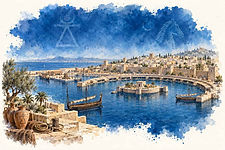
Dido was born in Tyre, the great Phoenician port city on the coast of what is now Lebanon, the daughter of King Mutto and the sister of Pygmalion. Tyre was the wealthiest city in the Mediterranean, a trading empire whose purple dye was worth its weight in silver and whose ships reached every shore from Spain to the Black Sea. When Mutto died, Pygmalion inherited the throne while still a boy, and the kingdom was governed by a council of elders. Dido married her uncle Sychaeus, also called Acerbas, the high priest of Melqart, the patron god of Tyre, and the richest man in the kingdom after the king himself. The marriage was happy and prosperous, but it attracted the envy of Pygmalion, who coveted his uncle's treasure. The young king had Sychaeus murdered in secret and seized his gold, telling Dido that her husband had died by accident.
Sychaeus appeared to Dido in a dream, his ghost pale and bleeding, and revealed the truth. He told her where his treasure was hidden and urged her to flee before Pygmalion killed her too. Dido gathered her loyal followers, loaded the ships with Sychaeus's gold, and sailed westward into the Mediterranean, leaving Tyre forever. Her flight was not cowardice but calculation. She took with her not only treasure but the craftsmen, sailors, and nobles who would build a new city, a Tyre reborn on foreign soil. The fleet stopped at Cyprus, where Dido's followers took eighty young women from the temples to serve as wives for the colonists, and then continued to the coast of North Africa, to a bay sheltered by a peninsula and backed by a hill that would one day be called the Byrsa.
The local inhabitants were the Libyans, ruled by a chieftain named Hiarbas, who controlled the surrounding territory. Dido asked him for as much land as could be enclosed by a single bull's hide. Hiarbas laughed at the modest request and granted it willingly. Dido then took the hide and cut it into the thinnest possible strips, tying them end to end until she had a cord long enough to encircle the entire Byrsa hill. The trick was a Phoenician specialty, a combination of commercial cunning and legal precision that turned a joke into a fortress. Hiarbas was furious but bound by his word, and Dido began to build. The city rose quickly, a walled settlement with a harbour, a marketplace, and a temple to the goddess Astarte, the Phoenician equivalent of Aphrodite, the goddess of love and fertility. Within a generation, Carthage was the greatest city in North Africa, a trading power that rivalled its mother city of Tyre.
The Greek historian Timaeus of Tauromenium, writing in the fourth century BCE, recorded the earliest surviving account of Dido's foundation of Carthage, placing the event around 814 BCE, a date that became canonical in the ancient world. Timaeus drew upon Phoenician and Carthaginian sources that have since been lost, and his version of Dido's story was the one that Greek and Roman writers would repeat and embellish for centuries. In Timaeus's account, Dido remained faithful to the memory of Sychaeus and refused to remarry, even when Hiarbas demanded her hand in marriage and threatened war. Rather than submit, she built a great pyre in the courtyard of her palace, pretended to perform a sacrifice to appease the spirit of her dead husband, and climbed onto the pyre with a sword in her hand. She stabbed herself and fell into the flames, and her followers buried her on the Byrsa hill, where her tomb became a sacred site.
The Roman poet Virgil transformed this story in the first century BCE, in his epic the Aeneid, which tells how Aeneas, the Trojan prince who survived the fall of Troy and wandered the Mediterranean for seven years, was shipwrecked on the coast of Carthage. Dido received him with hospitality, fell in love with him, and entered into a union that she considered marriage, though the gods did not. When Aeneas was reminded by the god Mercury, the messenger of Jupiter, that his destiny lay in Italy and the founding of Rome, he prepared to leave in secret. Dido discovered his plan and confronted him in one of the most famous scenes in Latin literature, a speech of wounded pride and desperate love that ends with a curse upon Aeneas and his descendants. After his ships sailed, Dido climbed a pyre covered with the weapons and garments he had left behind, took a sword, and killed herself, calling down vengeance upon the Trojans and prophesying that her people and his would one day meet in war. The prophecy was fulfilled three centuries later, when Rome and Carthage fought the Punic Wars, the most devastating conflict the ancient world had ever seen.
Summary
Dido endures as the most cunning and tragic queen of the ancient Mediterranean, the Phoenician princess who founded Carthage with a bull's hide and died upon a pyre rather than submit to a king she did not love. From the treasure ships of Tyre to the walls of the Byrsa, from the ghost of Sychaeus to the sword that took her life, her story is one of exile, ingenuity, and the terrible price of sovereignty. A detail worth remembering: the real Dido died for her dead husband's memory, but the Dido that the world remembers died for Aeneas, and the Roman poet's invention was so powerful that the true queen has been hidden behind the tragic lover for two thousand years.
Now enter the Mythopouch World!
You’ve discovered:
Dido
From Myth to Game
Join to access FREE real-world mythology "Learn Quests" and "Courses". Sign up to the newsletter for new releases, game updates, insider news, and more as Mythopouch brings real mythology to life. EARN the right to purchase an offline board game by completing FREE modules.


It's FREE to join as a MEMBER!
Not ready to join? Get the newsletter instead below



Looking for others?
Click into the field below to search, or click the icon to go to full page search function!

Looking for Mythology Insights?


Click below to view our mythology blog article insights, where we delve into the current Mythopouch Tier regions, and what we think you should know!
Sources & Retellings
Explore the original mythological Source texts (most from over 75 years ago, some as translated, possibly with mature content) and Mythopouch's source Retellings (a modern retelling also suitable for 15+) connected to this mythological entity. We are growing this resource and will link these in the future; for now, check the References below, then find the Sources or Retellings on those pages!


References
Validation References:
- Timaeus of Tauromenium, Fragmente der griechischen Historiker 566 F60-65 (c. 4th century BCE) - earliest Greek account of Dido's foundation of Carthage
- Justin, Epitome of the Philippic History of Pompeius Trogus, Book 18.4-6 (c. 2nd-3rd century CE) - Latin narrative of Elissa's flight from Tyre and foundation of Carthage
- Virgil, Aeneid, Books 1 and 4 (c. 19 BCE) - Roman poetic account of Dido and Aeneas
- Orosius, Historiarum Adversum Paganos, Book 4.6 (c. 5th century CE) - chronological placement of Dido's foundation
- Josephus, Against Apion, Book 1.18 (c. 93 CE) - Jewish historian's reference to Phoenician sources on Dido
- Serge Lancel, Carthage: A History (Blackwell, 1995) - scholarly archaeological and historical study of Carthage's foundation
- Maria Eugenia Aubet, The Phoenicians and the West: Politics, Colonies and Trade (Cambridge University Press, 1993) - scholarly analysis of Phoenician colonisation and Dido's historical context
- David L. Quint, Epic and Empire: Politics and Generic Form from Virgil to Milton (Princeton University Press, 1993) - scholarly study of Virgil's transformation of the Dido myth
Cultural Context Notice
Mythology developed across different cultures, periods and traditions, and there is rarely one universally accepted version of a story. Mythopouch approaches these traditions with respect while remaining faithful to the complexity of the surviving material. Retellings and educational content may interpret or adapt historical sources, but are not presented as definitive accounts of any culture, religion or belief system.