Arthurian Mythology List


Welcome to the Mythopouch list of Arthurian Legend mythology entries! We also delve into the early history of Britain, Wales, and the Celtic and medieval traditions that shaped the Arthurian world. From kings, queens, knights and mages to castles, quests, monsters, artefacts, weapons, enchanted objects, creatures and more, this collection will continue to grow over time. Mythopouch provides real-world background and mythological information drawn from early chronicles, Welsh tales and medieval romances such as: the Welsh Triads, Culhwch and Olwen, the Historia Brittonum, the Annales Cambriae, Geoffrey of Monmouth, Chrétien de Troyes, the Lancelot-Grail or Vulgate Cycle, Sir Gawain and the Green Knight, and Thomas Malory’s Le Morte d’Arthur. Arthurian legend carries powerful ideas about courage, honour, loyalty, temptation, sacrifice, prophecy, betrayal and the dream of a better kingdom - messages passed from storyteller to storyteller for centuries, many of which still speak to modern life. Our unique imagery is meant to capture the imagination and ignite the Arthurian spark within us all. Our “token mark” coin symbol assigned to each record is a visual representation of the entity, for use in Mythopouch learning modules and games.
"Nothing is given, everything is earned" at Mythopouch!
Learn - Earn - Play
Arthurian Entity Quick Index
Our current list of ancient British mythology (Arthurian Legend) and ancient history entities are here - which are growing day by day!
Search by using the:
-
"Search Mythology Records" function to browse all mythology records and blog pages;
-
Browse the visual cards with overviews by clicking "Go to Visual A-Z";
-
Or just browse and click the A-Z entries below....
See more list entries
Read Arthurian Legend Insights
Click below to view our Arthurian Legend (ancient British) mythology blog article insights, where we delve into the current Mythopouch Tier regions and what we think you should know!


Arthurian Entity Card Index
See more card entries

Kay
Kay is the foster-brother of King Arthur and the sharp-tongued seneschal of Camelot, the man who held the keys to the king's household and who turned a kitchen into a testing ground for the noblest knight of the Round Table. He is the son of Sir Ector, the nobleman who raised Arthur in secret after Merlin, the wizard who placed the sword in the stone by which Arthur proved his right to the throne, spirited the infant away from the court of Uther Pendragon, Arthur's father. He is the boy who grew up beside Arthur, sharing lessons in swordcraft and horsemanship, never knowing that his foster-brother was the heir to all Britain. He is the knight who tried to claim credit for drawing the sword from the stone, the weapon embedded in an anvil outside St Paul's cathedral in London by Merlin for Uther Pendragon, and who was forgiven when the truth came out. He is the seneschal who managed the kitchens, the feasts, and the provisions of Camelot, and who nicknamed Gareth of Orkney Beaumains, meaning Fair Hands, in mockery of his uncalloused palms before that same kitchen knave proved himself the equal of any knight in Christendom. And he is the warrior who killed two kings with his own hand at the Humber River, the foster-brother whose loyalty outlasted his pride, and whose sharp tongue was the whetstone against which the virtue of the Round Table was sharpened.
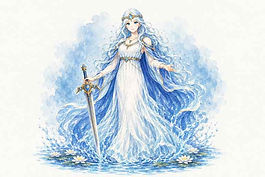
Lady of the Lake
The Lady of the Lake is one of the most enigmatic figures in Arthurian legend, a supernatural being associated with bodies of water who serves as the guardian of Excalibur, the foster-mother of Lancelot, and the captor of Merlin. She is not a single, consistent character across the Arthurian tradition but rather an archetype that fulfills multiple functions depending on the source. The figure evolved from Celtic water fairy traditions, particularly the Welsh tradition of the lwyd and the Irish sídhe, supernatural beings who dwell in bodies of water and interact with mortals for their own purposes.
The Lady of the Lake first appears in Chrétien de Troyes's Le Chevalier de la Charrette (c. 1170s), where she is mentioned as having given Lancelot a magic ring that detects enchantment. The character was most fully developed in the Vulgate Cycle (c. 1215-1235), where she is named "Viviane" and given a detailed backstory as Merlin's pupil. Thomas Malory's Le Morte d'Arthur (1485) synthesizes the various traditions, referring to her primarily as "Nimue."

Lake Lausanne
Lake Lausanne is the Arthurian lake where a fisherman's broken vow brings a monstrous black kitten into the human world. In the Suite Vulgate du Merlin, the fisherman promises God his first catch, keeps two valuable fish for himself and draws up a black kitten on the third cast. He raises the animal to kill household vermin, but it grows into a monster, destroys his family and escapes to a nearby mountain. Merlin later guides Arthur to the devastated district, where the king kills the cat and renames Mont du Lac as Mont du Chat. The romance calls the water Lake Lausanne, normally understood as Lake Geneva, yet the real Mont du Chat stands much farther south beside Lac du Bourget. The geography is therefore literary and internally difficult rather than a route that can be plotted exactly onto a modern map.
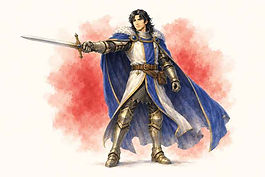
Lancelot (Sir)
Sir Lancelot du Lac stands as the greatest knight of the Round Table, the central figure of the Vulgate Cycle, and the tragic protagonist of Arthurian chivalry. His story begins not in Britain but in France, first appearing in Chrétien de Troyes' Lancelot, or the Knight of the Cart (c. 1177-1181) as the perfect courtly lover whose devotion to Queen Guinevere drives him to extraordinary deeds. According to the Vulgate Cycle, Lancelot was born the son of King Ban of Benwick and Queen Elaine, orphaned when their kingdom was conquered by King Claudas. The enchantress known as the Lady of the Lake-the same mystical figure associated with Excalibur-rescued the infant Lancelot, raised him in her magical realm beneath the waters, and gave him his surname "du Lac" (of the Lake). There he received training in chivalry, magic, and warfare that would make him the supreme knight of Arthur's court.
Lancelot's arrival at Camelot marked a transformation in Arthurian legend. Where earlier tales celebrated King Arthur himself as the paramount warrior, the French romances elevated Lancelot to a position of almost superhuman prowess. He was never defeated in fair combat, rescued Guinevere from abduction by Meleagant, and inspired generations of knights through his example of martial perfection and romantic devotion. Yet this same devotion contained the seeds of destruction. His secret affair with Guinevere-an open secret at Camelot for years-violated the sacred bond between king and queen, undermining the very chivalric order Lancelot represented. The Vulgate Cycle makes explicit what Chrétien implied: Lancelot's earthly love for Guinevere barred him from achieving the Holy Grail, a role reserved for his pure son Galahad.

Lanceor
Lanceor is the proud Irish knight whose pursuit of Balin ends in a fatal joust and the death of his lover Colombe. Malory identifies him as the son of a king of Ireland and places him at Arthur's early court, where Balin's unexpected success with a mysterious sword provokes his envy. After Balin kills the Lady of the Lake in the king's presence, Lanceor obtains permission to follow him and avenge the affront. His confidence cannot protect him: Balin's spear kills him in their first encounter. Colombe arrives afterwards and takes her own life in grief, despite Balin's attempt to intervene. King Mark gives the lovers a shared tomb, and Merlin connects that place with a future contest between Lancelot and Tristan. Lanceor has only a brief part in the narrative, but his death carries the story from rivalry at court towards the warnings and disasters that surround Balin.

Laudine
Laudine is the Lady of the Fountain in Chrétien de Troyes's Yvain, the widowed ruler who marries the knight responsible for her husband's death. Her lands depend on a champion able to defend the enchanted spring, where water poured upon a stone summons a destructive storm. When Yvain kills Esclados the Red, her handmaid Lunete persuades her that the victor can become the protector she needs. The marriage is followed by another test of trust. Laudine allows Yvain a year away at tournaments and lends him a protective ring, but he remains absent beyond the agreed date. She sends a messenger to reclaim the ring and withdraw her love. His subsequent madness and adventures take place away from her court, while her need for a reliable defender remains. Their eventual reunion is arranged through another promise, skilfully obtained by Lunete. Laudine's story joins grief, marriage, lordship and the difficult consequences of a broken word.

Launfal (Sir)
Sir Launfal is the Round Table knight whose generosity bankrupted him, the steward of King Arthur's court who was forgotten by his king and insulted by his queen. He is the lover of Tryamour, the daughter of the King of Faerie, a supernatural realm beyond the mortal world, who gave him a magical purse that never emptied, an invisible dwarf servant named Gyfre, a white fairy horse called Blaunchard, and armour that shone like crystal, on the single condition that he never reveal her existence. He is the broken knight who, provoked by Queen Guinevere's slander, boasted that his fairy lady's least attractive servant was more beautiful than the queen herself, and who lost everything the moment his secret slipped out. He is the accused man who stood trial for treason against the queen's honour, and who was saved at the last breath by Tryamour's arrival on a fairy horse, her beauty so blinding that it proved his words true and struck Guinevere blind in the same instant. And he is the knight who abandoned the mortal world for the fairy isle of Olyroun, returning once each year to joust with any challenger who dares face him.

Lionel
Lionel is the elder brother of Bors and a cousin of Lancelot, a displaced prince whose family ties carry him from childhood refuge to the wars that divide Arthur's court. His father is King Bors of Ganis, brother of Lancelot's father Ban, while their mothers are sisters. The French prose tradition places the young cousins under the protection of the Lady of the Lake after Claudas seizes their families' lands. As a knight, Lionel suffers captivity under Turquine and later a further assault during the Grail Quest. His brother's decision to rescue a threatened maiden instead of immediately helping him becomes the cause of a murderous quarrel. Lionel nevertheless remains part of Lancelot's loyal family following through exile and civil war. His ending changes between the French prose accounts and Malory's version, but his central role is consistent: kinship brings him protection and belonging, while wounded loyalty can turn that same bond into danger.

Lionesse (Dame)
Dame Lionesse is the lady of Castle Dangerous whose rescue became the central quest of Sir Gareth of Orkney, the most chivalrous tale in Thomas Malory's Le Morte d'Arthur. She is the lady of great renown and worship and of great lands, the sister of the sharp-tongued damsel Lynette and Sir Gringamore of Avalon, a woman whose beauty was so great that Gareth declared her the fairest lady he had ever seen from the moment he glimpsed her at a castle window. She is the possessor of a magic ring that changed all the colours of its bearer's apparel and stopped the loss of blood from wounds, a ring she gave to Gareth so that he could fight in disguise at the tournament that would reveal his true name. She is the lady who barred her own rescuer from her castle, telling him that he must labour in worship for a year before she would give him her love. And she is the bride who finally wed Gareth in one of the great joint ceremonies of Arthurian romance, a wedding shared with her sister Lynette and Gareth's brother Gaheris.

Lludd, son of Beli Mawr
Lludd, son of Beli Mawr, is the legendary king of Britain at the centre of the Middle Welsh tale Lludd and Llefelys. The story makes him the eldest son of Beli Mawr and brother of the wise Llefelys, who becomes king of France. During Lludd's reign Britain is struck by three plagues: the Coraniaid, who know any words the wind carries; a terrible May Eve scream caused by two fighting dragons; and a magician who steals the royal provisions after enchanting the household to sleep. Lludd crosses the sea to seek Llefelys's counsel, then returns to Britain and ends each affliction exactly as instructed. Medieval Welsh tradition also connects his name with the British king Lud of chronicle tradition, but the relationship between Lludd ap Beli and the separate figure Lludd Llaw Eraint should not be treated as a settled identity.

Llwydawg the Hewer
Llwydawg the Hewer, also called Llwydawg the Killer, is one of the young boars who accompany Twrch Trwyth in Culhwch and Olwen. He belongs to the monstrous family pursued by Arthur's warriors because their father carries the comb, razor and shears required for Culhwch's marriage quest. Alongside Grugyn Silver Bristle, Llwydawg survives the deaths of the other young pigs and repeatedly turns against the hunters. His most destructive encounters form part of the tale's detailed route across Wales, from the Llychwr valley towards a final battle at Ystrad Yw. There he kills named leaders among the pursuing forces before being killed himself. Unlike Grugyn, he receives no extended speech or description of shining bristles. His identity emerges through action, companionship and the cost of the pursuit. The names Hewer and Killer both emphasise his destructive role, while the Welsh form Llwydawg Govynnyad preserves the name beneath those English renderings.

Loch Sunart
Loch Sunart is the sea loch on Scotland's west coast where no swan will rest, the waters that witnessed one of the most tragic love stories in Celtic folklore, a place where a chieftain's son killed his beloved by mistake and then took his own life to join her at the bottom. It is the Swanless Loch, the body of water where, in the old tales, all the swans took flight the moment two lovers fell together into the depths, and where none have returned since. It is the setting of the tale of Eideard and Ceana, the heir to Dùn Ghallain and the crofter's daughter whose love was destroyed by a mother's pride and a witch's curse. It is the waters bounded by ancient oak forests and Iron Age forts, a place where the boundary between the mortal world and the fairy realm grows thin, as the Gaelic name of its chief village reveals: Strontian, Sròn an t-Sithein, the Fairy Point. And it is the reminder that the most beautiful legends often carry the darkest endings, that a loch can be cursed not by a monster but by a grief so profound that even the birds refuse to forget it.