Arthurian Mythology List


Welcome to the Mythopouch list of Arthurian Legend mythology entries! We also delve into the early history of Britain, Wales, and the Celtic and medieval traditions that shaped the Arthurian world. From kings, queens, knights and mages to castles, quests, monsters, artefacts, weapons, enchanted objects, creatures and more, this collection will continue to grow over time. Mythopouch provides real-world background and mythological information drawn from early chronicles, Welsh tales and medieval romances such as: the Welsh Triads, Culhwch and Olwen, the Historia Brittonum, the Annales Cambriae, Geoffrey of Monmouth, Chrétien de Troyes, the Lancelot-Grail or Vulgate Cycle, Sir Gawain and the Green Knight, and Thomas Malory’s Le Morte d’Arthur. Arthurian legend carries powerful ideas about courage, honour, loyalty, temptation, sacrifice, prophecy, betrayal and the dream of a better kingdom - messages passed from storyteller to storyteller for centuries, many of which still speak to modern life. Our unique imagery is meant to capture the imagination and ignite the Arthurian spark within us all. Our “token mark” coin symbol assigned to each record is a visual representation of the entity, for use in Mythopouch learning modules and games.
"Nothing is given, everything is earned" at Mythopouch!
Learn - Earn - Play
Arthurian Entity Quick Index
Our current list of ancient British mythology (Arthurian Legend) and ancient history entities are here - which are growing day by day!
Search by using the:
-
"Search Mythology Records" function to browse all mythology records and blog pages;
-
Browse the visual cards with overviews by clicking "Go to Visual A-Z";
-
Or just browse and click the A-Z entries below....
See more list entries
Read Arthurian Legend Insights
Click below to view our Arthurian Legend (ancient British) mythology blog article insights, where we delve into the current Mythopouch Tier regions and what we think you should know!


Arthurian Entity Card Index
See more card entries

Gwyn ap Nudd
Gwyn ap Nudd is the king of the Tylwyth Teg, the fair folk of Welsh mythology, and the ruler of Annwn, the Welsh Otherworld that lies beyond the boundaries of mortal time and space. He is the black-faced huntsman who leads the Wild Hunt through the winter skies, riding a white horse with a golden saddle and commanding the Cŵn Annwn, the spectral hounds of the Otherworld whose white coats and red ears herald death to any who hear their baying. He is the warrior in whom God placed the spirit of the demons of Annwn, lest they destroy the world, a figure so powerful that King Arthur himself needed his aid to hunt the monstrous boar Twrch Trwyth. He is the abductor of Creiddylad, the maiden condemned to be fought over every May Day until Judgement Day, and the psychopomp who gathers the souls of fallen British warriors from the battlefield and guides them to the realm beyond. And he is the fairy king who was banished from Glastonbury Tor by Saint Collen with a flask of holy water, a lord of the Otherworld who has been called a demon, a deity, and the eternal guardian of the threshold between life and death.

Gyfre
Gyfre is the invisible servant given to Sir Launfal by Tryamour, the fairy queen of Olyroun, as one of three magical gifts that transformed a poor knight into the most celebrated champion in Britain. He is the unseen squire who restored Launfal's helmet in the midst of combat when the giant Sir Valentyne struck it from his head, leaping onto Blaunchard's back to set it fair and well-fitted before the knights met again. He is the shadow who caught Launfal's shield before it touched the ground, returning it to his master's arm in the same breath. He is the retainer who calculated Launfal's debts and paid them in full, who rode behind the pack horses bearing gifts through the streets of Caerleon, and who served as the only witness to Tryamour's nightly visits besides Launfal himself. He is the servant who vanished the instant Launfal broke his vow of secrecy, melting away like snow before the sun, and who reappeared from the forest at the hour of vindication to bring Blaunchard to his master one final time. And he is the only named invisible servant in the Breton lay tradition, a creature whose presence meant that the fairy queen's favour was absolute and whose absence meant that it was withdrawn.

Gyngolyn
Gyngolyn is the son of Sir Gawain and Dame Ragnelle in The Wedding of Sir Gawain and Dame Ragnelle, a Middle English romance that briefly names him as a strong knight of the Round Table. His name also connects him with the Fair Unknown tradition, in which Gawain's son reaches Arthur's court without an acknowledged identity and earns recognition through adventure. The French Guinglain, the English Libeaus Desconus and Malory's Gingalin belong to related tellings, but their histories cannot simply be joined into one biography. Ragnelle is not his mother in every version: Renaut de Beaujeu's Le Bel Inconnu gives that role to the fairy Blanchemal. In the French adventure, the hero frees Blonde Esmeree from a serpent's shape through the Fearsome Kiss, while his love for the Maiden with the White Hands complicates the reward of marriage. Malory gives Gingalin a darker appearance among the knights killed during the exposure of Lancelot and Guinevere's relationship.

Hafgan
Hafgan is the rival king whom Pwyll defeats in the First Branch of the Mabinogi, one of the Welsh tales collected in the Mabinogion. He rules a realm within Annwn, the Otherworld, opposite the lands of Arawn. Their conflict reaches the mortal world when Pwyll, prince of Dyfed, offends Arawn during a hunt and offers to make amends. Arawn arranges for them to exchange appearances and kingdoms for a year, sending Pwyll to face Hafgan in his place. The challenge depends on more than strength. Arawn warns that Hafgan must receive only one blow: when he previously granted a second, his opponent was able to fight again the following day. Pwyll follows the warning, mortally wounds Hafgan at a ford and refuses the requested finishing stroke. Hafgan's defeat places the two Otherworld kingdoms under Arawn's authority and helps explain Pwyll's title, Head of Annwn. The tale gives Hafgan no developed family history beyond this conflict.

Harpin of the Mountain
Harpin of the Mountain is the giant who threatens a noble family in Chrétien de Troyes's Yvain, or The Knight with the Lion. After the lord refuses to surrender his daughter, Harpin captures six of his sons, kills two and keeps the remaining four as hostages. His raids devastate the surrounding land, and his demand places the daughter's safety against her brothers' lives. Yvain reaches the household while travelling with the lion he rescued and learns that the threatened children are related to Gawain. He agrees to help, although he must also arrive in time to defend Lunete, whose life depends on another combat. Harpin's appearance therefore tests both the knight's courage and his ability to honour competing promises. The giant fights with a pointed stake and relies on his strength and bearskin rather than a knight's armour. Yvain and the lion together defeat him, freeing the captives and allowing the journey to continue.

Helena
Helena is the niece of Duke Hoel of Brittany whose kidnapping by the Giant of Mont Saint Michel set in motion one of the most brutal episodes in Arthurian legend, the rescue that came too late and the vengeance that Arthur took upon a monster from Spain. She is the maiden whose beauty drew the giant from his lair to carry her off to the rocky summit, whose terror was so great that her spirit fled before the brute could touch her, and whose death turned a military campaign into a mission of righteous fury. She is the lady whose old nurse lit a fire on a lesser eminence in the sea and kept vigil through the night, weeping beside the fresh grave where Helena lay buried, the only witness to the tragedy who survived to tell Sir Bedivere what had happened. She is the victim whose fate Arthur avenged by scaling the mount in darkness with Cei and Bedivere, by hurling the giant's own club back at him, and by striking the monster dead with a single blow to the forehead. And she is the buried lady whose tomb stood on Mont Saint Michel as a memorial to innocence destroyed by brute strength, a reminder that the greatest knight in Britain could kill any monster but could not turn back time to save the maiden who had already died of fear.

Hellawes
Hellawes is the sorceress of Castle Nygurmous, the Lady of Necromancy, who built the Chapel Perilous as a charade of terror to trap the knight she had loved for seven years, Sir Lancelot, the greatest warrior in Christendom, hoping that if she could not have him alive she would embalm his dead body and kiss it daily for the rest of her life. She is the widow of Sir Gylbert the Bastard, the knight slain by Sir Meliot de Logres, and she cursed Meliot with a spell that no leech could heal, so that his wounds would bleed forever unless some knight braved the Chapel Perilous and retrieved the dead man's sword and a piece of the bloody silk that wrapped his corpse. She is the enchantress whose thirty black knights, each a foot taller than mortal men, grinned and gnashed their teeth at Lancelot but scattered like dead leaves before his courage, revealing themselves as illusions conjured by her art. She is the woman who begged Lancelot for a single kiss, knowing that if he consented his life days would be done, and who confessed that she had prepared the chapel for him and for Gawain, despairing of ever possessing a living lover. And she is the sorceress who died within a fortnight of pure sorrow when Lancelot refused her, a necromancer whose magic could summon the dead and terrify the living but could not compel the heart of the one man she loved beyond reason.

Hen Wen
Hen Wen is the enchanted white sow whose pregnancy threatened the Isle of Britain, the prophetic pig whose every birth brought either bounty or ruin across the land from Cornwall to Anglesey. She is the sow of Dallwyr Dallben, kept by Coll son of Collfrewy in the Glen of Dallwyr in Cornwall, whose womb-burden was foretold to worsen the state of Britain, so that King Arthur assembled the entire army of the island to hunt her down and destroy her before she could give birth. She is the mother who, even as she fled for her life across sea and mountain, dropped a grain of wheat and a bee at Maes Gwenith in Gwent, making that field the best place for wheat and for bees in all Britain, and a grain of barley at Llonion in Pembroke, giving that village the finest barley ever since. She is the sow who gave birth to a wolf-cub and a young eagle on the Hill of Cyferthwch in Arfon, creatures that were given to eminent men who were both the worse for them, and to a black kitten beneath the Black Rock at Llanfair in Arfon, the kitten that Coll threw into the Menai Strait only to watch it swim to Anglesey and grow into Cath Palug, the monstrous cat that devoured one hundred and eighty warriors. And she is the white sow whose flight across Britain transformed the landscape itself, sowing fields of gold and terror in her wake, the proof that a single pregnant pig can change the destiny of a kingdom.

Hengist
Hengist, also called Hengest, is the leader associated with Kent's beginnings in medieval accounts of the arrival of Germanic settlers in Britain. Bede names him with his brother Horsa, while later chronicles develop the stories of their service to Vortigern and the conflict that followed. In Geoffrey of Monmouth's History of the Kings of Britain, Hengist becomes a central opponent in the generation before Arthur: a commander who gains land, arranges the marriage of his daughter Rowena and organises the massacre known as the Treachery of the Long Knives. Geoffrey eventually has him captured and executed after defeat by Aurelius Ambrosius. These episodes should not be treated as a single securely documented fifth-century biography. The sources were written much later, and their chronology, genealogy and purposes differ. This record treats Hengist as a legendary figure with a possible historical background, preserving the distinction between Kentish foundation traditions and Geoffrey's expanded account of British catastrophe.

Herlews
Herlews is the sorrowful knight whose death under Balin's promised protection begins a chain of pursuit and revenge in Malory's tale of the Dolorous Stroke. He rides past King Arthur's pavilion in grief but will not explain its cause, and Arthur sends Balin to bring him back. Herlews agrees only after Balin guarantees his safety. Before they reach the king, the invisible knight Garlon pierces him with a spear, defeating a promise that ordinary courage cannot fulfil. The dying man leaves instructions that Balin take his better horse, return to the unnamed damsel guiding his quest and avenge him when possible. Arthur records the murder on his tomb, while the damsel carries the broken spear shaft. That fragment later becomes the weapon Balin thrusts through Garlon at King Pellam's feast. Herlews's own sorrow remains unexplained, but his death helps connect a failed act of protection to the catastrophe that overtakes Pellam's castle.

Hoel (Duke)
Duke Hoel is the greatest ally King Arthur ever had, the Breton warlord who sailed from Brittany with fifteen thousand warriors to help his kinsman drive the Saxons from Britain and who later conquered Gaul in Arthur's name. He is the Duke of Brittany, the son of King Budic II of the Armorican Britons, a ruler of such standing that Geoffrey of Monmouth made him either Arthur's nephew or his first cousin depending on which chapter one reads. He is the general who fought beside Arthur at the Battle of Badon, who held Dumbarton Castle against the Picts and Scots while Arthur was away, and who led a division of Britons at the decisive battle of Saussy against the Romans. He is the uncle whose niece Helena was carried off by the Giant of Mont Saint-Michel, whose death drove Arthur to scale the mountain in the dead of night and slay the monster with his own hand. And he is the father, in the Prose Tristan tradition, of Isolde of the White Hands and Kaherdin, the family that would one day give Tristan his second, unloved bride.
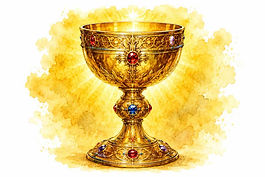
Holy Grail
The Holy Grail is the most sacred object in Arthurian legend, the cup of the Last Supper in which Joseph of Arimathea caught the blood of the crucified Christ, and the shining vessel that appeared to the Round Table at Camelot and drew the whole fellowship of knights out upon the greatest and most ruinous quest of the age. It is the mysterious graal of Chretien de Troyes, a dish of gold carried in candlelight through the hall of the wounded Fisher King, and the strange stone of Wolfram von Eschenbach, guarded by virgin knights on the mountain of salvation. It is the prize that only the purest knight could achieve, the reward of Galahad, the stainless son of Lancelot, who looked into the vessel and saw what no tongue may tell. It is the quest that ended the golden age, for the knights who rode after it never returned whole in fellowship or number. And it is the enduring symbol of every human search for the divine, the vessel that feeds the soul, heals the wounded land, and vanishes the moment it is grasped by the unworthy.