Greek Mythology List


Welcome to the Mythopouch list of Greek mythology entries! We also delve into the ancient history of Greece and the surrounding areas. From heroes to goddesses, places, monsters, artifacts, weapons, creatures and more - which will only grow over time. Mythopouch provides real-world information extracted from the original source material such as that from: Homer, Hesiod, Apollodorus, Ovid, Pausanias, Pindar, Aeschylus, Sophocles, Euripides, Hyginus, Diodorus Siculus and Apollonius of Rhodes. Words and stories carry powerful messages that were passed down from one generation to the next, many of which are still very applicable to modern times. Our unique imagery is meant to capture the imagination and ignite the magic mythology spark within us all. Our "token mark" coin symbol that is assigned to each record is a visual representation of the entity, for use in Mythopouch learning modules and games.
Learn - Earn - Play
Greek Entity Quick Index
Our current list of ancient Greek mythology and ancient history entities are here - which are growing day by day!
Search by using the:
-
"Search Mythology Records" function to browse all mythology records and blog pages;
-
Browse the visual cards with overviews by clicking "Go to Visual A-Z";
-
Or just browse and click the A-Z entries below....
See more list entries
Read Ancient Greek Insights
Click below to view our ancient Greek mythology blog article insights, where we delve into the current Mythopouch Tier regions and what we think you should know!


Greek Entity Card Index
See more card entries

Arachne
Arachne is the mortal weaver whose skill was so extraordinary that she challenged Athena, the goddess of wisdom and war, and was transformed into the first spider. She is the daughter of a dyer from Lydia whose tapestries were so lifelike that nymphs left their streams to watch her work. She is the proud craftswoman who declared that her skill surpassed even the gods, a boast that brought the grey-eyed goddess to her door in disguise. She is the weaver who depicted the gods' worst crimes on her loom, the rapes and deceptions of Zeus, the king of the gods who ruled from Olympus, and the other Olympians, the twelve deities who shared his throne. She is the girl who hung herself in shame after Athena destroyed her masterpiece, only to be saved by the goddess in the cruellest form of mercy, her body shrinking into a spider condemned to weave forever. And she is the origin of every arachnid on earth, the name that scientists still use for the class of eight-legged creatures that spin silk from their bodies.

Arae
The Arae, also written Arai, are the personified Curses of Greek poetic and tragic tradition, invoked when grief, injustice or anger finds expression in a malediction. They are closely connected with the Erinyes, the formidable goddesses of vengeance, but ancient authors did not always describe the relationship in the same way. In Aeschylus' Eumenides, the Erinyes themselves say that they are known beneath the earth as Curses, while Sophocles' Electra invokes a Curse and the Erinyes alongside one another. The Arae also appear in the intimate suffering of a daughter who calls upon the powers below against her father, as recorded in a surviving fragment of Bacchylides. Rather than a firmly defined sisterhood with its own separate genealogy, they reveal how the Greeks could imagine a spoken curse as something more enduring and formidable than the words alone.
Arcadia
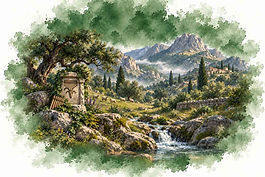
Arcadia is the mountain heart of the Peloponnese, a historical Greek region whose valleys and peaks became the setting for stories of shepherds, kings and gods. Its legendary name comes from Arcas, the son of Zeus and Callisto, whose family belongs to the traditions of the Great Bear and the Bear-Watcher. It is the country of Lycaon, the king whose violence at a sacred meal brought divine punishment, and of Hermes, born to Maia on Mount Cyllene before beginning his extraordinary first day's adventures. It is also closely associated with Pan, the goat-footed god whose music and presence belong to the wild spaces beyond the town. Yet Arcadia was never only an untouched pastoral paradise. Its cities, sanctuaries and communities had histories of their own, while ancient poets and later readers imagined the region in different ways. The real landscape and the literary ideal must be distinguished, even when they meet. Arcadia's power lies in that meeting: a recognisable country became a place where people explored the border between civilisation and the wild.

Areopagus
The Areopagus is the rocky hill beside the Acropolis where Athenian traditions placed trials of gods and heroes, and whose name also belonged to an important council and court. It is the Hill of Ares, associated with the trial of the god of war after he killed Halirrhothius, the son of Poseidon, for attacking his daughter Alcippe. It is the open-air setting where Aeschylus brings Orestes, the son of Agamemnon, before Athena to answer for the killing of his mother. There the Erinyes, the avenging goddesses of blood-guilt, confront the claim that one murder can justify another, and eventually accept an honoured place within Athens. It is also the historical council of former archons that heard serious homicide cases and retained important responsibilities after changes to Athenian government. In Christian tradition, it is associated with the apostle Paul's address about an unknown god. The Areopagus therefore belongs to several histories at once: a physical place, a civic institution and a landscape of stories about vengeance, judgement and reconciliation.

Ares
Ares is the Olympian god of war, the blood-stained son of Zeus and Hera who personifies the brutal, chaotic violence of the battlefield rather than the strategic cunning of Athena. He is the deity whom Homer calls "hateful," the most hated of all the gods among the immortals themselves, a figure of raw slaughter and indiscriminate destruction. He is the lover of Aphrodite, the goddess of love and beauty, whose adulterous affair with him was exposed when Hephaestus, the lame smith-god and her husband, trapped them in an invisible net and summoned all Olympus to witness their shame. He is the father of Phobos and Deimos, the spirits of panic and terror who rode with him into battle, and of Harmonia, the wife of the Theban prince Cadmus whose necklace would bring destruction to every generation that possessed it. He is the god who was wounded by the mortal hero Diomedes, aided by the goddess Athena, during the Trojan War, a humiliation that proved even a god of war could be driven from the field by a mortal armed with divine favour. And he is the deity whose cult was strongest among the Thracians, the warlike people of the northern Aegean, and whose sacred birds were the vultures that circled above every battlefield, a god who demanded blood and received it in rivers.

Arete
Arete is the queen of the Phaeacians whose favour Athena tells Odysseus to win before he dares ask the king of Scheria for passage home. She is the daughter of Rhexenor and the niece of her husband Alcinous, joining two branches of the Phaeacian royal family. She is the mother of Nausicaa and the royal children of Alcinous, honoured by her children, her husband and the people like a goddess. She is the woman who walks through the city settling the quarrels of men and women, giving her judgement the force of public order. She is the first person in the palace to recognise Odysseus's clothing as the work she and her maids had made, transforming a domestic detail into a question that opens the hero's identity and his tale. She is the listener beside Alcinous during the Odyssey's four-book narration of Odysseus's wanderings. She is the queen of Drepane who receives Medea's plea, protects her when the Colchians demand her surrender and gives her twelve attendants as a wedding gift. And she is the figure whose name, arete, means excellence or virtue, a name Homer lets her earn through her wisdom, honour and social authority.

Argonauts
The Argonauts are the company of heroes who sailed the Argo to Colchis in search of the Golden Fleece, bringing many of Greek mythology's best-known figures together in a single expedition. Their vessel was built by Argus with Athena's guidance and carried a speaking piece of sacred oak from Dodona. Their captain was Jason, the prince sent by Pelias on a mission intended to be impossible. Among the companions named in different accounts are Heracles, known also as Hercules, the musician Orpheus, the Dioscuri, Peleus, Telamon and Meleager. Their number and membership vary from one telling to another, although the ship is commonly imagined with fifty oars. They are the travellers who lost Heracles in Mysia, helped Phineus against the Harpies and passed the clashing rocks before reaching the kingdom of Aeëtes. With Medea's aid, they won the fleece and escaped, but the return voyage carried danger and blood-guilt as well as triumph. Their story is a major ancient quest narrative in which skill, companionship, divine assistance and the choices of outsiders matter as much as strength.

Argos
Argos is one of the ancient cities of the Peloponnese, a centre of the Argolid whose traditions trace its kings back to the river god Inachus. It is the city of Phoroneus, remembered as the ruler who gathered scattered people into a community, and of Argus, the son of Zeus and Niobe who gave the city his name. This royal namesake is distinct from Argus Panoptes, the hundred-eyed guardian of Io. It is the kingdom that Danaus gained after arriving from Egypt with fifty daughters, and where the Danaids killed their bridegrooms while Hypermnestra spared Lynceus. It is the home of Acrisius, the king who confined his daughter Danae to prevent a prophecy, and of Perseus, the child who survived that attempt and became the slayer of Medusa. It is a city associated with Diomedes in the Trojan tradition and with the worship of Hera in its surrounding countryside. And it is a historical community whose rivalry with Sparta helped shape the Peloponnese, a place where archaeological remains and stories of divine ancestry belong to different kinds of evidence.

Argos, Dog of Odysseus
Argos is Odysseus' hunting dog, the old hound who remains faithful through twenty years of war, wandering and neglect and who recognises his master immediately when no human on Ithaca can do so. He is the dog Odysseus bred and trained from puppyhood before leaving for Troy, a swift tracker intended to hunt wild goats, deer and hares across the island. He is the animal left behind before Odysseus could ever take him hunting, loved by his master but never used for the purpose for which he had been made. He is the neglected guardian of the palace, lying on heaps of mule and cattle dung outside the gates while the suitors consume Odysseus' household within. He is the infested, immobile old dog whose body has become a mirror of the ruined household around him. He is the only figure in the Odyssey who recognises Odysseus at once and without divine assistance, raising his head, pricking his ears, wagging his tail and dropping his ears in submission as the disguised king passes. He is the dog whose brief reunion with his master consists entirely of a look, a wagging tail and a tear Odysseus must wipe away in secret. He is the animal whose death Homer records in the epic language used for heroes: black death seized Argos when he had seen Odysseus in the twentieth year. And he is the most famous faithful dog of ancient Greek literature, a minor character in the plot of the Odyssey but one of the most emotionally powerful figures in Western epic.

Argus Panoptes
Argus Panoptes is the hundred-eyed giant who served the goddess Hera as the most vigilant watchman ever born, a creature so perfectly designed for guard duty that only a god could defeat him. He is the earth-born son of Gaia, the primordial goddess of the earth herself, or in some accounts the descendant of the river-god Inachus, a giant of immense strength who roamed the Peloponnese slaying monsters before he ever drew the gaze of the Olympian gods. He is the killer of Echidna, the half-woman half-serpent mother of monsters who made the roads unsafe for travellers, and the avenger of Apis, a murdered king whose death he punished with blood. He is the herdsman set by Hera to guard Io, the priestess of Hera whom Zeus, the king of the gods, had transformed into a white heifer, tethered to an olive tree where Argus's hundred eyes watched her day and night without rest. And he is the victim of Hermes, the messenger god who lulled every one of those eyes to sleep with music and stories before striking off his head, earning the epithet Argeiphontes, the Slayer of Argus, and leaving Hera to place the giant's eyes in the tail of her sacred peacock, where they gleam to this day.

Ariadne
Ariadne is the princess of Crete who gave Theseus the thread that led him through the Labyrinth and saved the lives of fourteen Athenian youths, only to be abandoned by the very hero she rescued on the island of Naxos. She is the daughter of King Minos, the lawgiver whose judgements were so just that he became a judge of the dead, and Pasiphae, the sorceress queen cursed by Poseidon, the god of the sea and earthquakes, to bear the Minotaur. She is the bride of Dionysus, the god of wine and ecstasy, who found her sleeping on the shore and made her his immortal wife on Olympus. She is the mistress of the Labyrinth, the only person who knew its secret besides the builder Daedalus, and the woman who turned that secret into a weapon against the monster that her own mother's curse had created. She is the wearer of the crown that became a constellation, the Corona Borealis, placed in the northern sky by the gods as a monument to her wedding. And she is the tragic figure whose love for a stranger cost her her home, her family, and her place in the world, only to win her a seat among the gods.

Arima
Arima is the uncertain mythological landscape associated with Echidna's subterranean dwelling and with Typhon among the Arimoi. Homer says Zeus lashes the earth around Typhoeus in the land of the Arimoi, while Hesiod places the ageless Echidna in a cave beneath the earth in Arima. The two passages were later read together, but neither gives a map that fixes the place securely. Ancient geographers proposed Cilicia, Syria, Lydia, Mysia and the volcanic island of Pithecussae, among other locations. Arima should therefore be treated as mobile mythic geography rather than a single historical country whose borders can be reconstructed.