Details
Region
Greek
Regional Information Additional (if applicable)

Athenian / Attic tradition
Category
Location
Historicity (actuality or factual truth of persons, events, and claims)
Historical
Gender
N/A
Time Period
Ancient Athenian hill and council; historical court active in the Archaic, Classical and Roman periods; legendary divine trials
Symbol
Ballot urn
Tags
greek, areopagus, athens, ares, orestes, athena, alcippe, homicide-court, eumenides
Introduction - Overview
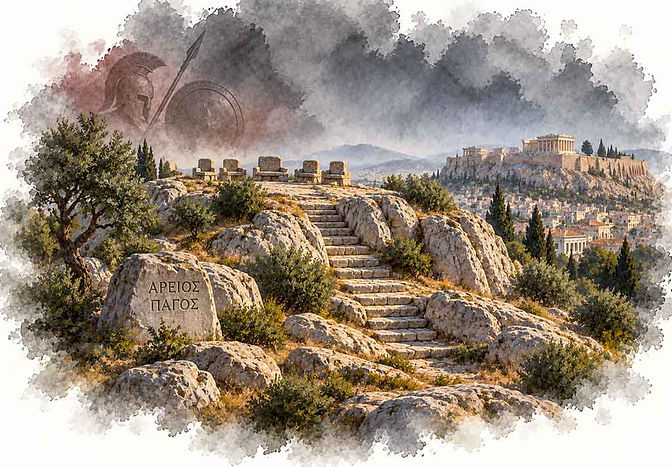
The Areopagus is the rocky hill beside the Acropolis where Athenian traditions placed trials of gods and heroes, and whose name also belonged to an important council and court. It is the Hill of Ares, associated with the trial of the god of war after he killed Halirrhothius, the son of Poseidon, for attacking his daughter Alcippe. It is the open-air setting where Aeschylus brings Orestes, the son of Agamemnon, before Athena to answer for the killing of his mother. There the Erinyes, the avenging goddesses of blood-guilt, confront the claim that one murder can justify another, and eventually accept an honoured place within Athens. It is also the historical council of former archons that heard serious homicide cases and retained important responsibilities after changes to Athenian government. In Christian tradition, it is associated with the apostle Paul's address about an unknown god. The Areopagus therefore belongs to several histories at once: a physical place, a civic institution and a landscape of stories about vengeance, judgement and reconciliation.
Gallery
Main Article - Who or What was...
Areopagus
The Areopagus is a rocky outcrop northwest of the Acropolis. Greek traditions connected its name with Ares, the god of war, and the killing of Halirrhothius. In Apollodorus's account, Halirrhothius, a son of Poseidon and the nymph Euryte, attempted to violate Alcippe, the daughter of Ares and Aglaurus. Ares discovered the attack and killed him. Poseidon brought an accusation against Ares, and the god was tried on the Areopagus before the twelve gods and acquitted. Pausanias likewise connects the hill's name with this case and points to the nearby spring associated with the attack. These accounts explain a sacred place through a divine trial; they do not establish a historical first homicide prosecution. The surviving passages do not give the detailed speeches, a specific spear stroke or Alcippe's courtroom testimony described in some modern retellings. The central conflict is nevertheless clear: the killing of an attacker creates a further demand for judgement between the families of two gods.
By the historical period, the name Areopagus also designated a council whose members were former archons, the magistrates who had held Athens' leading offices. Its members served for life, although its powers changed over time. Aristotle describes its jurisdiction over deliberate killing, intentional wounding and certain other offences, including fatal poisoning and arson. Homicide proceedings took place in the open air. Antiphon explains this practice in terms of avoiding a shared roof with someone accused of bloodshed and ritual pollution, rather than claiming that the sky itself washed guilt away. The proceedings used solemn oaths and restrictions intended to keep speeches focused on the charge. Pausanias describes the rough stones on which prosecutors and defendants stood, and the nearby sanctuary of the Semnai Theai, the August Goddesses whom he identifies with the Erinyes. The sanctuary and the court were closely associated, but the goddesses' name was not an alternative name for the hill. Legal judgement and religious responsibility met in the same landscape.
The defining dramatic episode is the trial of Orestes in Aeschylus's Eumenides, produced in 458 BCE. Orestes has killed Clytemnestra, his mother, to avenge her killing of Agamemnon, his father. The Erinyes pursue him for shedding kindred blood until he seeks protection from Athena at Athens. Unwilling to settle the case alone, Athena selects citizen judges and establishes a court that she declares will endure. The Erinyes prosecute, while Apollo defends Orestes as a man who acted under his command. Apollo's argument that the father is the true parent, and Athena's declaration that she favours the father's side, belong to the play's ancient assumptions about family and gender; they are not biological facts. Athena announces her vote for Orestes and states that an equal division will acquit him. When the ballots are counted, the totals are equal and Orestes is released. The text should therefore not be simplified into a modern judge casting an extra vote after a completed tie. The Erinyes threaten Athens, but Athena persuades them to accept honour, a sanctuary and a protective role. Their reconciliation is often described as their becoming the Eumenides, the Kindly Ones: vengeance is not simply destroyed, but given a place within civic order.
The historical council also stood at the centre of disputes over Athenian government. Its early development is not fully recoverable, but it held substantial authority before the democratic reforms associated with Ephialtes in 462/461 BCE. Aristotle reports that responsibilities were transferred from the Areopagus to the Council of Five Hundred, the Assembly and the popular courts. Its homicide jurisdiction survived these changes. Ephialtes was subsequently murdered, a reminder that institutional reform could be accompanied by violence rather than a tidy transfer of authority. Aeschylus presented the Eumenides only a few years later. Its foundation story gives lasting dignity to the surviving court while asking how fear, respect for law and citizen judgement might coexist. The relation between the play and contemporary reform is a matter of interpretation; the drama is not a straightforward transcript of a political programme. Its force comes from placing a family blood feud before a public institution whose authority the audience already knew.
The Areopagus continued to be remembered in the Roman period. Acts of the Apostles describes Paul being brought to the Areopagus in Athens, where he addresses an audience about an altar dedicated to an unknown god and speaks of resurrection. The passage places the episode before the Areopagus, but the name can refer to the council as well as its traditional hill; it should not be treated as a precise record of a trial on a particular rock. Nor does the passage itself establish the exact year 51 CE or make this the first encounter between Greek philosophy and Christianity. In the second century CE, Pausanias described the Hill of Ares, the trials associated with it and the sanctuary of the August Goddesses nearby. His account joins the visible landscape to the stories that explained it. The hill's significance rests on that combination: it was both an actual Athenian place and a setting in which successive communities considered accusation, responsibility and the possibility of reconciliation.
Summary
The Areopagus endures as a historical Athenian hill and institution surrounded by stories of divine and human judgement. The acquittal of Ares, the trial of Orestes, the honoured place of the Erinyes and the address of Paul gave it different meanings across time. Its history also includes changes to the powers of the council and the continued hearing of homicide cases. Myth and civic practice should not be confused, but their meeting on this rocky outcrop remains powerful. The Areopagus invites reflection on how communities turn demands for vengeance into proceedings that require accusation, response and judgement.
Now enter the Mythopouch World!
You’ve discovered:
Areopagus
From Myth to Game
Join to access FREE real-world mythology "Learn Quests" and "Courses". Sign up to the newsletter for new releases, game updates, insider news, and more as Mythopouch brings real mythology to life. EARN the right to purchase an offline board game by completing FREE modules.


It's FREE to join as a MEMBER!
Not ready to join? Get the newsletter instead below


Looking for others?
Click into the field below to search, or click the icon to go to full page search function!

Looking for Mythology Insights?


Click below to view our mythology blog article insights, where we delve into the current Mythopouch Tier regions, and what we think you should know!
Sources & Retellings
Explore the original mythological Source texts (most from over 75 years ago, some as translated, possibly with mature content) and Mythopouch's source Retellings (a modern retelling also suitable for 15+) connected to this mythological entity. We are growing this resource and will link these in the future; for now, check the References below, then find the Sources or Retellings on those pages!


References
Validation References:
- Apollodorus, Bibliotheca 3.14.2: Alcippe, Halirrhothius and the acquittal of Ares
- https://topostext.org/work/150
- Pausanias, Description of Greece 1.21.4 and 1.28.5-6: hill, trials and the August Goddesses
- https://www.theoi.com/Text/Pausanias1B.html
- Aeschylus, Eumenides 681-710, 734-753 and the concluding reconciliation: court, equal votes and the Erinyes
- https://www.theoi.com/Text/AeschylusEumenides.html
- Aristotle, Athenian Constitution 25: the reforms associated with Ephialtes
- https://classics.mit.edu/Aristotle/athenian_const.2.2.html
- Aristotle, Athenian Constitution 57: homicide jurisdiction and procedure
- https://classics.mit.edu/Aristotle/athenian_const.3.3.html
- Antiphon, On the Murder of Herodes 5.11: open-air homicide trials and ritual pollution
- https://www.perseus.tufts.edu/hopper/text?doc=Perseus%3Atext%3A1999.01.0020%3Aspeech%3D5%3Asection%3D11
- Acts 17.19-34: Paul before the Areopagus
- https://www.biblegateway.com/passage/?search=Acts+17%3A19-34&version=NRSVUE
Cultural Context Notice
Mythology developed across different cultures, periods and traditions, and there is rarely one universally accepted version of a story. Mythopouch approaches these traditions with respect while remaining faithful to the complexity of the surviving material. Retellings and educational content may interpret or adapt historical sources, but are not presented as definitive accounts of any culture, religion or belief system.