Egyptian Mythology List


Welcome to the Mythopouch list of Ancient Egyptian mythology entries! We also delve into the ancient history of Egypt, the Nile Valley and the wider world shaped by its gods, temples, tombs and pharaohs. From gods, goddesses, queens, pharaohs and sacred animals to monsters, symbols, artefacts, creatures, places, funerary objects and more - this collection will only grow over time. Mythopouch provides real-world information extracted from original source material and ancient records such as the Pyramid Texts, Coffin Texts, Book of the Dead, temple and tomb inscriptions, the Rosetta Stone, the Memphis Decree, the Metternich Stele, and classical accounts such as Plutarch's writings on Isis and Osiris. Ancient Egyptian words, symbols and stories carried powerful messages about life, death, truth, balance, magic, kingship, resurrection and the journey into the afterlife - many of which still resonate deeply in modern times. Our unique imagery is meant to capture the imagination and ignite the magic mythology spark within us all. Our "token mark" coin symbol that is assigned to each record is a visual representation of the entity, for use in Mythopouch learning modules and games.
"Nothing is given, everything is earned" at Mythopouch!
Learn - Earn - Play
Ancient Egyptian Entity Quick Index
Our current list of ancient Egyptian mythology and ancient history entities are here - which are growing day by day!
Search by using the:
-
"Search Mythology Records" function to browse all mythology records and blog pages;
-
Browse the visual cards with overviews by clicking "Go to Visual A-Z";
-
Or just browse and click the A-Z entries below....
See more list entries
Read Ancient Egyptian Insights
Click below to view our ancient Egyptian mythology blog article insights, where we delve into the current Mythopouch Tier regions and what we think you should know!


Egypt Entity Card Index
See more card entries
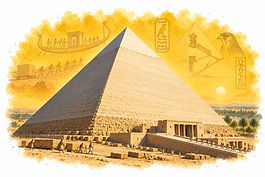
Great Pyramid
The Great Pyramid is the royal tomb that Khufu built at Giza in the Fourth Dynasty, and the surviving monument of the ancient Seven Wonders. Known to the Egyptians as Akhet-Khufu, the Horizon of Khufu, it rose above the Nile valley in carefully arranged courses of stone, originally enclosed in fine white limestone. It is the pyramid of the Grand Gallery, the granite King's Chamber and the coffer whose occupant has not been securely identified among surviving remains. It is a monument to surveying, quarrying, transport and the organisation of labour on a vast scale. Its scientific investigation has continued into the age of particle detectors, including the discovery of a large internal void in 2017. The Great Pyramid remains astonishing not because its construction lies beyond human ability, but because it preserves so powerful an example of what an ancient society could accomplish.

Hapi
Hapi is the god of the inundation, the annual miracle of the rising Nile that turned a rainless desert valley into the most fertile farmland on earth, the bringer of water and black silt without which Egypt simply did not exist. He is the plump, blue-skinned figure of abundance, his body heavy-breasted and full-bellied like a woman great with child, his head crowned with the papyrus of the north or the lotus of the south, for he belonged to both lands at once. He is the paired giant who kneels at the base of every pharaoh's throne, tying the plants of Upper and Lower Egypt into a single knot, the binding of the Two Lands. He is the god who rose each summer from the hidden caverns of Qerti at the First Cataract, measured cubit by cubit on the Nilometers, too little meaning famine and too much meaning ruin. He is the flood heralded by the star Sirius and by the tear that Isis, the queen of magic, let fall into the river for her murdered husband. He is the god no temple could hold and no myth could trap, because his myth was the year itself. And he is the grandfather of every river god ever carved, from the Nile-god statues of Rome to the river spirits of every land fed by a flood.
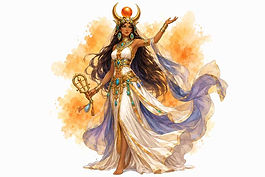
Hathor
Hathor stands as one of the most ancient, widely worshipped, and multifaceted goddesses in the Egyptian pantheon - a celestial deity of extraordinary scope whose domains encompass love, beauty, motherhood, music, dance, joy, sexuality, fertility, and foreign lands. Her Egyptian name, Het-Heru, meaning "House of Horus," establishes her fundamental connection to the sky god Horus, whom she nurtured and protected. Hathor is most commonly depicted as a woman bearing the horns of a cow with a solar disc nestled between them, as a full cow, or as a woman with cow's ears - iconography that emphasizes her nurturing, maternal, and celestial qualities. Her worship extended from the Predynastic period through the end of Egyptian paganism, with major cult centers at Dendera, Thebes, and Memphis, and her influence permeated every stratum of Egyptian society from pharaohs to common laborers.
One of Hathor's most distinctive and enigmatic aspects is the tradition of the Seven Hathors - seven goddess-forms who appear together to pronounce destiny upon a newborn child, determining the manner of their death and the course of their life. This fatalistic function links Hathor to the deepest mysteries of human existence, complementing her more celebrated roles as a goddess of pleasure and celebration. In the afterlife, Hathor welcomed the justified dead into the next world, offering them refreshment and protection as the "Lady of the West," the direction associated with the setting sun and the realm of Osiris. Her dual nature encompasses both ecstatic joy and inexorable fate, making her one of the most complex theological figures in Egyptian religion.

Hatshepsut
Hatshepsut is the woman who made herself pharaoh, the queen who set aside the title of regent, put on the kilt and false beard of a king, and ruled Egypt for twenty years as though the gods had always intended it. She is the daughter of Thutmose I, the warrior who carried Egypt's armies to the river Euphrates, and the stepmother of Thutmose III, the greatest conqueror Egypt ever produced, yet for two decades the throne, the treasury, and the empire were hers alone. She is the builder of Deir el-Bahari, the terraced temple against the golden cliffs of Thebes that many call the most beautiful building of the ancient world. She is the sponsor of the voyage to Punt, the fabled land of incense, whose ships came home laden with myrrh trees, gold, ivory, and leopard skins. She is the raiser of the tallest obelisks of her age, single shafts of granite tipped with gold that caught the first light of dawn at Karnak. She is the king whose statues were smashed and whose name was chiselled from her own temple walls twenty years after her death, buried in a pit and forgotten for three thousand years. And she is the mummy identified in the twenty-first century by a single tooth, the woman who was king, restored at last to her own name.
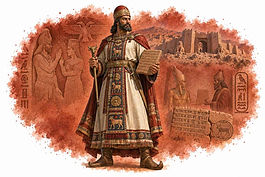
Hattusili III
Hattusili III is the Hittite king who seized a throne and then worked to make his rivals recognise his right to keep it. He ruled Hatti, the Bronze Age kingdom centred in Anatolia, while Ramesses II ruled Egypt. He is the authorial voice of the Apology, a royal defence that turns a disputed succession into a story of divine protection. He is the husband of Puduhepa, a queen whose correspondence and religious authority helped shape the life of the court. And he is the ruler who concluded the celebrated Egyptian-Hittite treaty, transforming a dangerous rivalry into an alliance. His story joins warfare, family conflict and diplomacy, but its most revealing feature is the effort to explain power: the king wanted his subjects, his gods and the other great rulers to accept a crown he had taken from his nephew.
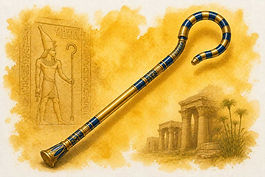
Heka Crook
The Heka Crook is the shepherd's staff that became the most enduring symbol of kingship in ancient Egypt, the hooked sceptre that pharaohs held crossed over their chests with the flail for more than three thousand years as proof that they were shepherds of their people and not merely rulers over them. It is the crook whose very name, heka, is the Egyptian word for ruler itself, the same root that gives us Hyksos, the Greek name for the foreign kings who seized the Delta, literally the heka-khasut, the rulers of foreign lands. It is the staff that predates the pyramids, with the earliest example carved from limestone and found in a tomb at Abydos from the Gerzeh culture around 3500 BCE, centuries before a single stone of Giza was laid. It is the sceptre that began as the attribute of Andjety, an early god of agriculture worshipped at Busiris in the Delta, and was absorbed into Osiris, the murdered and resurrected king of the dead, so that every pharaoh who held the crook claimed kinship with the god who had conquered death itself. It is the staff that only Tutankhamun's tomb has preserved in its original royal form, a heavy bronze rod sheathed in alternating stripes of gold, blue glass, and obsidian, the only royal crook and flail on earth that a living king once gripped. And it is the ancestor of the Christian bishop's crosier, the hooked staff that pastors still carry today, the shepherd's crook outlasting the empire that made it divine.

Heliopolis
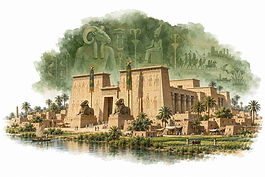
Heliopolis is the City of the Sun, the Greek name for the Egyptian settlement of Iunu. It was a great centre of solar worship, where the powers of Ra and Atum were connected with the beginning and renewal of the world. It is the home of the Heliopolitan Ennead, the family of nine gods whose relationships helped explain the earth, the sky and the struggle over kingship. It is associated with the Benben Stone, sacred images of first creation and obelisks that made royal devotion visible in granite. It is also the biblical On and the source of monuments later moved to other cities. Much of its ancient landscape lies beneath modern Cairo, but its influence survives in religious texts, royal names and stones that travelled far beyond Egypt.
Herakleopolis
Herakleopolis is the Egyptian city whose name became attached to an age of divided kingship. Known in Egyptian as Henen-nesut, often translated as the House of the Royal Child, it was the royal centre of the Ninth and Tenth Dynasties. It is the city of the ram-headed Heryshaf, the god whose association with Heracles helped shape its Greek name. It is also a setting remembered through Egyptian literature: the advice offered to Merikare and the eloquent appeals of a wronged countryman place questions of justice before rulers and officials. The city lost its struggle with Thebes, but neither its sacred life nor its literary reputation ended with that defeat. Its story brings political rivalry, temple worship and the persuasive power of words into the same landscape.
Hetepheres I
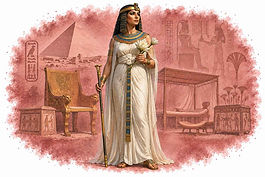
Hetepheres I is the queen whose burial equipment survived more clearly than the story of her life. She was the mother of Khufu, builder of the Great Pyramid, and is generally identified as the wife of Sneferu. Her funerary deposit at Giza preserves the luxury of an early Fourth Dynasty royal household: gilded furniture, a carrying chair, jewellery and equipment intended for the afterlife. Yet the stone sarcophagus found with those objects was empty when excavators opened it. The contrast has made her tomb one of the most discussed discoveries of the Old Kingdom. Hetepheres is remembered not through a surviving autobiography, but through carefully made objects, royal relationships and the unanswered question of what happened to the woman for whom the burial was prepared.

Hieracosphinx
The hieracosphinx is the Egyptian sphinx with the head of a hawk or falcon, distinguished from the human-headed androsphinx and the ram-headed criosphinx. The term was coined by the Greek historian Herodotus, who needed a classification for the hawk-headed lion-bodied creatures he observed in Egyptian temple art. In Egyptian theology, the hieracosphinx was intimately associated with the sun god Ra-Horakhty ("Ra-Horus of the Horizons") and with Horus the Elder (Haroeris), making it a creature of intense solar and royal significance.
The hieracosphinx represents perhaps the most celestial of the three sphinx types. Where the androsphinx embodied the earthly pharaoh and the criosphinx represented Amun's creative fertility, the hieracosphinx channeled the sky god Horus and the solar deity Ra - powers of heavenly authority, divine sight, and cosmic order.

Hierakonpolis
Hierakonpolis is the City of the Falcon, the Greek name for the Egyptian settlement of Nekhen. It was one of the great centres of Upper Egypt before and during the emergence of the unified state. It is associated with Horus, the falcon god whose presence became inseparable from the image of kingship. It is the place where the Narmer Palette and the Scorpion Macehead were recovered, objects that show how rulers pictured authority through ceremony and force. It is also a landscape of settlements, workshops, early painted burial scenes and richly supplied graves. Hierakonpolis matters not because every Egyptian institution can be assigned to one birthplace, but because its remains bring us close to the communities in which royal power was becoming visible.
Horemakhet
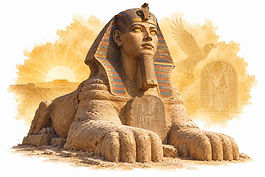
Horemakhet, 'Horus in the Horizon', is the New Kingdom divine identity of the Great Sphinx of Giza. The physical Sphinx is far older, generally dated to the Fourth Dynasty, but its Old Kingdom name is unknown and evidence for an active Sphinx cult at that time is limited. By the Eighteenth Dynasty the monument was worshipped as Horemakhet, a solar and royal god whose cult transformed the ancient statue into a focus of kingship, pilgrimage and personal devotion. The Dream Stela of Thutmose IV gives the most famous statement of that theology: the Sphinx speaks as Horemakhet-Khepri-Ra-Atum and promises the prince kingship if he clears away the sand surrounding the divine body. A separate Horemakhet record is therefore useful even though Mythopouch also has a Sphinx record, because this page concerns the deity and New Kingdom cult rather than the monument's entire architectural history.