Egyptian
Was Sceptre
Name in Non-English, or Alternative Name/s
Was Scepter, Tcham-Scepter, W3s Scepter
Also known as, and/or Titles and Roles
The Staff of Dominion, the Sceptre of Power, the Serpent Staff, the Forked Staff, the Staff of Set, the Pillar of the Sky

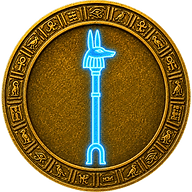
Mythopouch artistic interpretation
Details
Region
Egyptian
Regional Information Additional (if applicable)
Ancient Egypt
Category
Artifact/Object/Weapon
Historicity (actuality or factual truth of persons, events, and claims)
Historical
Gender
N/A
Time Period
c. 3100 BCE - 395 CE (First Dynasty to Roman period); literary tradition c. 2400-1550 BCE (Pyramid Texts to Book of the Dead)
Symbol
The long staff with a stylised animal head and a forked base, held by gods and pharaohs as the visible sign of dominion over chaos
Tags
egyptian, was-sceptre, artefact, set, osiris, anubis, maat, pyramid-texts, coffin-texts, pharaoh, power
Introduction - Overview
The Was Sceptre is the most enduring symbol of power in ancient Egypt, the staff that gods and pharaohs carried for more than three thousand years as proof that they held dominion over chaos and preserved the cosmic order called ma'at. It is the sceptre whose very name, was, is the Egyptian hieroglyph for power and dominion, a word that appears in royal names and titles from the First Dynasty to the Roman period. It is the staff with the forked base that some scholars believe was originally a dried bull's penis, a visceral symbol of masculine potency transformed by millennia of ritual use into an emblem of divine authority. It is the sceptre held by Osiris, the god of the afterlife, as he judges the dead; by Anubis, the jackal-headed god of mummification, as he guides souls through the underworld; by Set, the god of storms and chaos, as he defends the solar barque of Ra against the serpent Apep each night. It is the staff that appears in the Pyramid Texts of King Unas, carved into the walls of his pyramid at Saqqara around 2400 BCE, where the Praise-serpent is said to rest upon its sceptre and the king is promised that his Was shall be at the head of the living. And it is the sceptre that, together with the ankh of life and the djed pillar of stability, forms the sacred trinity of Egyptian symbols, the three emblems that framed every temple relief and adorned every royal tomb, telling the illiterate farmer in the fields and the embalmed king in his sarcophagus the same story: that power, life, and stability are the foundations of the ordered world.
Gallery
Main Article - Who or What was...
Was Sceptre
The Was Sceptre first appears in the archaeological record during the First Dynasty of Egypt, around 3100 BCE, in the time of King Narmer, the unifier of Upper and Lower Egypt whose palette shows him smiting his enemies with a mace. The earliest sceptres were probably functional objects - shepherd's crooks, walking staffs, tent poles, or fighting canes - that acquired sacred meaning through their association with the gods and kings who carried them. By the Old Kingdom, the period of pyramid building that lasted from 2686 to 2181 BCE, the Was Sceptre had become firmly established as a symbol of divine kingship, and pharaohs, regarded as living gods, adopted it as part of their regalia to underscore their authority over both the earthly and spiritual realms.
The design of the Was Sceptre is unmistakable. It consists of a long straight shaft, a stylised animal head at the top, and a forked or bifurcated base. The animal head is usually identified with the Set animal, the mysterious long-snouted, big-eared creature associated with the god Set, though some representations show a jackal head linking the sceptre to Anubis. The forked base has been the subject of intense scholarly debate. The Egyptologists Calvin Schwabe, Joyce Adams, and Carleton Hodge proposed in 1982 that the Was, together with the ankh and the djed pillar, was derived from the anatomy of the bull, the most sacred animal in ancient Egypt. In their hypothesis, the ankh represents a thoracic vertebra, the djed the sacrum and lumbar vertebrae, and the Was the dried penis of the bull, a symbol of semen, life-force, and masculine power. Richard Lobban, an anthropologist, extended this theory in 1997 and 1999, arguing that the Was Sceptre originated in African bull cults and that its forked base represents the split tip of the organ. Whether or not this anatomical theory is correct, it captures something essential about the sceptre's meaning: it is a symbol of generative power, of the force that creates and sustains order.
The Was Sceptre is inseparable from the concept of ma'at, the divine order that balances chaos in Egyptian thought. Ma'at was not merely justice or truth but the very structure of the cosmos, the pattern that kept the sun rising, the Nile flooding, and the stars turning in their courses. The opposite of ma'at was isfet, chaos, disorder, and lies, embodied in the serpent Apep who tried each night to swallow the sun god Ra and plunge the world into eternal darkness. The Was Sceptre was the weapon and the guarantee of ma'at. In temple reliefs, the pharaoh is shown holding the Was in one hand and smiting foreign enemies or chaotic forces with the other, the staff a visible sign that his power came from the gods and was exercised on their behalf. In the Book of the Dead, the Was appears as one of the amulets placed with the deceased to ensure their power and protection in the afterlife, and in some depictions the forked base is shown pinning the head of a malevolent serpent, the sceptre literally crushing chaos beneath its feet.
The Was Sceptre enters written literature for the first time in the Pyramid Texts, the oldest known religious texts in the world, carved into the walls of the pyramids of the Fifth and Sixth Dynasties at Saqqara between 2400 and 2300 BCE. In the Pyramid Texts of King Unas, the last king of the Fifth Dynasty, the Was appears in Utterance 254, where the text declares that "the Praise-serpent is on its scepter, the Tefnut of Unas, she who supports Shu." Tefnut and Shu are the first two gods born from the creator Atum, the goddess of moisture and the god of air, and their embrace holds up the sky. The Was Sceptre here is not merely a symbol of power but a cosmic pillar, the staff upon which the serpent of divine praise rests and through which the king connects heaven and earth. In other Pyramid Text utterances, the king is promised that his Was shall be at the head of the living and his staff at the head of the blessed dead, the sceptre thus bridging the two realms.
The Coffin Texts, which developed from the Pyramid Texts during the First Intermediate Period and Middle Kingdom and were painted on the coffins of nobles and officials, expanded the Was Sceptre's role in the afterlife. In Coffin Text Spell 885, the grasping of a serpent or other threatening animal is described as a way for the deity or his priestly representative to exert mastery over dangerous forces, rendering them harmless to the holder but dangerous weapons against enemies. The Was Sceptre, sometimes depicted wrapped with a serpent, embodies this principle: the serpent around the staff is the benevolent power of the god, while the forked base pins the malevolent serpent of chaos to the ground. This duality - the same symbol representing both the power that heals and the power that destroys - is characteristic of Egyptian religious thought, where divine authority is always double-edged.
In the New Kingdom, from 1570 to 1069 BCE, the Was Sceptre became one of the most common motifs in temple and tomb art. At Karnak and Luxor, the great temple complexes of Thebes, gods and pharaohs are shown holding the Was in processions and rituals, the staff a constant presence in the visual language of power. The sceptre was often combined with the ankh and the djed in a single composite symbol, the three emblems together representing the totality of divine blessing: life, stability, and dominion. In the tomb of Tutankhamun, discovered by Howard Carter in 1922, a gilded wooden Was Sceptre was found among the king's funerary equipment, proof that even a boy king who reigned for only ten years was buried with the symbol of eternal power.
The Was Sceptre also had a linguistic life beyond its physical form. The hieroglyph was, a picture of the sceptre itself, was used to write the word for power and dominion, and it appears in royal titulary throughout Egyptian history. The city of Waset, the Egyptian name for Thebes and modern Luxor, derives its name from the same root, meaning "the Sceptre City" or "the City of Dominion." This linguistic connection reveals how deeply the symbol was woven into the fabric of Egyptian civilisation: the sceptre was not merely an object carried by kings but the name of the kingdom's greatest city, the word for power itself.
Summary
The Was Sceptre endures as the most ancient and persistent symbol of authority in Egyptian civilisation, the staff that carried the meaning of power for three millennia and outlasted every dynasty that wielded it. From the First Dynasty tombs to the Pyramid Texts of Unas, from the temples of Karnak to the tomb of Tutankhamun, the sceptre tells a story about the Egyptian understanding of rule: that power is not mere force but the preservation of cosmic order, the dominion that keeps chaos at bay. It is the reminder that the oldest symbols are often the most visceral, and that the staff that pins the serpent to the earth may have begun as something far more primal than a king's ornament.
Now enter the Mythopouch World!
You’ve discovered:
Was Sceptre
From Myth to Game
Join to access FREE real-world mythology "Learn Quests" and "Courses". Sign up to the newsletter for new releases, game updates, insider news, and more as Mythopouch brings real mythology to life. EARN the right to purchase an offline board game by completing FREE modules.


It's FREE to join as a MEMBER!
Not ready to join? Get the newsletter instead below


Looking for others?
Click into the field below to search, or click the icon to go to full page search function!

Looking for Mythology Insights?


Click below to view our mythology blog article insights, where we delve into the current Mythopouch Tier regions, and what we think you should know!
Sources & Retellings
Explore the original mythological Source texts (most from over 75 years ago, some as translated, possibly with mature content) and Mythopouch's source Retellings (a modern retelling also suitable for 15+) connected to this mythological entity. We are growing this resource and will link these in the future; for now, check the References below, then find the Sources or Retellings on those pages!


References
Validation References:
- Pyramid Texts of King Unas, c. 2400-2300 BCE, Pyramid of Unas at Saqqara - Utterance 254: "The Praise-serpent is on its scepter, the Tefnut of Unas"; the Was as cosmic pillar
- Coffin Texts, c. 2134-2040 BCE (Middle Kingdom) - Spell 885: grasping serpents as mastery over chaos; the Was as benevolent power against malevolent forces
- Book of the Dead, c. 1550-1070 BCE (New Kingdom) - the Was as funerary amulet ensuring power and protection in the afterlife
- Faulkner, Raymond O., The Ancient Egyptian Pyramid Texts Translated into English (Clarendon Press, 1969) - standard English translation of the Pyramid Texts including the Was references
- Allen, James P., The Ancient Egyptian Pyramid Texts (Society of Biblical Literature, 2005) - revised scholarly translation with analysis of the Was in royal afterlife ritual
- Wilkinson, Richard H., Symbol and Magic in Egyptian Art (Thames and Hudson, 1994) - analysis of the Was as symbol of power and its combination with ankh and djed in temple and tomb art
- Wilkinson, Richard H., Reading Egyptian Art: A Hieroglyphic Guide to Ancient Egyptian Painting and Sculpture (Thames and Hudson, 1992) - the Was hieroglyph and its use in royal iconography
- Schwabe, Calvin W., Joyce Adams, and Carleton T. Hodge, "Egyptian Beliefs about the Bull's Spine: An Anatomical Origin for Ankh," Anthropological Linguistics 24, no. 4 (1982): 445-79 - the anatomical hypothesis linking Was, ankh, and djed to bull anatomy
- Lobban, Richard, "A Solution to the Mystery of Was Scepter of Ancient Egypt and Nubia," KMT: A Modern Journal of Ancient Egypt 10/3 (1999): 68-77 - extended analysis of the Was origin in African bull cults
- Lobban, R.A. and M. Sprague, "Bulls and the W3s Sceptre in Ancient Egypt and Sudan," Anthrozoos 10 (1997): 14-22 - comparative study of bull symbolism and the Was across Egypt and Nubia
- Te Velde, H., Seth, God of Confusion: A Study of His Role in Egyptian Mythology and Religion (Brill, 1967) - analysis of the Set animal and its connection to the Was Sceptre
- Wilkinson, Richard H., The Complete Gods and Goddesses of Ancient Egypt (Thames and Hudson, 2003) - overview of the gods associated with the Was Sceptre including Osiris, Anubis, and Set
Cultural Context Notice
Mythology developed across different cultures, periods and traditions, and there is rarely one universally accepted version of a story. Mythopouch approaches these traditions with respect while remaining faithful to the complexity of the surviving material. Retellings and educational content may interpret or adapt historical sources, but are not presented as definitive accounts of any culture, religion or belief system.