Egyptian Mythology List


Welcome to the Mythopouch list of Ancient Egyptian mythology entries! We also delve into the ancient history of Egypt, the Nile Valley and the wider world shaped by its gods, temples, tombs and pharaohs. From gods, goddesses, queens, pharaohs and sacred animals to monsters, symbols, artefacts, creatures, places, funerary objects and more - this collection will only grow over time. Mythopouch provides real-world information extracted from original source material and ancient records such as the Pyramid Texts, Coffin Texts, Book of the Dead, temple and tomb inscriptions, the Rosetta Stone, the Memphis Decree, the Metternich Stele, and classical accounts such as Plutarch's writings on Isis and Osiris. Ancient Egyptian words, symbols and stories carried powerful messages about life, death, truth, balance, magic, kingship, resurrection and the journey into the afterlife - many of which still resonate deeply in modern times. Our unique imagery is meant to capture the imagination and ignite the magic mythology spark within us all. Our "token mark" coin symbol that is assigned to each record is a visual representation of the entity, for use in Mythopouch learning modules and games.
"Nothing is given, everything is earned" at Mythopouch!
Learn - Earn - Play
Ancient Egyptian Entity Quick Index
Our current list of ancient Egyptian mythology and ancient history entities are here - which are growing day by day!
Search by using the:
-
"Search Mythology Records" function to browse all mythology records and blog pages;
-
Browse the visual cards with overviews by clicking "Go to Visual A-Z";
-
Or just browse and click the A-Z entries below....
See more list entries
Read Ancient Egyptian Insights
Click below to view our ancient Egyptian mythology blog article insights, where we delve into the current Mythopouch Tier regions and what we think you should know!


Egypt Entity Card Index
See more card entries

Duat
The Duat is the underworld of ancient Egypt, the vast hidden realm beneath the earth and within the night sky where the dead go and the sun itself travels every night. It is the kingdom of Osiris, the murdered and risen god who rules the dead from his hall of judgement, where every human heart is weighed against the feather of truth. It is the road of twelve hours and twelve gates, the path the sun god Ra sails each night in his barque, fighting the chaos serpent Apep in the dark so that dawn can come. It holds both paradise and annihilation: the Field of Reeds, the green mirror of Egypt where the blessed live forever, and the Lake of Fire, where the damned are burned, beheaded, and erased. It is the place where the sun god merges with the corpse of Osiris at the deepest hour of night and is reborn as the scarab of dawn. And it is the best mapped afterlife of the ancient world, for the Egyptians painted its guidebooks on the walls of their royal tombs.

Elephantine
Elephantine is the island of Egypt's southern threshold, a settlement near the First Cataract where river travel, frontier administration and sacred tradition met. Known to the ancient Egyptians as Abu, it stood opposite the place now called Aswan and linked the Nile valley with routes into Nubia. It is the home of the divine group formed by Khnum, Satis and Anuket, whose worship connected creation and protection with the life-giving waters of the Nile. It is the island where nilometers turned the height of the river into measurable information, and where surviving letters and contracts reveal the lives of people from different cultural and religious communities. Its history is not the story of one temple or one population, but of a place repeatedly reshaped by the people who crossed, defended and inhabited the frontier.

Ernest Alfred Wallis Budge (Sir)
Sir E. A. Wallis Budge was a British orientalist, philologist, museum curator and prolific writer whose editions and translations made ancient Egyptian and Near Eastern texts widely available to English-language readers. He began studying Hebrew and Syriac while working for W. H. Smith, then studied at Christ's College, Cambridge from 1878 to 1883 before joining the British Museum. In 1894 he became Keeper of Egyptian and Assyrian Antiquities, a position he held until 1924. Budge published more than one hundred monographs and became especially famous for his editions of funerary texts, including the Papyrus of Ani and works marketed in English as the Book of the Dead. His scholarship is now substantially outdated and his collecting practices belong to an imperial museum system that modern institutions recognise as unacceptable by current legal and ethical standards. He remains important to Mythopouch because many public-domain English source witnesses used in early Egyptology and still encountered by general readers bear his name.

Esna
Esna is the Nile town whose ancient sanctuary preserves a sky of gods, stars and brilliant colour beneath the level of the modern streets. Known to Greek speakers as Latopolis, it is especially associated with the temple of Khnum, the ram-headed creator. The surviving columned entrance hall belongs to the final centuries of Egyptian temple building under Ptolemaic and Roman rule. It is the place where floral capitals rise beneath an astronomical ceiling, where hymns and festival instructions cover the stone, and where recent conservation has revealed painted details long concealed by soot. Esna is not the site of Egypt's last dated hieroglyphic inscription, but it preserves an exceptionally rich late temple corpus that shows how much Egyptian religious learning continued to flourish under foreign rulers.

Euphrates
The Euphrates is the great river of Mesopotamia whose waters became both a foundation of civilisation and a boundary in the ancient imagination. In the Babylonian creation epic, Marduk releases it and the Tigris from the eyes of the defeated Tiamat. In Genesis, it is the fourth river named in the account of Eden. It is the waterway that fed cities and canals, passed through Babylon, and marked a distant objective for Egyptian kings campaigning in Syria. It is the river that Herodotus placed at the centre of his account of Cyrus's capture of Babylon, and the frontier crossed by armies confronting the powers of the east. Its history belongs chiefly to Mesopotamia, but its Egyptian connections reveal how far the ambitions of the pharaohs could reach beyond the Nile.

Eye of Horus (Wedjat)
The Eye of Horus is the most famous amulet of ancient Egypt, the painted and carved eye that protected the living, healed the sick, and watched over the dead for three thousand years. It is the eye that was torn from the face of the falcon god Horus by Seth, the red god of chaos, during their battle for the throne of Egypt, and made whole again by Thoth, the ibis-headed god of wisdom. Its name, wedjat, means the Whole One, for the amulet celebrates not the wound but the healing. It is the eye that Horus gave to his murdered father Osiris, the lord of the dead, to revive him, which is why every offering of bread, beer, and incense in Egypt was called by its name. It is a piece of practical mathematics, its six parts used by scribes as fractions to measure grain. And it is the eye painted on the bows of boats so the vessel could see its way safely, a tradition that survives on Mediterranean fishing boats to this day.

Eye of Ra
The Eye of Ra is the blazing female power of the sun, the daughter and enforcer of the sun god Ra, sent out from his forehead to do his will in the world. She is the destroyer of mankind, the lioness goddess Sekhmet who nearly wiped out the human race in a hurricane of slaughter and was only stopped by seven thousand jars of blood-red beer. She is the Distant Goddess, the furious lioness who quarrelled with her father and fled to the deserts of Nubia, leaving Egypt to parch until wisdom coaxed her home. She is the guardian of the solar barque, the cobra of flame who spits venom into the eyes of the chaos serpent Apep every night as the sun sails through the underworld. She wears many names and faces, Sekhmet, Hathor, Tefnut, Wadjet, Bastet, Mut, for every fierce goddess of Egypt is one of her forms. And she is the rearing cobra on the crown of every pharaoh, the fire that never sleeps.
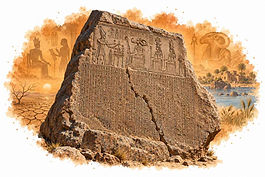
Famine Stela
The Famine Stela is the inscription on Sehel Island that gives an ancient king's voice to a much later story. Carved in the Ptolemaic Period but set in the reign of Djoser, builder of the Step Pyramid, it describes seven years of inadequate Nile floods and a country in distress. It brings the wisdom associated with Imhotep into a search for the river's divine source, then presents a dream in which Khnum promises abundance. Its ending is also a royal charter, assigning resources and privileges to the god's temple at Elephantine. The stone is a historical monument, but the events it narrates are not thereby proven historical. It is a remarkable example of how Egyptian religious writing could use the authority of the distant past to explain, justify and protect the institutions of a later age.

Feather of Maat
The Feather of Maat is the single most famous object in Egyptian afterlife belief, the ostrich plume that every Egyptian hoped would outweigh their heart when they stood before Osiris in the Hall of Two Truths, the place of judgment in the Duat, the underworld through which the sun travelled each night. It is the feather that represents the goddess Maat herself, the daughter of Ra who is truth and justice and the cosmic order that keeps the sun rising and the Nile flooding and the stars turning in their courses. It is the plume that the jackal-headed god Anubis placed on one pan of the scales while the heart of the deceased, still in its body after mummification, stood on the other, the moment that determined whether a soul would live forever in the Field of Reeds or be devoured by Ammit, the monster with the head of a crocodile, the front of a lion, and the hindquarters of a hippopotamus, the three most dangerous animals in Egypt combined into one devourer. It is the feather that the ibis-headed god Thoth, the divine scribe, recorded in his judgment book when the scales balanced, declaring the deceased "True of Voice," the Egyptian phrase for "not guilty." It is the feather that pharaohs offered in small statues to the gods to prove they upheld ma'at on earth, that judges wore as emblems on their clothing, and that priests drew on their tongues before passing sentence in the law courts. And it is the feather that has become the universal symbol of truth in Egyptian art, the white plume that outlasted every temple and every papyrus, the simple ostrich feather that weighed more than every sin in the world.

Field of Reeds
The Field of Reeds is the Egyptian heaven, the paradise where the justified dead lived forever in a perfect Egypt of green fields, full canals, and wheat that grew seven cubits tall, twice the height of a man. It is the destination of every soul that passed the Weighing of the Heart, the judgment where the heart was balanced against the feather of truth, ruled over by Osiris, the green-skinned king of the dead. It is the mirror of the Nile valley at its best, where the blessed ploughed and sowed and reaped, feasted, sailed, and played senet, the board game of the afterlife, in a land that never knew drought or debt. It is the heaven with servants, for every Egyptian took small statues called shabtis into the grave to answer for them when labour was called, so that eternity could be spent in leisure. It is the paradise that had to be earned twice, once by a blameless heart and once by the passwords and spells that opened its demon-guarded gates. And it is the oldest fully pictured heaven in human religion, the green original from which every later paradise, Elysian or otherwise, borrowed its colour.

Geb
Geb is the earth itself, the solid ground of Egypt made into a god, the brown and green body on which everything that lives was built. He is the husband of the sky, the brother of Nut, torn away from her by their own father and left lying forever beneath her, still reaching upward after three thousand years. He is the laughing god, for the Egyptians heard the earthquakes as Geb's laughter rumbling through the land, and he is the Great Cackler, the primeval goose whose honk first broke the silence of creation and whose egg hatched the sun. He is the father of the five greatest gods of Egypt, Osiris, Isis, Set, Nephthys, and Horus the Elder, and the first true king to rule the land, who judged the terrible quarrel between his son Set and his grandson Horus and divided Egypt between them. And he is the god whose throne every pharaoh inherited, for the kings of Egypt did not call their seat the throne of any other god: for three thousand years they sat, by their own proud formula, upon the throne of Geb.

Giza
Giza is the plateau where three Fourth Dynasty kings transformed the desert edge into one of the world's most enduring royal landscapes. It is the home of Khufu's Great Pyramid, the pyramids of Khafre and Menkaure, and the Great Sphinx, whose human head and lion's body became an image of royal power. It is a place of temples, causeways, cemeteries and workers' settlements, where the effort needed to sustain a dead king also leaves evidence of the lives of the people who served him. It is the setting of Thutmose IV's dream of a sand-buried god, and of stories told by travellers who arrived long after the builders had disappeared. The surviving wonder is the Great Pyramid; Giza is the larger landscape that gives that monument its setting and much of its meaning.