Egyptian
Set
Name in Non-English, or Alternative Name/s
stš (Egyptian), Σήθ (Greek), Sutekh, Setesh
Also known as, and/or Titles and Roles
Seth, Suty, the Red Lord, Lord of the Desert, Master of Storms, Great of Strength, the Bull of Nubt, He Before Whom the Sky Shakes, Typhon

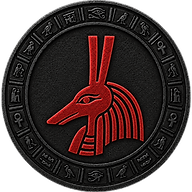
Mythopouch artistic interpretation
Details
Region
Egyptian
Regional Information Additional (if applicable)
Ancient Egypt
Category
Deity
Historicity (actuality or factual truth of persons, events, and claims)
Mythological
Gender
Male
Time Period
c. 4000 BCE (predynastic graves at Naqada) - Roman period
Symbol
Set's Head
Tags
egyptian, set, osiris, horus, chaos, desert, apophis, storm-god
Introduction - Overview
Set is the Egyptian god of chaos who murdered his own brother, the storm-lord who cut the good king Osiris into fourteen pieces and scattered him across the land. He is the rival who fought his nephew Horus for the throne of Egypt in a lawsuit and a war that dragged on for eighty years, tearing out the falcon god's eyes and losing his own testicles in the struggle. He is the strongest of the gods, the only one mighty enough to stand at the prow of the sun god's night barque and spear Apophis, the great serpent that tries to swallow creation before every dawn. He is the master of the red desert, of thunder and foreigners, and his sacred creature is a square-eared, fork-tailed beast that no one has ever identified. He is the patron of invading shepherd kings and of warrior pharaohs like Seti I, whose name means Man of Set. And he is the god that Egypt finally turned against, his statues smashed and his name chiselled from stone, until the Greeks knew him only as Typhon, the father of monsters.
Gallery

Other depictions of Set as a donkey.
Main Article - Who or What was...
Set
Set was born on the third of the five epagomenal days, the days won in a dice game with the moon so that Nut, the sky goddess whose arched body spans the heavens, could bear her children despite a curse from Ra, the ageing sun god who had forbidden her to give birth on any day of the year. His father was Geb, the green earth god, and his siblings were Osiris, the future king of Egypt; Isis, the future mistress of magic; and Nephthys, his twin and his wife. Unlike his brothers and sisters, Set would not wait to be born. He tore his way violently from his mother's side, the first act of disruption in a life made of them. The Egyptians gave him the red desert, the scorched wasteland that lay beyond the black soil of the Nile valley, and they called him Great of Strength, the mightiest of the gods. His sacred creature was the sha, the Set animal, a long-snouted, square-eared, fork-tailed beast that has never been matched to any living species, part greyhound, part jackal, part antelope, and wholly other. His bones were said to be made of iron, and the iron that fell from the sky in meteorites was called the metal of heaven and the bones of Set.
Set's defining crime was the murder of Osiris, his brother, who ruled Egypt as a wise and beloved king with Isis at his side. Burning with envy, Set gathered seventy-two conspirators and built a chest of cedar and electrum, measured in secret to fit Osiris alone. At a banquet he offered the glittering coffin as a gift to whichever guest it fitted best. One by one the gods lay down inside, but the chest had been made for the king. When Osiris reclined within it, Set slammed the lid, sealed the seams with molten lead, and hurled the coffin into the Nile. The river carried the living king out to the Great Green Sea, where he drowned, and Isis wandered the world in mourning to recover his body. She found him at Byblos, the Phoenician port where a tamarisk tree had grown around the chest, and she brought him home to Egypt. But Set, hunting by moonlight, discovered the body, and in a rage he hacked Osiris into fourteen pieces and scattered them across the provinces so that no single tomb could hold him whole. This was the first murder the world had known, and it shattered the age of harmony.
The struggle that followed lasted eighty years. Horus, the falcon-headed son whom Isis had conceived from her murdered husband and raised in hiding in the marshes of the Delta, claimed his father's throne, but Set refused to yield, arguing that the kingdom needed his strength, for he alone could spear the chaos serpent. The case went before the Ennead, the council of nine gods, and in one early telling the earth god Geb simply split the kingdom in two, giving the south to Set and the north to Horus, before regret moved him to grant the whole land to Horus. The two fought on with words, with tricks, and with terrible violence. They raced boats of stone down the Nile, and Horus won by building his vessel of pine and plastering it to look like stone, while Set's true stone boat sank like a millstone. Set transformed himself into a great red hippopotamus and dragged Horus down into the deep water. In the wrestling that followed, Set tore out both of Horus's eyes, which were buried and grew back as lotus flowers, and Horus ripped away Set's testicles, leaving the storm god barren as his desert. Set even tried to prove his mastery by lying with Horus, but Horus caught his uncle's seed in his hand, Isis flung it into the river, and she smeared her son's seed on the lettuce that Set ate each morning. When the gods called the seed of each to testify, the seed of Horus answered from within Set's own body, and a golden disk rose from between Set's brows. At last Isis herself tricked him, appearing as a weeping widow whose son had been robbed of his inheritance by a stranger, and Set, asked to judge the case, declared that a son should inherit his father's goods. By his own words he condemned himself. The tribunal gave the throne to Horus, and Ra, who had always favoured Set, took the storm-lord into his own company as a son, granting him a place in heaven and making his voice the thunder that rolls above the clouds.
Yet Set was never a simple villain, and the Egyptians never forgot his greatest service. Every night the sun god Ra sailed his barque through the Duat, the shadowy underworld, and every night Apophis, the colossal serpent of chaos, rose from the darkness to swallow the boat and extinguish the sun. None of the other gods dared face the monster. Set alone took his stand at the prow, harpoon in hand, and drove his spear into the serpent's coils, forcing it to vomit up the waters it had swallowed so the barque could pass and the dawn could come. Priests in the temples cut up wax models of Apophis, spat on them, and burned them, re-enacting Set's victory so the sun would keep rising. The god of chaos was the only weapon strong enough to hold chaos at bay, and this was why even his enemies called him Great of Strength.
In the earliest history of Egypt, Set was no outcast but a kingmaker. He was the god of Upper Egypt, the southern land, while Horus ruled the north, and when the two halves of the country were united around 3100 BCE, the artists of the kings carved Set and Horus side by side, twin gods binding the plants of the two lands around the symbol of union. His cult city was Nubt, the gold town that the Greeks called Ombos, near Naqada in Upper Egypt, and his square-eared standard has been found in graves laid down around 4000 BCE. In the Second Dynasty a pharaoh named Peribsen set the Set animal above his name in place of the falcon of Horus, a sign of some forgotten civil war, until King Khasekhemwy ended it by taking a name that meant The Two Powers Have Arisen, bearing both gods as his patrons. Centuries later the Hyksos, shepherd kings from Canaan who seized the Delta around 1650 BCE, adopted Set as their chief god at their capital Avaris, identifying him with Baal, their own storm god, and wedding him to the Canaanite war goddesses Anat and Astarte. When native kings drove the Hyksos out, the warrior pharaohs of the Nineteenth Dynasty still honoured him. Seti I, whose name means Man of Set, and Ramesses II, who called himself a son of Set, raised temples to him at Pi-Ramesses, and kings named Setnakhte and Seti II carried his name into battle. But the memory of foreign rule poisoned him at last. From around 700 BCE the Egyptians turned upon their old god. His statues were smashed, his face was chiselled from the monuments, donkeys were hurled from cliffs as his beast, and men with red hair were hunted as his kin. When the Greeks came, they named him Typhon, the monstrous giant who had fought Zeus, and the god who had once saved the sun became the image of evil itself.
Even so, Set never vanished entirely. In the far oases of the western desert his temples still received offerings when the Nile valley had already cursed his name, and at Edfu the temple walls still show the feast of victory in which Horus harpoons the red hippopotamus before the assembled gods, a pageant of Set's defeat carved in the very stone. In the modern world he has been raised again, invoked by occult movements, cast as the dark god of films and games, and studied as the mirror every civilisation holds up to its own violence. He remains the desert wind and the red sky before the storm, the reminder that strength without justice becomes destruction, and that destruction itself has its place in the turning of the world.
Summary
Set endures as the necessary destroyer, the strongest of the gods, who used his strength first to shatter the divine family and then to defend the sun itself. From the cedar chest on the Nile to the prow of the night barque, from the gold town of Nubt to the smashed statues of the Late Period, his arc is the strangest in Egyptian belief, kingmaker, kinslayer, champion, and demon across three thousand years. The Egyptians long whispered that every quarrel between brothers echoed his crime, and every red sunset was his hand. In the human imagination, Set remains the red god of the wasteland, the proof that chaos cannot be destroyed, only harnessed.
Now enter the Mythopouch World!
You’ve discovered:
Set
From Myth to Game
Join to access FREE real-world mythology "Learn Quests" and "Courses". Sign up to the newsletter for new releases, game updates, insider news, and more as Mythopouch brings real mythology to life. EARN the right to purchase an offline board game by completing FREE modules.


It's FREE to join as a MEMBER!
Not ready to join? Get the newsletter instead below


Looking for others?
Click into the field below to search, or click the icon to go to full page search function!

Looking for Mythology Insights?


Click below to view our mythology blog article insights, where we delve into the current Mythopouch Tier regions, and what we think you should know!
Sources & Retellings
Explore the original mythological Source texts (most from over 75 years ago, some as translated, possibly with mature content) and Mythopouch's source Retellings (a modern retelling also suitable for 15+) connected to this mythological entity. We are growing this resource and will link these in the future; for now, check the References below, then find the Sources or Retellings on those pages!


References
Validation References:
- Pyramid Texts (5th-6th Dynasties, c. 2345 BCE) - earliest attestations of Set among the gods and his role in the royal afterlife
- The Contendings of Horus and Set, Papyrus Chester Beatty I (20th Dynasty, c. 1186-1077 BCE) - the eighty-year lawsuit, the boat race, and the trials of strength
- Shabaka Stone (25th Dynasty, c. 710 BCE) - Geb's division of Egypt between Horus and Set
- Plutarch, De Iside et Osiride (c. 100 CE) - the birth of Set, the murder of Osiris, and the battles with Horus
- Herodotus, The Histories, Book II (c. 440 BCE) - Set as Typhon and the hippopotamus rites at Papremis
- Herman te Velde, Seth, God of Confusion: A Study of His Role in Egyptian Mythology and Religion (Brill, 1967) - the definitive study of Set's character, cult, and demonisation
- J. Gwyn Griffiths, The Conflict of Horus and Seth from Egyptian and Classical Sources (Liverpool UP, 1960) - the contendings in Egyptian and classical texts
- Richard H. Wilkinson, The Complete Gods and Goddesses of Ancient Egypt (Thames & Hudson, 2003) - iconography, the Set animal, and cult centres
Cultural Context Notice
Mythology developed across different cultures, periods and traditions, and there is rarely one universally accepted version of a story. Mythopouch approaches these traditions with respect while remaining faithful to the complexity of the surviving material. Retellings and educational content may interpret or adapt historical sources, but are not presented as definitive accounts of any culture, religion or belief system.