
Details
Region
Egyptian
Regional Information Additional (if applicable)
Category
Creature/Monster/Animal
Historicity (actuality or factual truth of persons, events, and claims)
Mythological
Gender
N/A
Time Period
Predynastic through Late Period (c. 4000-332 BCE)
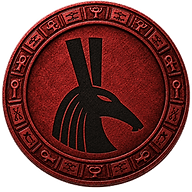
Symbol
Set Head
Tags
egyptian, monster, set-animal, totem, cryptid
Introduction - Overview
The sha - universally known as the Set Animal or Typhonian Beast - is the mysterious caniform creature that served as the totem and hieroglyphic emblem of the god Set. Unlike every other major deity in the Egyptian pantheon, whose sacred animals were readily identifiable real species (Horus the falcon, Thoth the ibis, Sobek the crocodile), Set was associated with a creature that does not match any known animal, living or extinct. This anomaly has made the sha one of the most debated puzzles in Egyptology.
The sha is depicted with a distinctive anatomy: a downward-curving snout, large square-tipped ears, an upright or bristling tail that terminates in a fork, and a lean, greyhound-like body with long legs. Its forked tail bears a resemblance to the was-sceptre, a symbol of power and authority. In the earliest Predynastic representations from the Naqada culture, the sha appears alongside standards and on pottery, suggesting it was a totemic emblem even before Set's full theological elaboration.
Gallery
Main Article - Who or What was...
Sha
Numerous zoological identifications have been proposed for the sha, each with significant drawbacks. The saluki or greyhound theory - suggested by Egyptologist Ken Moss - notes similarities in body shape and curved snout, but fails to explain the square ears and forked tail, and dogs were not typically associated with desert chaos. The aardvark proposal (recently reargued by Pierre de Maret, 2024) fits the elongated digging snout and nocturnal desert habits, but the aardvark's ears are not square and its tail is not forked. The fennec fox theory accounts for the large ears and desert habitat, but the fennec's ears are rounded, not square-tipped, and its tail is bushy, not forked. The oryx, wild dog, jackal, hyena, donkey, and even extinct species have all been suggested, none satisfactorily.
The most likely explanation is that the sha was either a purely mythical composite creature or a deliberately stylised emblem whose incongruities were meaningful rather than accidental. The sha may have been designed to embody Set's nature as a god of disorder and otherness - a creature that deliberately defies natural taxonomy just as Set himself defies cosmic order. This interpretation is supported by the creature's consistency across three millennia of Egyptian art: if it were a real animal, one might expect more naturalistic variation; instead, the sha maintains its impossible anatomy with remarkable fidelity.
Under Greco-Roman influence, Set was syncretised with the Greek monster Typhon, and the sha became known as the Typhonian Beast. By the Ptolemaic period and into Roman Egypt, systematic damnatio memoriae campaigns led to the defacement of Set's images, including the sha. The rise of the Osiris cult progressively demonised Set, and his animal emblem suffered corresponding suppression - one reason the sha virtually disappears from official art after the first millennium BCE.
Summary
The sha or Set Animal is a unique anomaly in Egyptian sacred iconography - a caniform creature with a curved snout, square ears, and forked tail that matches no known animal. Whether extinct species, composite invention, or purely mythical emblem, the sha served for three millennia as the distinctive visual signature of Set, god of chaos, storms, and the desert, and remains one of Egyptology's enduring zoological mysteries.
Now enter the Mythopouch World!
You’ve discovered:
Sha
From Myth to Game
Join to access FREE real-world mythology "Learn Quests" and "Courses". Sign up to the newsletter for new releases, game updates, insider news, and more as Mythopouch brings real mythology to life. EARN the right to purchase an offline board game by completing FREE modules.


It's FREE to join as a MEMBER!
Not ready to join? Get the newsletter instead below


Looking for others?
Click into the field below to search, or click the icon to go to full page search function!

Looking for Mythology Insights?


Click below to view our mythology blog article insights, where we delve into the current Mythopouch Tier regions, and what we think you should know!
Sources & Retellings
Explore the original mythological Source texts (most from over 75 years ago, some as translated, possibly with mature content) and Mythopouch's source Retellings (a modern retelling also suitable for 15+) connected to this mythological entity. We are growing this resource and will link these in the future; for now, check the References below, then find the Sources or Retellings on those pages!


References
Validation References: - Wikipedia: "Set animal" (https://en.wikipedia.org/wiki/Set_animal) - Grokipedia: "Set animal" (https://grokipedia.com/page/Set_animal) - Historic Mysteries: "The Mysterious 'Set': An Ancient Egyptian Cryptid?" (https://www.historicmysteries.com/unexplained-mysteries/egyptian-set-animal/22150/) - Warriors of Myth Wiki: "Set Animal" (https://warriorsofmyth.fandom.com/wiki/Set_Animal) - Tumblr/rudjedet: "What was the Typhonian Beast?" (https://www.tumblr.com/rudjedet/650735304706293760/) - Pierre de Maret (2024) study on aardvark identification
Cultural Context Notice
Mythology developed across different cultures, periods and traditions, and there is rarely one universally accepted version of a story. Mythopouch approaches these traditions with respect while remaining faithful to the complexity of the surviving material. Retellings and educational content may interpret or adapt historical sources, but are not presented as definitive accounts of any culture, religion or belief system.