Details
Region
Egyptian
Regional Information Additional (if applicable)

Ancient Egypt; Nubian frontier; Aswan and the First Cataract
Category
Location
Historicity (actuality or factual truth of persons, events, and claims)
Historical
Gender
N/A
Time Period
Late fourth millennium BCE onward; long-lived ancient settlement and later habitation
Symbol
Nilometer steps
Tags
egyptian, elephantine, abu, aswan, first-cataract, khnum, satis, anuket, nilometer
Introduction - Overview
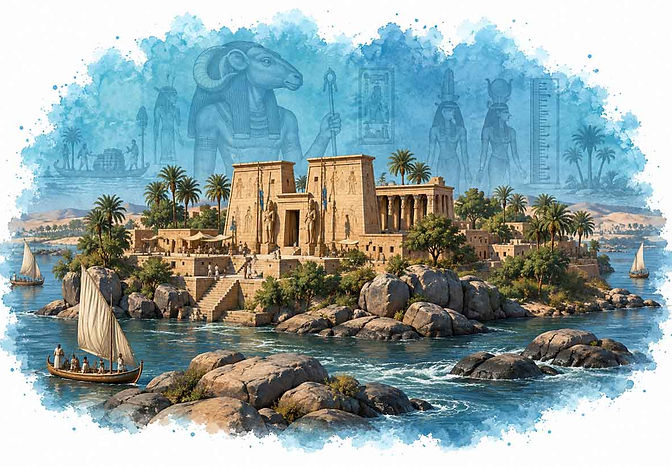
Elephantine is the island of Egypt's southern threshold, a settlement near the First Cataract where river travel, frontier administration and sacred tradition met. Known to the ancient Egyptians as Abu, it stood opposite the place now called Aswan and linked the Nile valley with routes into Nubia. It is the home of the divine group formed by Khnum, Satis and Anuket, whose worship connected creation and protection with the life-giving waters of the Nile. It is the island where nilometers turned the height of the river into measurable information, and where surviving letters and contracts reveal the lives of people from different cultural and religious communities. Its history is not the story of one temple or one population, but of a place repeatedly reshaped by the people who crossed, defended and inhabited the frontier.
Gallery
Main Article - Who or What was...
Elephantine
Elephantine's position made it important long before the great empires of the Mediterranean. Near the First Cataract, granite outcrops and difficult stretches of river affected movement between Egypt and Nubia. The island developed as a fortified settlement and an administrative centre, helping rulers organise journeys, collect goods and maintain a presence at the southern approach to the country. Its early occupation reaches back into the late fourth millennium BCE. The Egyptian name Abu is associated with elephants or ivory, although explanations connecting the name with particular rock shapes or trading practices should not be treated as a securely recorded founding story.
Trade gave the frontier a daily rhythm. Valuable materials and animals moved north from the south, while Egyptian products travelled in the other direction. Officials, boat crews, merchants and soldiers needed places to live, store supplies and carry out transactions. Elephantine was therefore more than a symbolic border. Houses, streets and administrative records show a working town whose inhabitants dealt with the practical demands of transport, taxation, property and family life. The mainland settlement at Aswan belonged to this same regional network rather than to an entirely separate world.
The island's religious importance was closely tied to the river. Khnum, the ram-headed creator, was believed to fashion living beings and to govern the release of the Nile's waters. In local theology the flood could be imagined as emerging from hidden caverns in the cataract region. This was a sacred explanation of the river's renewal, not a geographical discovery of the Nile's actual headwaters. Khnum's temple and the surrounding settlement connected divine creation with the water upon which fields, food supplies and human life depended.
Satis, also called Satet, belonged to this landscape of protection and inundation. Her sanctuary preserves a remarkable sequence of rebuilding, with its early sacred setting associated with natural granite boulders. Later temples replaced and enlarged earlier structures, making the site especially valuable for studying changes in Egyptian religious architecture. That long sequence is impressive without the claim that every dynasty rebuilt it or that no other Egyptian temple had a comparable history. The survival of successive foundations allows archaeologists to follow continuity and change within one sacred place.
Anuket completed the familiar divine group of the cataract region. Often represented as the daughter of Khnum and Satis, she was associated with the surrounding waters and with a distinctive feathered headdress. The relationships and roles of Egyptian gods could vary, and the triad should not be treated as an unchanging family arrangement from the beginning of Egyptian history. Worship also extended to nearby places such as Sehel, where inscriptions connect travellers and officials with the deities of the First Cataract. The sacred landscape crossed the water between islands.
The nilometers express another connection between the river and organised society. These installations allowed water levels to be observed against a graduated scale, including through passages or stairways descending towards the Nile. Readings helped people assess the progress of the inundation and the prospects for cultivation. Too little water threatened the harvest, while excessive flooding could also cause damage. The measurements belonged to a wider system of agricultural knowledge and administration; one staircase on Elephantine did not mechanically determine every tax assessment throughout Egypt.
The Aramaic documents from Elephantine open a particularly vivid window onto the period of Persian rule. They describe a Jewish military community whose temple was dedicated to Yaho. A petition states that this sanctuary already existed before Cambyses conquered Egypt in 525 BCE, so its foundation should not simply be assigned to the Persian conquest. Letters also describe its destruction around 410 BCE and the community's efforts to secure permission to rebuild. Other documents concern marriages, property, payments and disputes. Together they reveal a community with its own institutions living within a larger imperial and Egyptian setting.
These texts are important evidence for Jewish life outside Judaea, but they are not the sole or earliest proof of every form of Jewish religious activity beyond that homeland. They also do not describe a permanently harmonious island. Coexistence included cooperation, legal negotiation and serious conflict. Reading the letters alongside Egyptian records gives a more human picture than a simple list of religions living together: families formed relationships, officials made decisions, and communities argued over rights and sacred space.
Elephantine's later history includes changes in settlement, religious practice and the reuse of buildings. Decline in one ancient quarter should not be confused with the permanent disappearance of life from the whole island. Modern archaeological work, including the German-Swiss investigations begun in 1969, has examined both monumental and domestic remains. Separately, an international project brought together more than 10,000 papyri and ostraca from collections around the world in a digital research resource. That body of writing was not all discovered by one modern excavation team. It is the scattered documentary inheritance of many centuries, reunited through scholarship.
Summary
Elephantine endures as a meeting place of frontier power, river knowledge and religious life. Khnum, Satis and Anuket gave divine meaning to the cataract landscape, while nilometers, contracts and letters reveal the everyday work of living beside the Nile. A detail worth remembering: the Jewish community's own petition says its temple existed before the Persian conquest of Egypt in 525 BCE. In the human imagination, Elephantine remains the island where a border became a place of exchange, and where the voices of ordinary people survive alongside the monuments of the gods.
Now enter the Mythopouch World!
You’ve discovered:
Elephantine
From Myth to Game
Join to access FREE real-world mythology "Learn Quests" and "Courses". Sign up to the newsletter for new releases, game updates, insider news, and more as Mythopouch brings real mythology to life. EARN the right to purchase an offline board game by completing FREE modules.


It's FREE to join as a MEMBER!
Not ready to join? Get the newsletter instead below


Looking for others?
Click into the field below to search, or click the icon to go to full page search function!

Looking for Mythology Insights?


Click below to view our mythology blog article insights, where we delve into the current Mythopouch Tier regions, and what we think you should know!
Sources & Retellings
Explore the original mythological Source texts (most from over 75 years ago, some as translated, possibly with mature content) and Mythopouch's source Retellings (a modern retelling also suitable for 15+) connected to this mythological entity. We are growing this resource and will link these in the future; for now, check the References below, then find the Sources or Retellings on those pages!


References
Validation References:
- Staatliche Museen zu Berlin: Elephantine, Island of the Millennia (2024 exhibition and research account)
- https://www.smb.museum/en/exhibitions/detail/elephantine/
- Edda Bresciani, Elephantine, Encyclopaedia Iranica
- https://www.iranicaonline.org/articles/elephantine/
- Swiss Institute for Egyptian Architectural and Archaeological Research: research projects
- https://swissinst.ch/html/elephantine.html
- Bezalel Porten, Archives from Elephantine: The Life of an Ancient Jewish Military Colony (University of California Press, 1968).
- German Archaeological Institute and Swiss Institute: excavation reports on Elephantine.
Cultural Context Notice
Mythology developed across different cultures, periods and traditions, and there is rarely one universally accepted version of a story. Mythopouch approaches these traditions with respect while remaining faithful to the complexity of the surviving material. Retellings and educational content may interpret or adapt historical sources, but are not presented as definitive accounts of any culture, religion or belief system.